
1. Understanding Google Ads Keyword Match Types
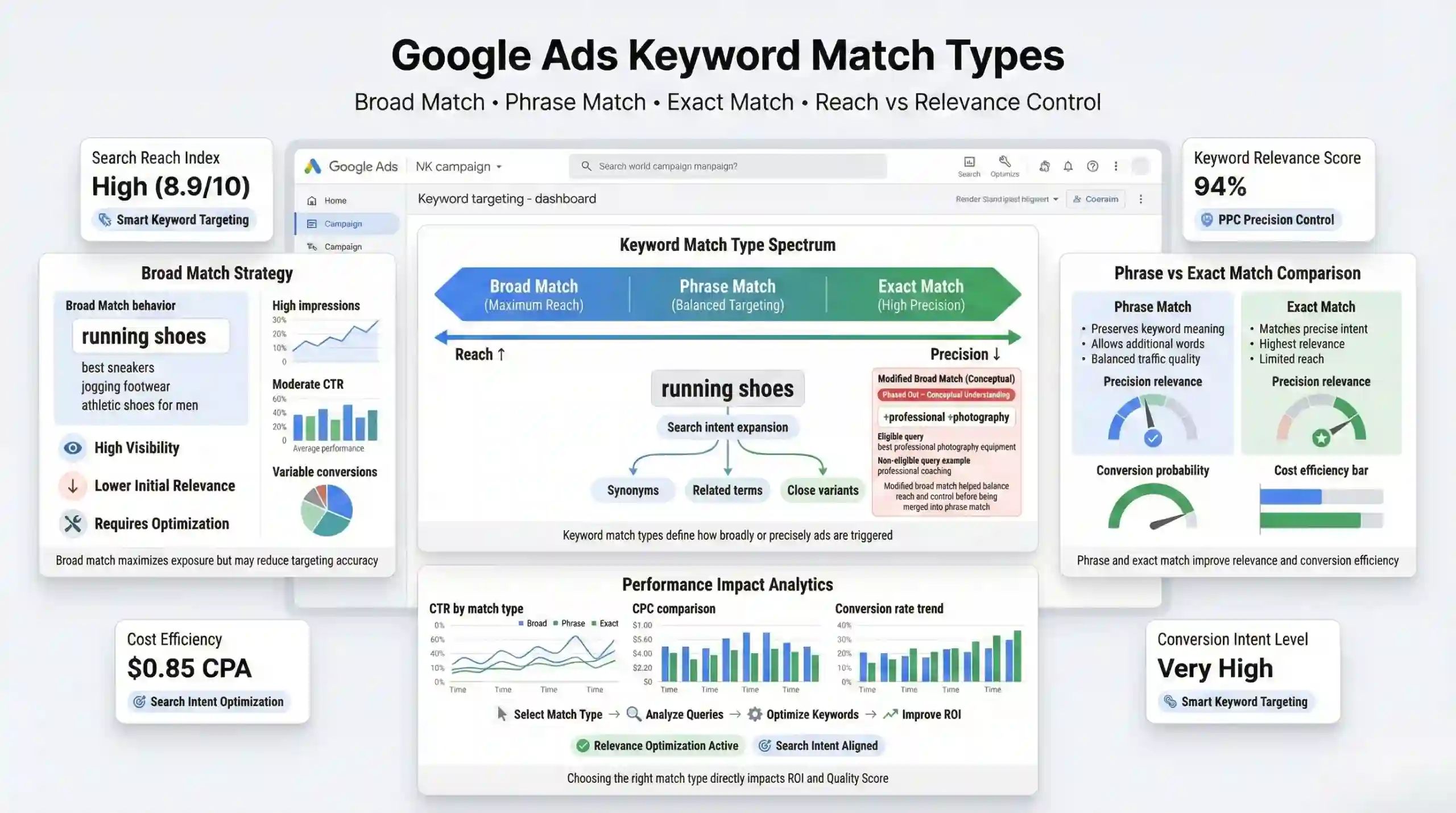
Effective Google Ads campaigns rely heavily on selecting appropriate keyword match types. These define the search queries for which your ads are eligible to appear, directly influencing ad reach, relevancy, and overall campaign performance. The primary match types include Broad Match, Modified Broad Match (BMM), Phrase Match, and Exact Match.
Broad Match Keyword Strategy
Broad Match is the default match type in Google Ads, allowing your ads to show for searches containing variations of your keywords, including synonyms, related searches, and other relevant variations. This maximizes visibility but may lead to less targeted impressions.
Example:
Keyword: *running shoes* (Broad Match)
Searches where ads may appear: *best sneakers*, *jogging footwear*, *athletic shoes for men*.
Outcome: While broad match increases reach, it may reduce click relevance, requiring subsequent optimization to maintain ROI.
Modified Broad Match (BMM) in Google Ads
Modified Broad Match (using plus signs, e.g., +keyword) was designed to restrict broad match by requiring specific words to be present in the search query. It offered a more controlled version of broad match, ensuring critical terms are included in user searches. However, BMM is being phased out, and Google recommends using phrase match and broad match modifiers (which have also been merged into the phrase match type in recent updates).
Example:
Keyword: +professional +photography
Search query: *best professional photography equipment* — Ad eligible.
Search query: *professional coaching* — Not eligible if “coaching” isn't included.
Note: Though BMM is phased out, understanding its concept helps in grasping how to balance reach and precision in keyword targeting.
Google Ads Phrase Match Keyword Targeting
Phrase Match allows your ads to appear for searches that contain your exact keyword phrase or close variations, including reordered variations, with additional words before or after the phrase.
Example:
Keyword: "digital marketing courses"
Searches: *best digital marketing courses online*, *digital marketing courses for beginners.*
Searches not matched: *online marketing strategies*.
Outcome: Provides a balance between broad reach and specificity, enhancing relevant traffic.
Google Ads Exact Match Keyword Targeting
Exact Match restricts your advertisements to show only for search queries that precisely match your keyword or minor close variants (plural, misspellings). This match type optimizes ad spend for highly targeted searches, leading to higher Click-Through Rate (CTR) and conversions.
Example:
Keyword: [graphic design tutorials]
Search query: *graphic design tutorials* — matched.
Search query: *best graphic tutorials* — not matched unless considered close variant.
Outcome: Increases relevance and ROI but limits reach, suitable for campaigns with specific goals.
2. Conducting Initial Keyword Research Using Google Keyword Planner
Google’s Keyword Planner for Search Volume Analysis
Google Keyword Planner is fundamental in initial keyword research. It helps identify search terms with high search volume, indicating popular search queries within your niche. Accessing insights on competition level, average CPC, and search trends enables strategic decisions about which keywords to incorporate.
Finding High-ROI Keywords for Student Campaigns
For educational or student-focused campaigns, select keywords aligning with student interests or educational topics—such as “scholarship tips,” “best online courses,” or “study guides.” Prioritize keywords with reasonable competition and high relevance, contributing to higher ad relevance and quality scores.
3. Utilizing Keyword Match Types for Campaign Targeting
Mapping Keywords to Match Types Based on Campaign Goals
Strategic alignment determines match type selection:
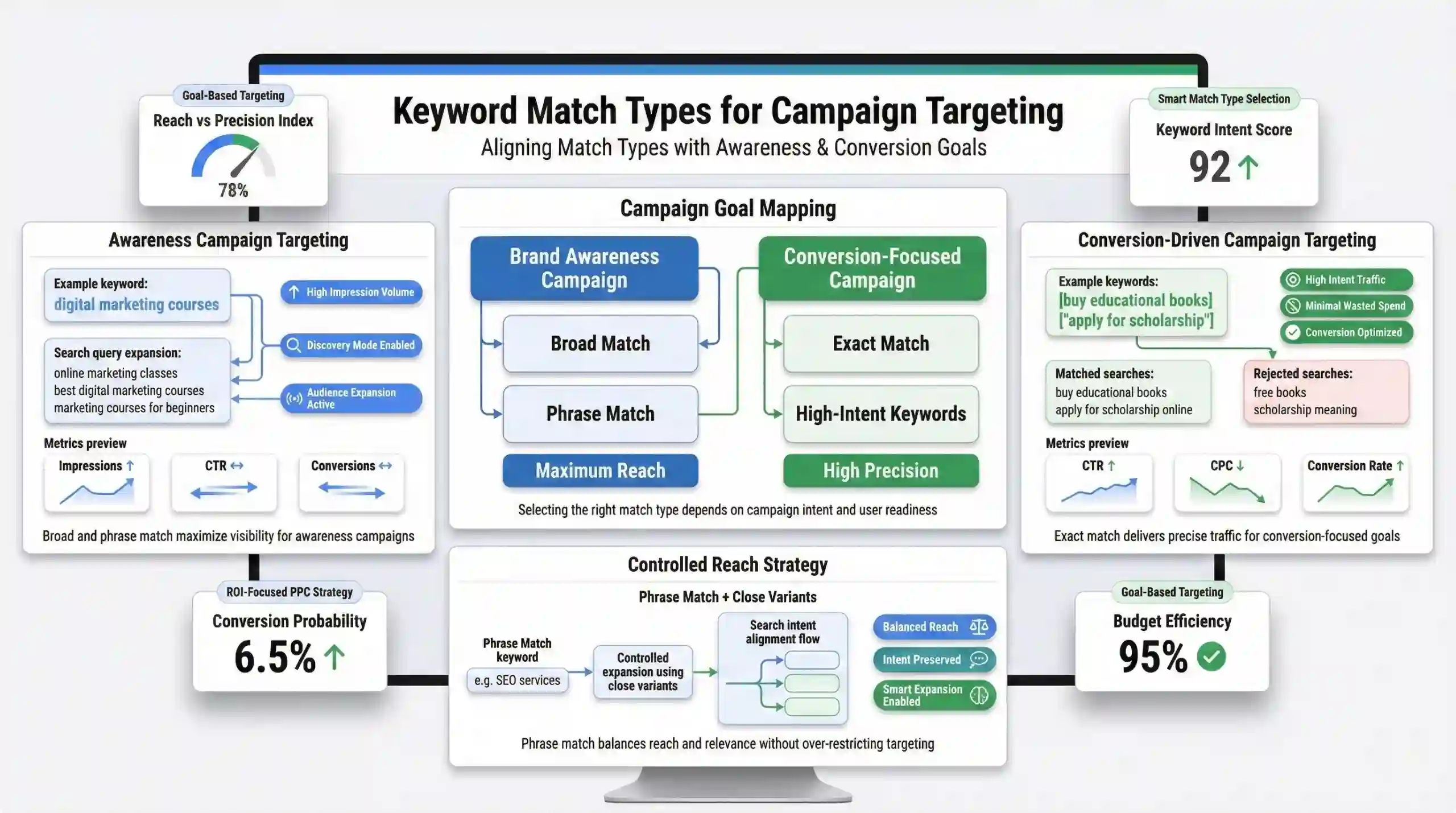
- Brand Awareness Campaigns: Prefer Broad Match or Phrase Match to maximize exposure.
- Conversion-Driven Campaigns: Use Exact Match for highly relevant traffic, minimizing wasted spend.
Example:
- Awareness Campaign: Use broad or phrase match for general exposure.
- Conversion Campaign: Use exact match to target specific search queries like +“Apply for scholarship” or [Buy educational books].
Using Phrase Match along with Modified Broad Match (or newer close variants) enables controlled reach, ensuring your ads target relevant queries without overly restrictive parameters.
4. Analyzing Search Intent and Keyword Relevance
Types of Search Intent
Understanding search intent helps craft appropriate ad copy and landing pages:
- Transactional: Searchers seek to complete actions (e.g., register for online course). Require direct, action-oriented keywords.
- Navigational: Searchers look for specific brands or websites (e.g., Google Scholar login). Use brand-specific keywords.
- Informational: Searchers gather knowledge (e.g., how to prepare for exams). Target with educational content.
Aligning search intent with your Google Ads keyword match types enhances campaign Quality Score, increases CTR, and reduces CPC by ensuring ads resonate with user needs.
5. Refining Keyword List with Negative Keywords and Search Query Reports
Using Search Query Reports
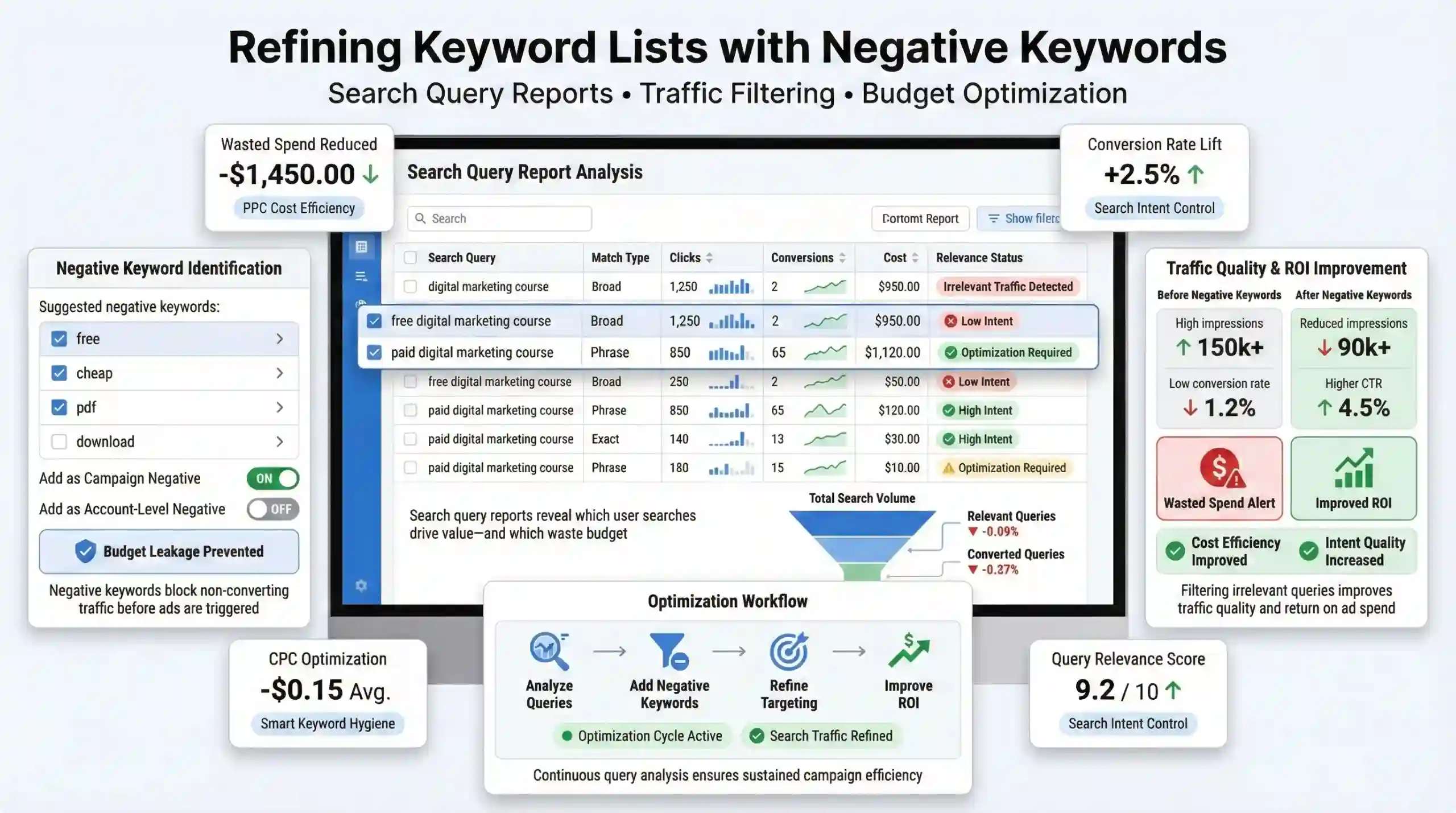
Perform regular analyses of Search Term Reports to identify irrelevant or low-converting queries. These insights inform adding Negative Keywords to exclude unwanted traffic.
Excluding Irrelevant Traffic
Implement negative keywords proactively to prevent showing ads for queries outside your target market, thereby optimizing your ad budget and ROI.
Example:
Adding “free” as a negative keyword if you only offer paid courses to avoid wasting impressions on freebie seekers.
6. Testing and Optimization of Google Ads Keyword Match Types
Monitoring Key Performance Metrics
Track metrics such as Conversion Rate, CPC, Impression Share, and Quality Score. These reveal how well your keywords and match types perform in attracting relevant traffic.
Adjusting Match Types Based on Performance Data
Based on collected data, refine keyword strategies:
- Shift underperforming Broad Match keywords to Phrase or Exact.
- Expand successful keywords into long-tail variations.
- Use negative keywords to filter undesirable searches.
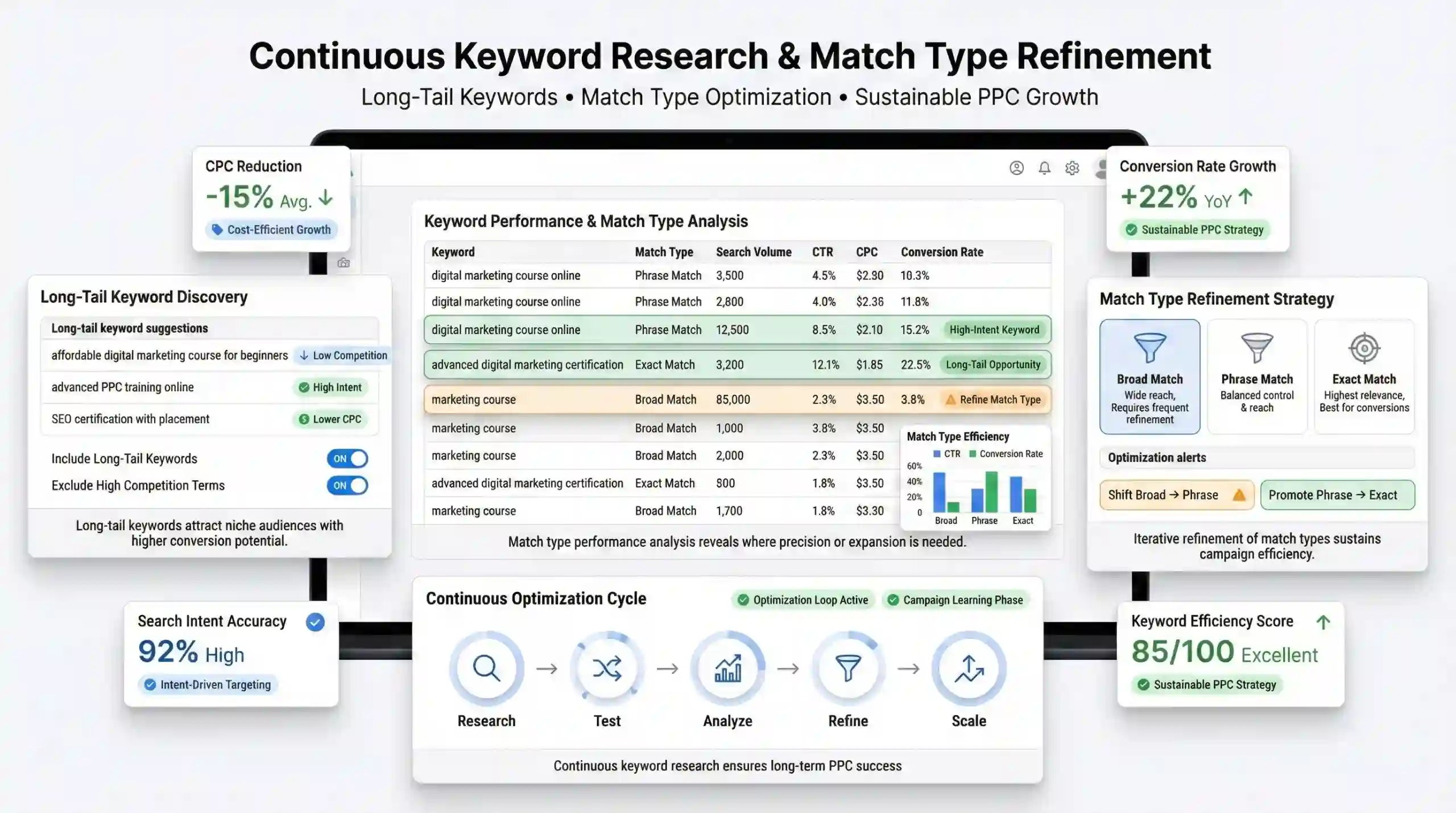
7. Continuous Keyword Research and Match Type Refinement
Identifying Long-Tail Keywords
Regularly explore long-tail keywords—more specific, less competitive phrases—to capture niche audiences and improve ad rank and lowering CPC.
Iterative Match Type Optimization
Maintain a cycle of testing, analyzing, and refining your Google Ads keyword match strategies to sustain campaign optimization and improve ad performance over time.
Summary
Mastering Google Ads keyword match types—including Broad Match, Phrase Match, and Exact Match—combined with strategic keyword research, negative keyword implementation, and ongoing performance analysis—enables students to construct highly effective ad campaigns. These strategies optimize ad relevance, reach, and return on investment (ROI), providing a robust roadmap for digital advertising success.
Practice Questions
- Explain the main differences between Broad Match and Exact Match keywords in Google Ads.
- How does Phrase Match differ in targeting compared to Broad Match and Exact Match? Provide examples.
- Why is it important to use Negative Keywords in Google Ads campaigns? Illustrate with an example.
- Describe a scenario where using Broad Match might be disadvantageous.
- If a campaign is not performing well, what steps would you take regarding match types and keyword optimization?
- What are the potential risks of relying solely on Broad Match keywords without negative keyword strategy?
- How can Search Query Reports inform your choice of keywords and match types?
- Why is understanding search intent vital for optimizing Google Ads campaigns?
- Provide an example of a long-tail keyword relevant to student education campaigns and explain its benefits.
- How does changing keyword match types based on performance data influence overall campaign ROI?
Sample Code Snippets (Conceptual, No Actual Coding Needed)
While Google Ads interface primarily manages match types, understanding the structure conceptually helps:

// Broad Match example
Keyword: running shoes

// Phrase Match example (enclosed in quotes)
Keyword: "running shoes"

// Exact Match example (enclosed in brackets)
Keyword: [running shoes]

// Negative Keyword example
Negative Keyword: -free
Additional Resources for Study
- Google Ads Help Center
- Google Keyword Planner Guide
- WordStream’s Guide to Google Ads Match Types
- W3Schools Google Ads Tutorial
Beginner-friendly learning sites for further exploration include:
Begin your journey today to mastering Google Ads keyword match types and build effective campaigns!
More Courses
- Social Media Marketing course with Gen AI
- Advance Digital Marketing & SEO course with Gen AI
- Advanced Certificate in Digital Design & Marketing course with Gen AI
- Meta & Google Ads course with Gen AI