

Mastering the “Art of the Basic” in a Fast-Fashion World
Most days, clothes are the last thing you want to spend time thinking about. You just reach for something that fits right, feels comfortable, and won’t give up on you after a few washes. While the fashion industry competes for attention with loud trends and fleeting “drops,” Uniqlo has chosen a different path.
By positioning clothing as a tool for living rather than a fashion statement, Uniqlo has built a global empire based on reliability, functionality, and the “LifeWear” philosophy.
1. Digital Marketing & SEO Strategy
Uniqlo’s digital strategy focuses on Utility over Hype. Their goal is to make the online shopping experience as frictionless as the clothes themselves.
- SEO Approach: Uniqlo dominates searches for “functional basics.” They optimize for problem-solving keywords like “thermal wear,” “breathable summer clothes,” and “lightweight down jackets.” Their SEO strategy ensures that when a consumer has a specific weather or comfort need, Uniqlo is the first answer.
- Content Marketing: Their content revolves around “How to Style” and “Product Science.” Instead of high-fashion editorials, they produce content showing how a single AIRism shirt can be worn at work, the gym, and home.
- Social Media Marketing: Uniqlo uses social media to highlight user-generated content (UGC) that showcases “real people in real life.” Their aesthetic is clean, minimalist, and orderly.
- Paid Advertising: Their paid campaigns are highly seasonal and weather-triggered. For example, they push HEATTECH ads the moment temperatures drop in a specific region, emphasizing immediate utility.
2. STP Analysis (Segmentation, Targeting, Positioning)
- Segmentation: * Demographic: All ages (infants to seniors) and all genders.
- Psychographic: Practical-minded individuals who value quality over brand status; “Minimalists” who want a clutter-free wardrobe.
- Behavioral: People looking for specific functional benefits (warmth, cooling, durability).
- Targeting: Uniqlo targets “Everyday Life.” They avoid narrow age-based targeting to focus on use cases: work, travel, home, and weather. Their pricing is income-neutral, appealing to middle-income shoppers for daily needs and high-income shoppers for quality basics.
- Positioning: They are positioned as “LifeWear.” This is a narrow, powerful positioning: clothes that are simple, well-made, and helpful. They sit in the gap between “Cheap Fast Fashion” and “Expensive Designer Labels.”
3. The 4 Ps of Marketing
- Product: The core is Innovation. Products like HEATTECH (warmth), AIRism (cooling), and Ultra Light Down are treated like tech products. They don’t change the design every year; they improve the material.
- Price: Value-Based Pricing. They keep prices in a middle range that reflects quality but remains accessible. They avoid frequent “yo-yo” discounting, which builds long-term price trust.
- Place: High-Traffic Flagships. Uniqlo invests in massive, minimalist stores in iconic locations (like Ginza, Tokyo or 5th Ave, NYC). These stores act as “Brand Cathedrals” that educate the customer on fabric technology.
- Promotion: Minimalist & Consistent. They use a distinct red square logo and clean white typography globally. Their promotion is “Product-Led”—the ad usually features the item’s benefit (e.g., “3x Warmer”) rather than a complex lifestyle story.
4. Influencer Marketing & Collaborations
Uniqlo uses collaborations as “Brand Accelerators” to add a layer of “cool” to their basic foundation.
- Strategy: They partner with high-end designers (e.g., Jil Sander/+J, Christophe Lemaire, JW Anderson) and cultural icons (e.g., Roger Federer, KAWS).
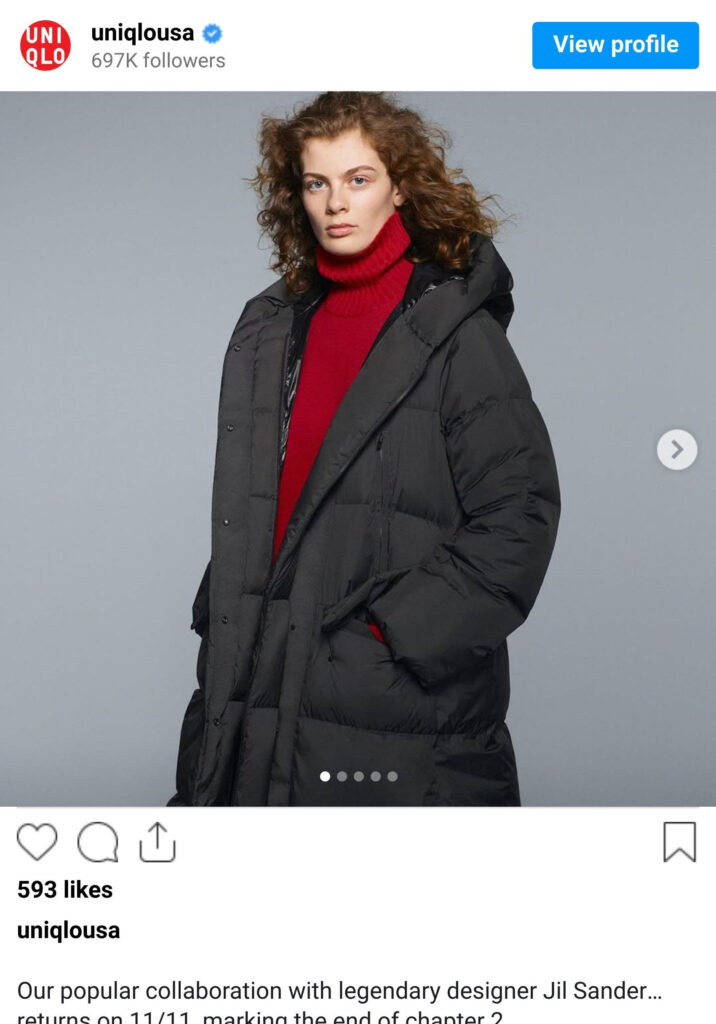
- Execution: These collaborations never change Uniqlo’s core identity. A Jil Sander collaboration still focuses on simple, functional shirts—just with a slightly more refined silhouette.
- The Goal: To attract “fashion-forward” audiences who might otherwise find basics boring, without alienating their core customer who wants simplicity.
5. Challenges & Competition
SWOT Analysis
| Strengths | Weaknesses |
| Fabric innovation (HEATTECH/AIRism), Global consistency, High quality-to-price ratio. | Can be perceived as “boring” or lacking personality by trend-chasers. |
| Opportunities | Threats |
| Growing demand for sustainable “slow fashion,” Expansion into more climate-specific tech. | Fast-fashion giants like Zara/H&M (speed), Ultra-fast players like Shein (price). |