Short answer. Yes. Python is still the best first language if you are heading towards AI, data or automation in 2027. It reads almost like plain English, and most AI tools and data libraries are built for it.
It will not do everything. Phone apps and the visible side of websites use other languages. But as a first skill that opens the most doors, Python is hard to beat.
Picture a commerce student in Surat who spends two hours every month copying figures from one file into another for the same report. A short Python script can do that in a few seconds, every single time. That small moment, when your own code does a boring job for you, is why so many people stay with Python once they start.
Why Python, and why now
Four facts point the same way, and none of them come from us.
- More people are using it. In Stack Overflow's 2025 Developer Survey, Python's use among developers rose by 7 percentage points in a single year. The survey ties that growth to AI, data science and back-end work. (Stack Overflow)
- It leads in AI. GitHub reported that, as of August 2025, nearly half of all new AI projects on its platform were built mainly in Python. (GitHub Octoverse)
- Employers want these skills. The World Economic Forum's Future of Jobs Report 2025 ranks AI and big data as the fastest-growing skill, and lists AI and machine learning specialists and big data specialists among the fastest-growing jobs. (World Economic Forum)
- It is still at the top of the rankings. Python was first in the TIOBE index in November 2026, although its share moves around from month to month. (TechRepublic)
One fair note. In that same GitHub report, TypeScript passed Python as the language with the most contributors overall. Python did not fall out of favour. It is just no longer the single biggest on that count. Where it clearly leads is AI and data, which is where many beginners want to end up.
What you can actually build with it
You do not need years of study to make something real. Here is what a beginner can typically build, roughly in this order.
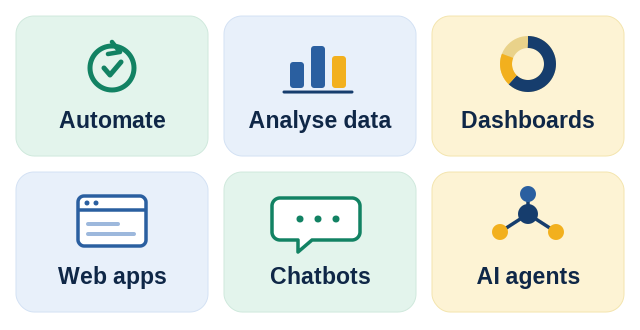
- Small automation scripts. Rename hundreds of files, merge Excel sheets, send reminder emails.
- Data analysis. Open a file of sales or exam marks, clean it, and find the answer in a few lines of code.
- Charts and dashboards. Turn the numbers into visuals people can read at a glance.
- Simple web apps. A form, a database and a page that shows the results.
- AI-powered tools. A chatbot, a document summariser, or an assistant that answers questions from your own files.
The last one is where 2027 gets interesting. Python is the usual way to connect to AI models, so the language you use for a first script is the same one you use to build with AI later.
Where Python is not the best choice
It helps to be honest about this. If you want to build Android or iPhone apps, you will use Kotlin, Swift or a tool such as Flutter. If you want to design the visible part of websites, you will learn JavaScript. Games that need very high speed often use C++ or C#.
Python can still be a good first language for all of these, because it teaches you how to think in code. It just will not be the only one you need.
How to start as a complete beginner
Keep the first month simple. Small wins matter more than a perfect plan.
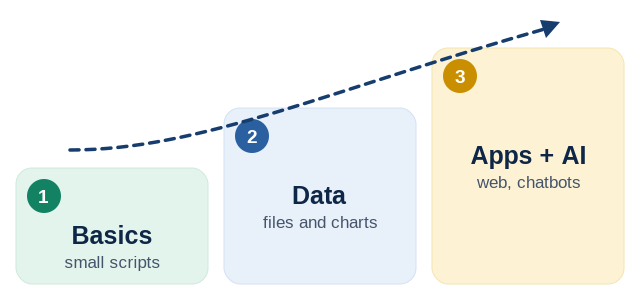
- Write your first programInstall Python and make it print a message. It takes ten minutes and removes the fear.
- Learn the basics properlyVariables, loops, conditions and functions. Practise with tiny problems every day.
- Work with files and dataRead a spreadsheet file, count things, find the highest and lowest values.
- Build one project you care aboutA budget tracker, a marks calculator, a quiz. Finish it, even if it looks rough.
- Add AICall an AI model from your own code and build a small assistant.
If you would like guidance, our Python Foundations Program starts from zero and runs for about 1.5 months. The Professional Python Developer course goes further into databases, Flask and AI tools over 4 months. The Python and Agentic AI certificate carries on into machine learning, generative AI and agents.
Never written code before?The Foundations program starts from zero, so you can begin without any experience.
View course →Not sure which Python course to pick?
Tell us where you are now and what you want to build. We will point you to the right starting point, even if that is the shortest course.
Talk to a counsellor on WhatsAppPython in 2027: frequently asked questions
Is Python still worth learning in 2027?
Yes, especially for AI, data and automation. Survey and GitHub data show Python growing in AI work, and employers list AI and data skills among the fastest-growing. It is not the only language worth knowing, but it is the best place to start for those fields.
Is Python good for complete beginners?
Yes. The code is easy to read and you can get a result with very little setup. Beginners spend more time learning ideas and less time fighting syntax.
If AI can write code, why learn Python?
AI tools can write code, but you still need to understand it to check it, fix it and ask for the right thing. People who can read Python get far more out of AI tools than people who cannot.
How long does it take to learn Python?
With regular practice, most beginners can write small useful programs within four to six weeks. Becoming job-ready takes longer, usually several months of practice with real projects.
Can I get a job with only Python?
Python on its own is rarely enough. Employers usually want Python plus something else, such as SQL and data analysis, a web framework or machine learning, along with projects you can show.