Introduction
In the fiercely competitive world of personal care, few brands have managed to stay relevant for as long as Sunsilk. Launched by Unilever in the UK in 1954 with a promise of “salon-like hair care at home,” it has evolved into a global powerhouse present in over 80 countries. Interestingly, while it has exited markets like the USA and Canada, it remains a titan in emerging economies.
In India, where it entered in 1964 (starting with hairspray!), Sunsilk has successfully positioned itself as the go-to brand for the modern, aspiring Indian woman. Today, it stands as the third-largest shampoo brand in India, a testament to its ability to democratize hair expertise and make it accessible to the masses.
The Core USP: Co-Creation with Experts
Sunsilk’s most significant strategic differentiator was its pivot from being just a “shampoo” to being a product “co-created by experts.”
- The Expert Alliance: Sunsilk didn’t just claim to be good; they partnered with the world’s best hair professionals—like Teddy Charles (shape expert) and Jamal Hammadi (shine expert).
- Democratizing Premium Care: By putting the faces and names of these high-end stylists on affordable yellow and pink bottles, Sunsilk bridged the gap between luxury salon care and the middle-class bathroom. This gave the product an aura of premium efficacy without the premium price tag.
Digital Marketing & SEO Strategy
Sunsilk’s digital strategy focuses on content that solves problems, leveraging the “how-to” nature of the beauty category.
- SEO (Search Engine Optimization): Sunsilk targets high-volume, problem-solution keywords. They optimize for terms like “shampoo for dry hair,” “how to stop hair fall,” and “long and black hair tips.” By creating content around these queries, they capture users who are actively looking for solutions. Their presence on e-commerce giants like Amazon and Nykaa involves rigorous optimization of product descriptions and utilizing customer reviews to boost visibility.
- Social Media Marketing: On platforms like Instagram and YouTube, Sunsilk acts as a beauty companion.
- Tutorials & Hacks: They understand that their audience (Gen Z and young Millennials) relies on online tutorials. They actively collaborate with beauty bloggers to create hairstyling hacks, routine videos, and “Get Ready With Me” content.
- Engagement: Their content is vibrant and youthful, often featuring contests and challenges that encourage users to share their own hair transformation stories.
STP Analysis
- Segmentation:
- Demographic: Primarily targets women aged 15-35. This includes students, young working professionals, and homemakers.
- Geographic: A dual focus on urban and semi-urban markets. Semi-urban areas are a critical growth engine due to rising disposable incomes and grooming awareness.
- Psychographic: Appeals to women who are appearance-driven, fashion-conscious, and confident. They want immediate results (shine, straightness) to feel ready for the world but are value-conscious.
- Targeting: Sunsilk targets the middle and upper-middle-class woman who aspires to the lifestyle of celebrities but needs a product that fits her monthly budget.
- Positioning: Sunsilk positions itself as the fun, youthful, and expert hair care solution. Unlike Dove (which is about “care” and “moisture”) or Clinic Plus (which is about “family” and “strength”), Sunsilk is about “Style and Confidence.” It is the brand for the girl who wants her hair to look great now.
The 4 Ps of Marketing
- Product:
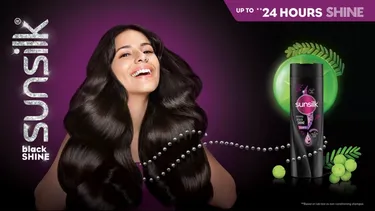
- Variant Strategy: Sunsilk was one of the first to segment the market by hair need (Pink for dry hair, Yellow for soft and smooth, Black for shine). This color-coded system makes shelf navigation incredibly easy.
- Formulation: Continuous innovation with ingredients like Keratin, Argan Oil, and Biotin, keeping up with ingredient trends while maintaining mass production scales.
- Price: Sunsilk employs a Penetration Pricing Strategy.
- The Sachet Revolution: A massive part of their success in India is the ₹1 – ₹3 sachet. This “low unit pack” strategy allows daily wage earners and rural consumers to access premium-quality shampoo, driving massive volume.
- Affordable Bottles: For urban consumers, larger bottles are priced competitively against rivals like Pantene, offering value for money.
- Place: Backed by HUL’s legendary distribution machine.
- Omnipresence: Available in everything from high-end supermarkets to the smallest rural kirana stores.
- Project Shakti: Leveraging HUL’s rural distribution program where local women entrepreneurs distribute products in villages, allowing Sunsilk to penetrate deep rural markets that competitors cannot reach.
- Promotion:
- Celebrity Endorsements: A long history of using top stars. Currently, Alia Bhatt serves as the brand ambassador. Her vibrant, energetic, and “girl-next-door” persona perfectly aligns with Sunsilk’s brand image.
- Mass Media: Heavy investment in TV commercials that focus on “hair problems vs. Sunsilk solutions,” often accompanied by catchy jingles and vibrant visuals.
Influencer Marketing & Collaborations
- Strategy: Sunsilk combines macro-celebrity power with micro-influencer authenticity.
- The Celebrity Face: Using Alia Bhatt provides instant mass recognition and aspirational value. The ads usually depict her facing a hair crisis (frizz, dullness) and finding an instant fix with Sunsilk.
- The Digital Tribe: On Instagram and YouTube, they work with beauty influencers to create user-generated content (UGC). When a relatable influencer shows a “frizzy to smooth” transformation using Sunsilk, it builds trust among younger consumers who are skeptical of TV ads.
Challenges & Competition (SWOT Insights)
- Challenges:
- Perception of Chemicals: In an era shifting towards “clean beauty,” Sunsilk is often perceived as a chemical-heavy, mass-market product.
- Innovation Speed: Competitors like Dove and new D2C brands are often faster to launch trendy variants (sulfate-free, paraben-free).
- Competition:
- Clinic Plus (HUL): The market leader in India, competing for the mass/family segment.
- Dove (HUL) & Pantene (P&G): Compete for the slightly more premium, care-oriented consumer.
- Patanjali & Kesh King: Ayurvedic brands that challenge Sunsilk with “natural” and “chemical-free” propositions.
🔑 Key Takeaways from Sunsilk’s Marketing
- Sachet Marketing is Key: In emerging markets like India, accessibility drives market share. The ₹1 sachet made a global brand accessible to rural India.
- Color-Coded Segmentation: Simplifying the buying decision by color-coding bottles based on hair problems (Pink, Yellow, Black) helped consumers navigate the shelf easily.
- Affordable Expertise: Partnering with global experts gave the mass-market brand a “premium” credibility that justified trust.
- Project Shakti: Leveraging rural distribution networks is a sustainable way to unlock new customer bases that traditional supply chains miss.