
1. Introduction to Social Media Marketing (SMM) & Gen AI
Understanding the Fundamentals of Social Media Marketing (SMM)
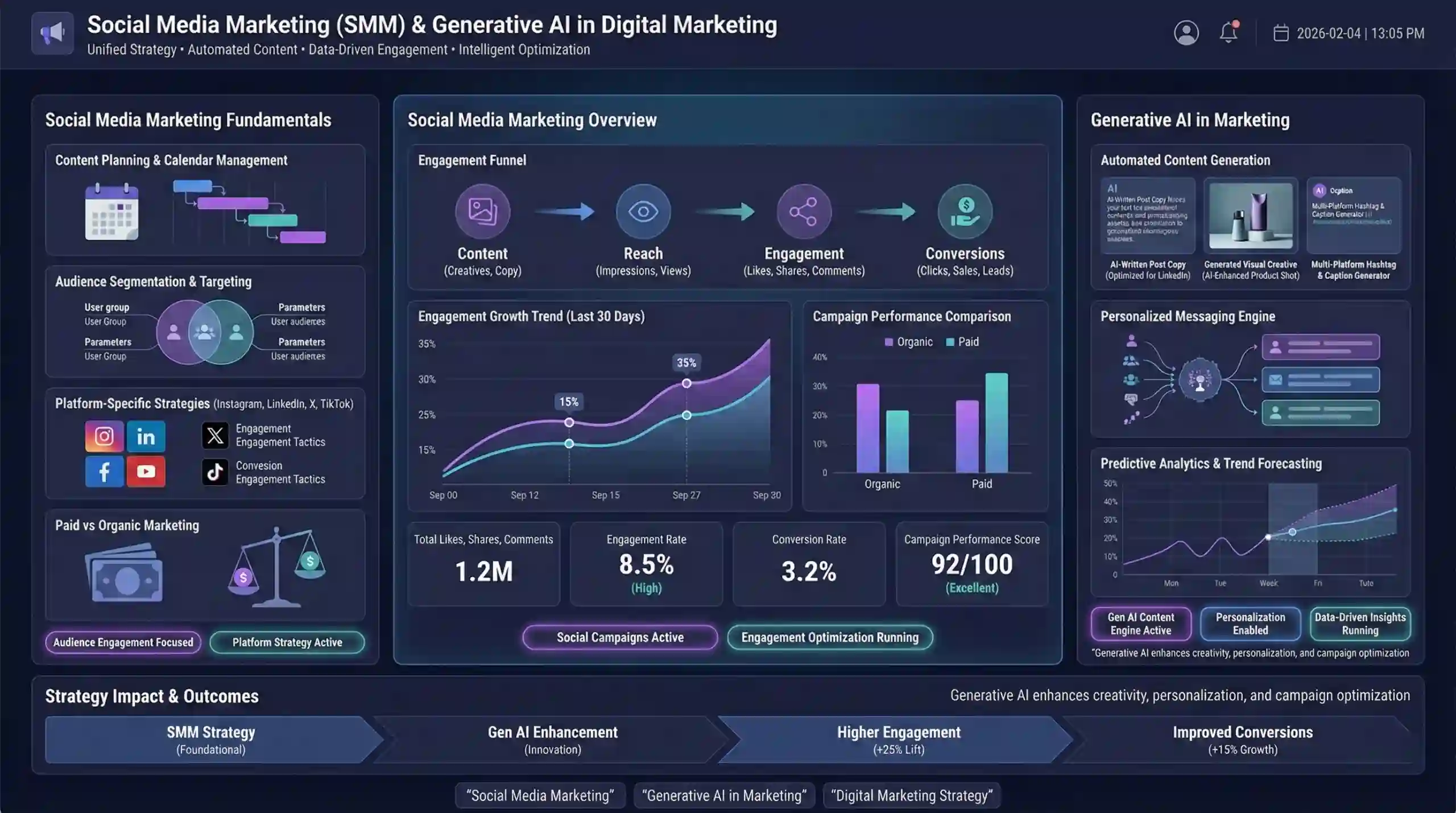
Social Media Marketing (SMM) is a strategic approach that leverages social media platforms such as Facebook, Instagram, Twitter, and LinkedIn to promote products, services, or brands. The goal of SMM is to connect with targeted audiences, increase brand awareness, engage users, and drive conversions. These platforms offer businesses unique opportunities to interact directly with consumers through organic content, paid advertisements, and influencer collaborations.
The core strategies in SMM involve content creation, audience engagement, analytics tracking, and campaign optimization. Content must be tailored to each platform’s unique user base and content format—visuals and videos for Instagram, articles and professional insights for LinkedIn, quick updates for Twitter, and comprehensive posts for Facebook.
Real-world Example: A clothing brand such as Nike uses Instagram for visual storytelling, sharing athlete stories and new product launches to boost engagement and sales. Their targeted campaigns rely on understanding their audience’s preferences and behaviors.
Key Concepts in SMM:
- Content Planning and Calendar Management
- Audience Segmentation and Targeting
- Platform-specific Strategies
- Paid vs. Organic Marketing
- Engagement Metrics (likes, shares, comments)
The Role and Impact of Generative Artificial Intelligence (Gen AI) in Digital Marketing Strategies
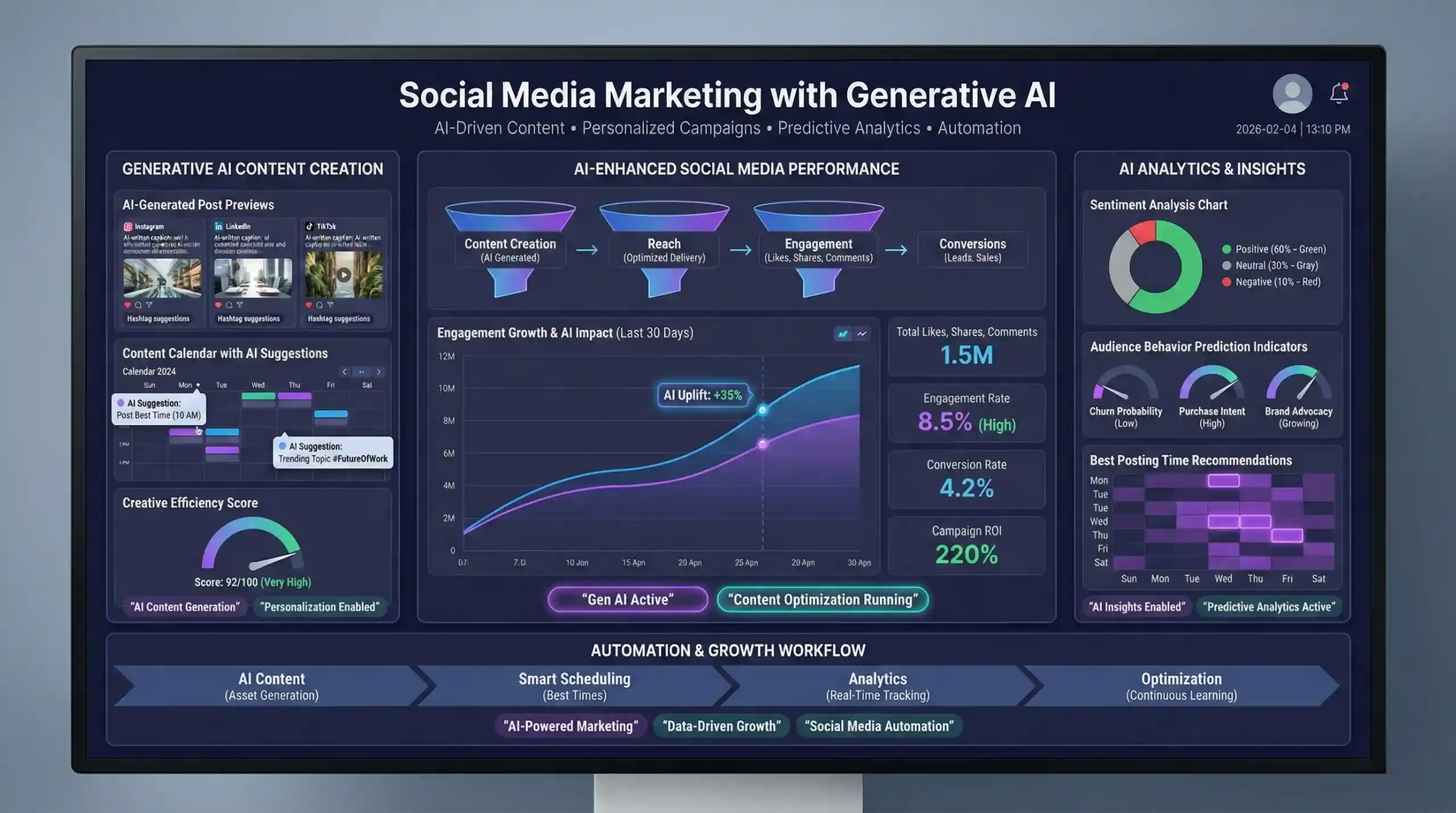
Generative Artificial Intelligence (Gen AI) refers to AI systems capable of creating new content—text, images, videos—based on input data patterns. In digital marketing, Gen AI is revolutionizing how brands develop content, personalize user experiences, and optimize campaign strategies.
By automating content creation, Gen AI reduces human effort and accelerates the production of marketing materials. It fosters personalization by crafting messages tailored to individual preferences and behaviors, significantly enhancing customer engagement. Moreover, Gen AI can analyze vast data sets to predict consumer trends, optimize ad placements, and refine marketing campaigns dynamically.
Real-world Example: A travel agency uses Gen AI tools to generate personalized email content that recommends destinations based on user browsing history, resulting in higher click-through and booking rates.
Benefits of Gen AI in Digital Marketing:
- Rapid Content Generation
- Personalized Customer Experiences
- Enhanced Campaign Optimization
- Data-Driven Insights and Predictions
Keywords: Social Media Marketing, Digital Marketing Strategy, Generative AI in Marketing
2. Content Creation & Optimization using Gen AI
AI-powered Content Generation for Engaging Social Media Posts
AI content generation platforms leverage natural language processing to create compelling narratives, captions, and even visual content tailored to specific audiences. These tools analyze existing content, audience preferences, and trending topics to craft relevant posts automatically.
Example: Using GPT-based tools, a social media manager can generate multiple tweet variations or Facebook posts within seconds, enabling rapid content deployment. AI-generated visuals can include banners or infographics designed to match brand style, reducing creative production time.
Practical Outcome:
Techniques for SEO-optimized Content Writing
Integrating SEO strategies ensures content is discoverable and ranked favorably in search results. AI tools assist in keyword research, content structuring, and meta-tag optimization. By analyzing trending keywords and competitor content, AI can suggest enhancements to improve visibility.
Example: An AI-powered content writer uses target keywords like “social media marketing,” “digital marketing strategy,” and “generative AI in marketing” to craft blog posts that rank higher on search engines, driving organic traffic.
Tailoring Content for Target Audiences
Personalization is crucial in content strategy. AI models analyze user data to produce customized messages aligned with customer interests, boosting engagement. Social media platforms then serve these tailored contents to relevant segments.
Example: An online learning platform uses AI to recommend tailored course content based on user browsing history, increasing session duration and conversions.
Practice Questions (with code snippets):
- Explain how GPT-based models can generate social media posts.
- Describe technical steps to optimize AI-generated content for SEO.
- Demonstrate with pseudocode how an AI tool can suggest hashtags based on content.
- Analyze the potential limitations of AI content generation in marketing.
- Example: Write a dummy Python function that uses an AI API to generate a social media post.
def generate_post(prompt):
    # Assume an API call to an AI content generator
    response = call_ai_api(prompt)
    return response['generated_text']

# Example usage:
prompt = "Create a catchy Instagram caption for a new sneaker release."
print(generate_post(prompt))
Output:
Generated caption based on prompt.
3. Social Media Analytics & Insights with AI
Leveraging AI Analytics Tools
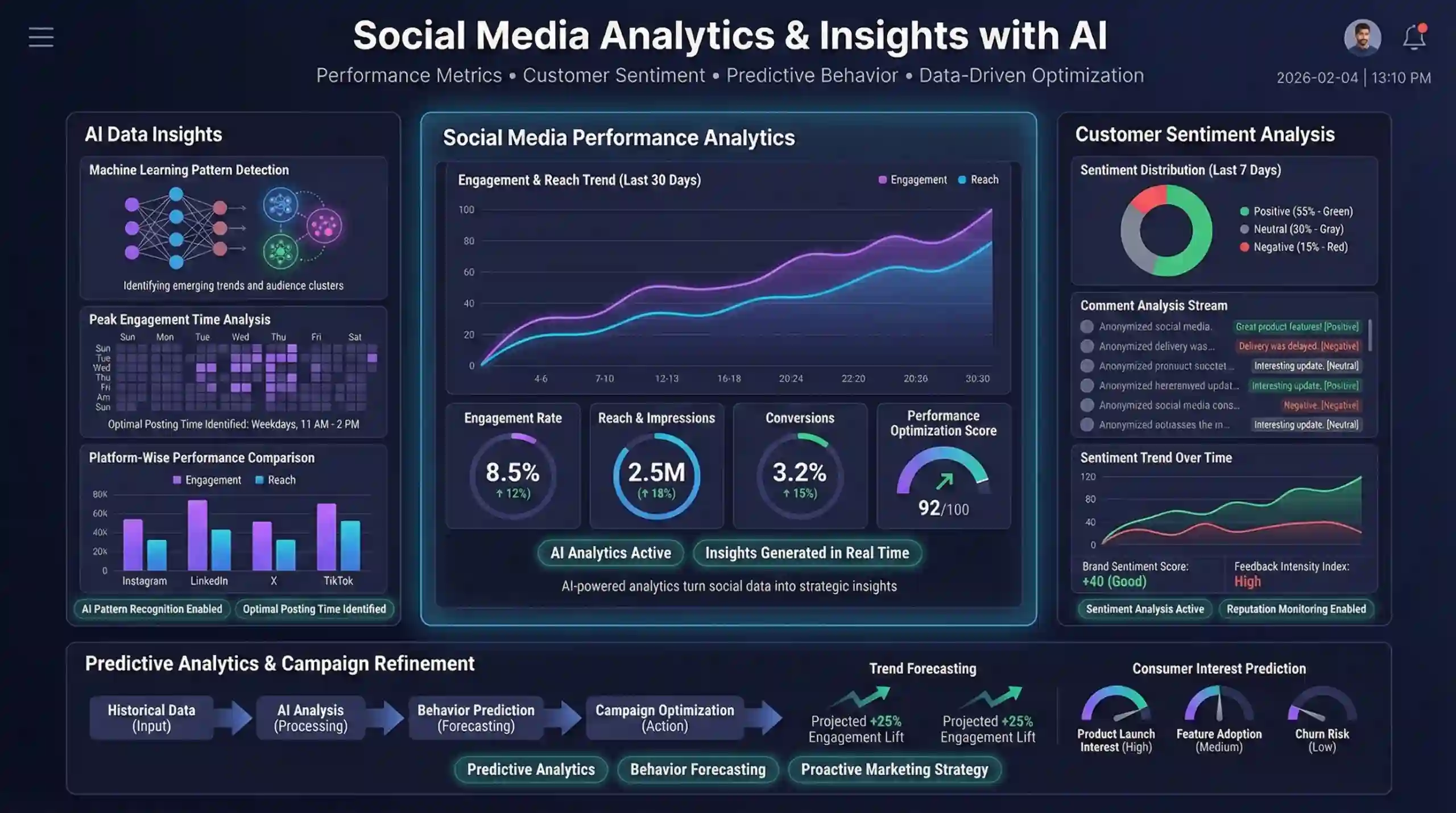
AI-driven analytics tools collect and interpret vast amounts of social media data to measure performance metrics such as engagement, reach, impressions, and conversions. These tools use machine learning algorithms to identify patterns and generate actionable insights.
Example: A marketing team uses AI-based analytics to discover that engagement peaks on Twitter during specific hours, leading to optimized posting schedules.
Interpreting Data to Refine Campaigns
Data insights help marketers adjust campaigns in real time. For example, if sentiment analysis reveals negative feedback about a product, actions can be taken promptly to address concerns, limiting reputational damage.
Example: Customer sentiment analysis indicates dissatisfaction with a recent ad campaign, prompting message adjustments that improve public perception and ROI.
Customer Sentiment Analysis & Behavior Prediction
Sentiment analysis uses natural language processing to determine whether customer comments are positive, negative, or neutral. Predictive analytics forecast future consumer behaviors, enabling proactive strategy adjustments.
Example: AI predicts increased interest in eco-friendly products, encouraging the business to expand relevant offerings.
Practice Questions:
- Describe the role of AI data insights in social media performance analysis.
- Explain customer sentiment analysis and its benefits.
- Show with pseudocode how AI can analyze customer comments for sentiment.
- Discuss how predictive analytics influence marketing decision-making.
- Code exercise: Mock-up of a simple sentiment categorization function.
def analyze_sentiment(comment):
    # Placeholder for sentiment analysis
    positive_keywords = ['good', 'great', 'amazing']
    negative_keywords = ['bad', 'poor', 'disappoint']
    if any(word in comment.lower() for word in positive_keywords):
        return 'Positive'
    elif any(word in comment.lower() for word in negative_keywords):
        return 'Negative'
    else:
        return 'Neutral'

# Test:
print(analyze_sentiment("This product is amazing!"))  # Output: Positive
print(analyze_sentiment("Not satisfied with the service."))  # Output: Neutral
4. Automation & Personalization in SMM
AI-driven Chatbots and Automation Tools
Chatbots are AI programs that simulate human conversations, providing instant customer support and engagement around the clock. Automation tools facilitate scheduling posts, monitoring campaigns, and responding to user interactions, saving time and ensuring consistent presence.
Example: A retail store employs a chatbot for FAQs and order tracking, improving customer satisfaction and freeing human resources for complex queries.
Personalization to Increase Conversion Rates
AI analyzes customer data to deliver personalized recommendations, tailored content, and targeted ads. This boosts user engagement and the likelihood of conversions.
Example: An online music service recommends playlists based on listening history, increasing user retention.
Social Media Automation Tools
Automation tools like Hootsuite or Buffer enable scheduling of posts, campaign management, and cross-platform publishing, leading to efficient and uniform marketing efforts.
Practice Questions:
- Describe how chatbots contribute to social media automation.
- Explain methods used by AI to personalize user experiences.
- Design pseudocode for an AI-driven recommendation engine.
- Discuss ethical considerations in automation and personalization.
- Sample code: Basic chatbot response logic.
def chatbot_response(user_input):
    responses = {
        'hello': 'Hi! How can I assist you today?',
        'order': 'Please provide your order ID for tracking.',
        'bye': 'Thank you for visiting. Have a great day!'
    }
    for key in responses:
        if key in user_input.lower():
            return responses[key]
    return "I'm sorry, I didn't understand that."

# Test:
print(chatbot_response("Hello"))
# Output: Hi! How can I assist you today?
5. Paid Advertising & AI Targeting
AI-based Audience Segmentation and Targeting
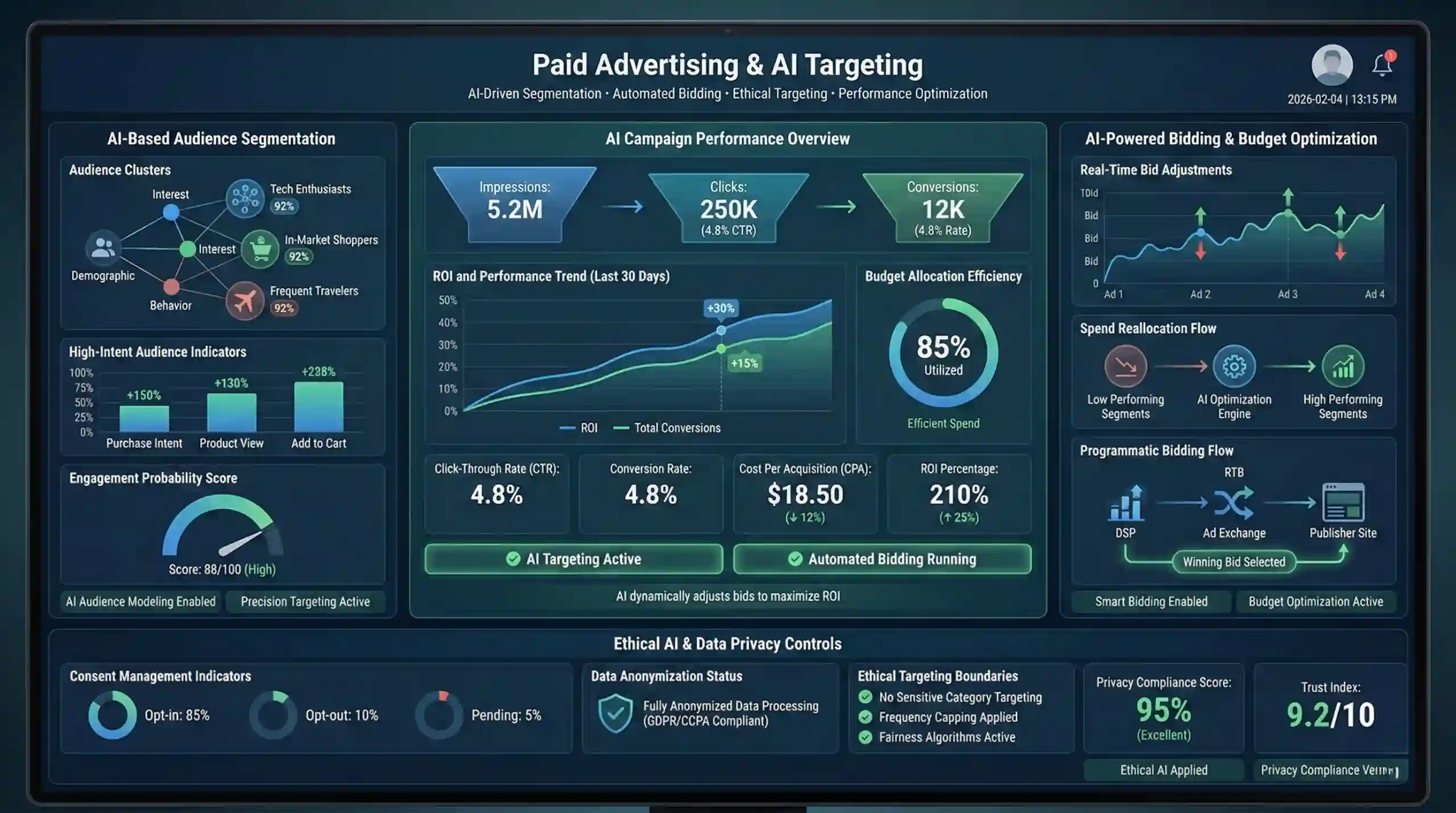
AI segments audiences by analyzing demographics, interests, behaviors, and past interactions. These segments enable precise targeting, increasing ad relevance and effectiveness.
Example: A fitness brand targets users who have shown interest in health and wellness products with tailored ads, resulting in higher engagement rates.
AI-powered Bidding & Budget Optimization
Programmatic advertising uses AI algorithms for automated bidding, adjusting ad bids in real-time based on audience responsiveness and conversion likelihood to maximize ROI.
Example: During a holiday sale, AI bidding adjusts spend towards high-converting segments, optimizing ad spend.
Ethical AI Use & Data Privacy
Implementing AI ethically involves respecting user privacy, avoiding discriminatory targeting, and complying with data protection laws like GDPR. Transparent data handling fosters trust and legitimacy.
Example: Ensuring data collected for ad targeting is anonymized and users have consented aligns with ethical AI standards.
Practice Questions:
- Explain how AI improves audience segmentation in social media advertising.
- Describe programmatic advertising and its advantages.
- Propose ethical considerations when deploying AI in targeted campaigns.
- Pseudocode: How an AI system might allocate budget between segments dynamically.
- Code sample: Basic audience segmentation based on interest keywords.
def segment_audience(user_data):
    if 'fitness' in user_data['interests']:
        return 'Fitness Enthusiasts'
    elif 'technology' in user_data['interests']:
        return 'Tech Lovers'
    else:
        return 'General Audience'

# Example:
user = {'interests': ['fitness', 'nutrition']}
print(segment_audience(user))  # Output: Fitness Enthusiasts
6. Emerging Trends & Ethical Considerations
Staying Updated on AI-driven Social Media Strategies
The field of AI in marketing is rapidly evolving. Staying current involves following industry blogs, academic publications, and participating in training webinars. AI trends like generative visuals, deepfake content, and voice assistants are reshaping social media strategies.
Ethical Implications of AI in SMM
Responsible AI use demands addressing bias, misinformation, and privacy concerns. Implementing fairness algorithms and transparency in AI decision-making helps uphold ethical standards.
Future of Social Media Marketing with Gen AI
Future developments include hyper-personalized experiences, AI-driven virtual influencers, and automated content moderation. These innovations will make digital marketing more immersive, responsive, and ethical.
Practice Questions:
- Describe upcoming AI trends influencing social media marketing.
- Explain the importance of ethical AI and privacy.
- Discuss methods to mitigate bias in AI-driven marketing.
- Predict future innovations in Gen AI for social media growth.
- Research exercise: Find a recent AI development in marketing and summarize its impact.
7. Practical Applications & Case Studies
Analyzing Successful AI-integrated Campaigns
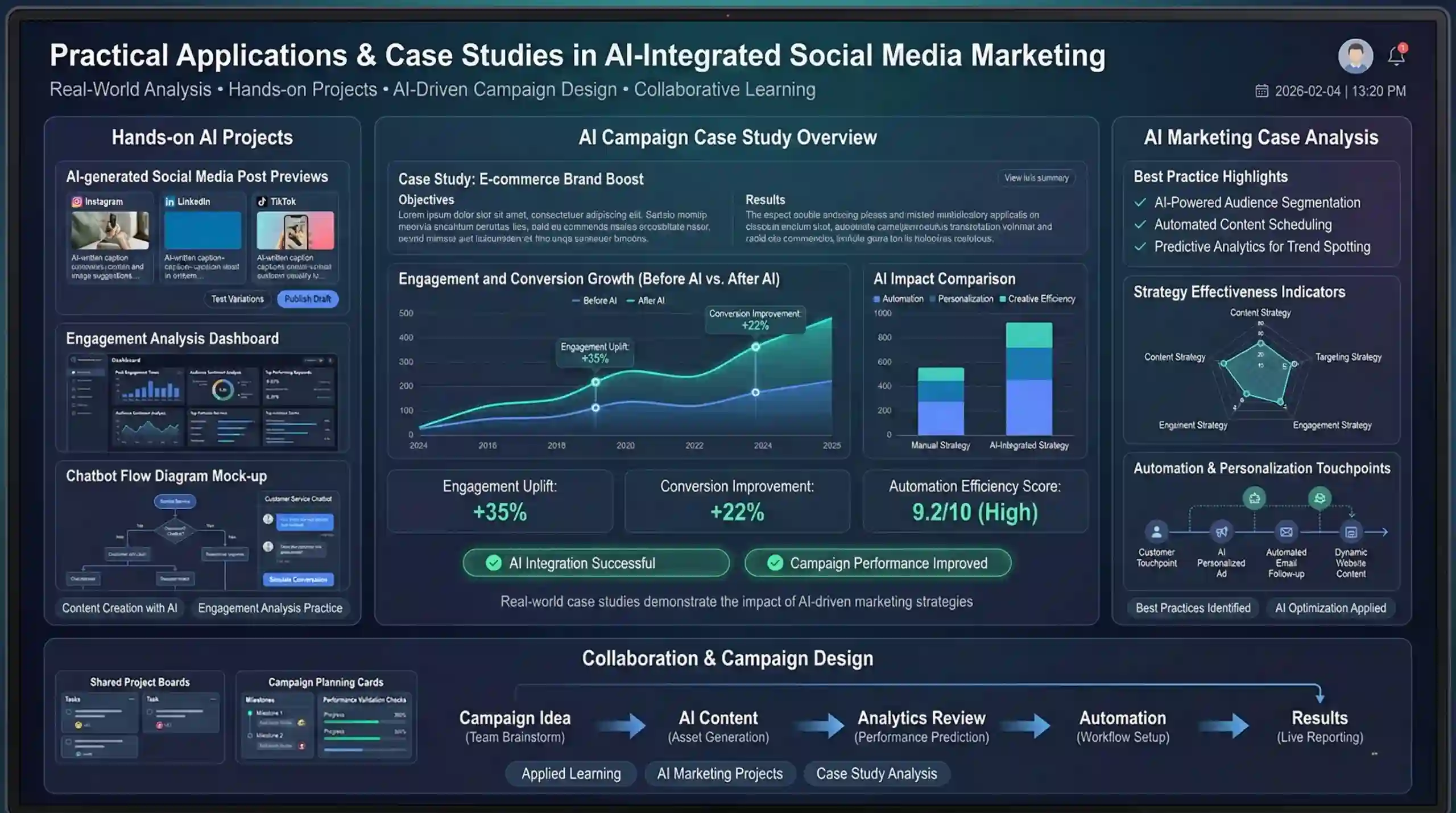
Case studies illustrate how brands effectively employ AI. For example, Sephora’s use of AI chatbots provides personalized beauty advice, boosting customer satisfaction and sales. Analyzing these successes highlights best practices.
Developing Hands-on Projects
Students can practice by creating AI-generated posts, analyzing engagement data with simulated tools, or designing chatbot scripts. Practical experience solidifies understanding of how AI is transforming social media marketing.
Collaborating on Case Studies
Working on real-world projects, students develop the ability to apply theoretical concepts actively. For instance, designing an AI-backed campaign plan demonstrates integration of content creation, analytics, and automation.
Practice Questions:
- Review a successful AI-integrated social media campaign and identify key strategies.
- Design a simple project plan using AI tools for content creation and analytics.
- Explain the role of AI in campaign performance improvement through a case example.
- Propose a hypothetical AI-powered social media strategy for a startup.
- Identify challenges faced in deploying AI in social media marketing and suggest solutions.
Resources for Further Learning
This comprehensive, theory-based study material provides a structured pathway to understanding Social Media Marketing and the transformative role of Gen AI. Combining foundational concepts with practical insights, it aims to equip learners with the knowledge to navigate and innovate within the evolving landscape of digital marketing.
More Courses
- Social Media Marketing course with Gen AI
- Advance Digital Marketing & SEO course with Gen AI
- Advanced Certificate in Digital Design & Marketing course with Gen AI
- Meta & Google Ads course with Gen AI