
OpenAI has hit the brakes on several experimental initiatives, shifting its entire focus back to its core product, ChatGPT, following internal alarms about Google’s rapidly advancing capabilities.
The Strategy:
- The Directive: CEO Sam Altman has issued a company-wide “code red,” signaling an urgent strategic pivot to defend the company’s market lead.
- The Cuts: Development on secondary projects—including advertising integration, shopping tools, health agents, and a project codenamed “Pulse”—has been paused.
- The Threat: The urgency stems from Google’s momentum, specifically the strong benchmark performance of Gemini 3 and its growing AI user base.
The Details:
OpenAI is restructuring its immediate priorities to address speed, reliability, and answer quality in ChatGPT. Staff members are being temporarily transferred from other departments to bolster the core team, with daily leadership calls instituted to track progress. This defensive maneuver comes as competitors like Google (with its new image models and Gemini updates) and Anthropic begin to close the performance gap that OpenAI has held for nearly two years.
Why It Matters:
This marks a significant shift in the AI wars: the battle is moving from “hype and features” to “daily utility.” OpenAI’s decision to sacrifice expansion for optimization acknowledges that being first isn’t enough if the product isn’t the best. For users, this competition is good news—it likely means a faster, more accurate, and more robust ChatGPT is on the horizon. However, it also signals that OpenAI’s dominance is no longer guaranteed, as the gap between the industry leader and its rivals narrows to a razor’s edge.
Mistral Unleashes Large 3 and ‘Ministers’ in Major Open-Source Push
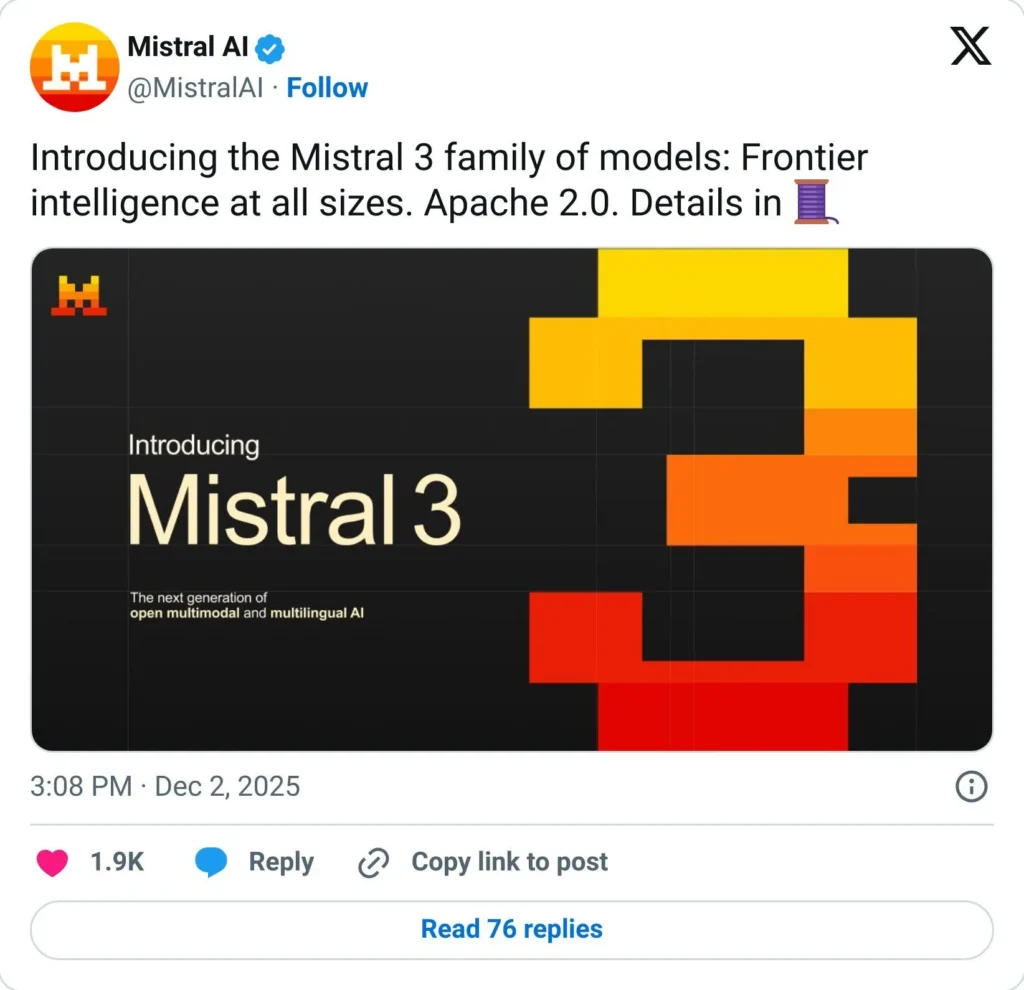
Mistral has rolled out a comprehensive new family of AI models, introducing a powerful flagship model alongside a suite of efficient, smaller variants designed for local deployment.
The Lineup:
- The Flagship: Mistral Large 3 launches as a fully open model under the permissive Apache-2.0 license, utilizing a sparse Mixture-of-Experts (MoE) architecture.
- The Edge Options: A new series called “Ministers” targets local and edge computing with 3B, 8B, and 14B parameter options.
- The Capabilities: The entire lineup is multilingual and multimodal, capable of processing images alongside text, and is available in base, instruct, and reasoning versions.
The Details:
Mistral is aggressively targeting the open-weight market with this release. The Large 3 model, trained on a cluster of roughly 3,000 H200 GPUs, features 41 billion active parameters, positioning it as a heavy hitter for complex tasks. Conversely, the “Ministers” variants are engineered for efficiency; the 14B model, in particular, is noted for delivering strong reasoning capabilities while remaining lightweight enough for local setups. The suite is immediately accessible through Mistral AI Studio and major cloud providers.
Why It Matters:
This release offers a highly practical toolkit for developers and enterprises looking to escape the high costs and data privacy concerns of closed APIs. By providing powerful models that can be self-hosted or run on edge servers (like laptops), Mistral is enabling companies to build AI features into SaaS products and on-premise tools with strict latency and data residency requirements. In a landscape increasingly populated by open models from competitors like DeepSeek and Qwen, Mistral provides a robust, audit-friendly European alternative that organizations can fork and integrate immediately.
Universities Deploy AI to Grade College Admissions Essays

Colleges are beginning to integrate artificial intelligence into the admissions process, using tools to review essays, verify research, and speed up decision-making.
The Numbers:
- The Adopters: Major institutions like Virginia Tech and Caltech are testing these tools on live applications.
- The Speed: AI tools can ostensibly scan up to 250,000 essays an hour, allowing universities to cut decision times by weeks.
- The Conflict: The move has sparked immediate pushback from applicants and educators concerned about algorithmic bias and the loss of human nuance.
The Details:
Admissions offices, drowning in record application numbers, are turning to automation for relief. Virginia Tech is utilizing an AI reader to score short answer essays, aiming to streamline the evaluation process. Meanwhile, Caltech has deployed a chatbot interface to interview applicants, specifically to verify their understanding of the research projects submitted in their portfolios.
Why It Matters:
This marks a profound shift in a deeply personal life milestone. The admissions essay, traditionally the one place for a student to show their “human” side, is now being parsed by a machine. This creates a strange feedback loop where students might write essays using one set of AI rules, only to have them judged by another. While it solves a logistical crisis for universities, it introduces critical questions about fairness, transparency, and whether an algorithm can truly measure potential or character.
Disclaimer: All images and videos used are for educational purposes only. We do not claim ownership of this content; all rights and credits belong to their respective owners.