1. Foundations of AI & Digital Marketing
Understanding Artificial Intelligence (AI) Fundamentals
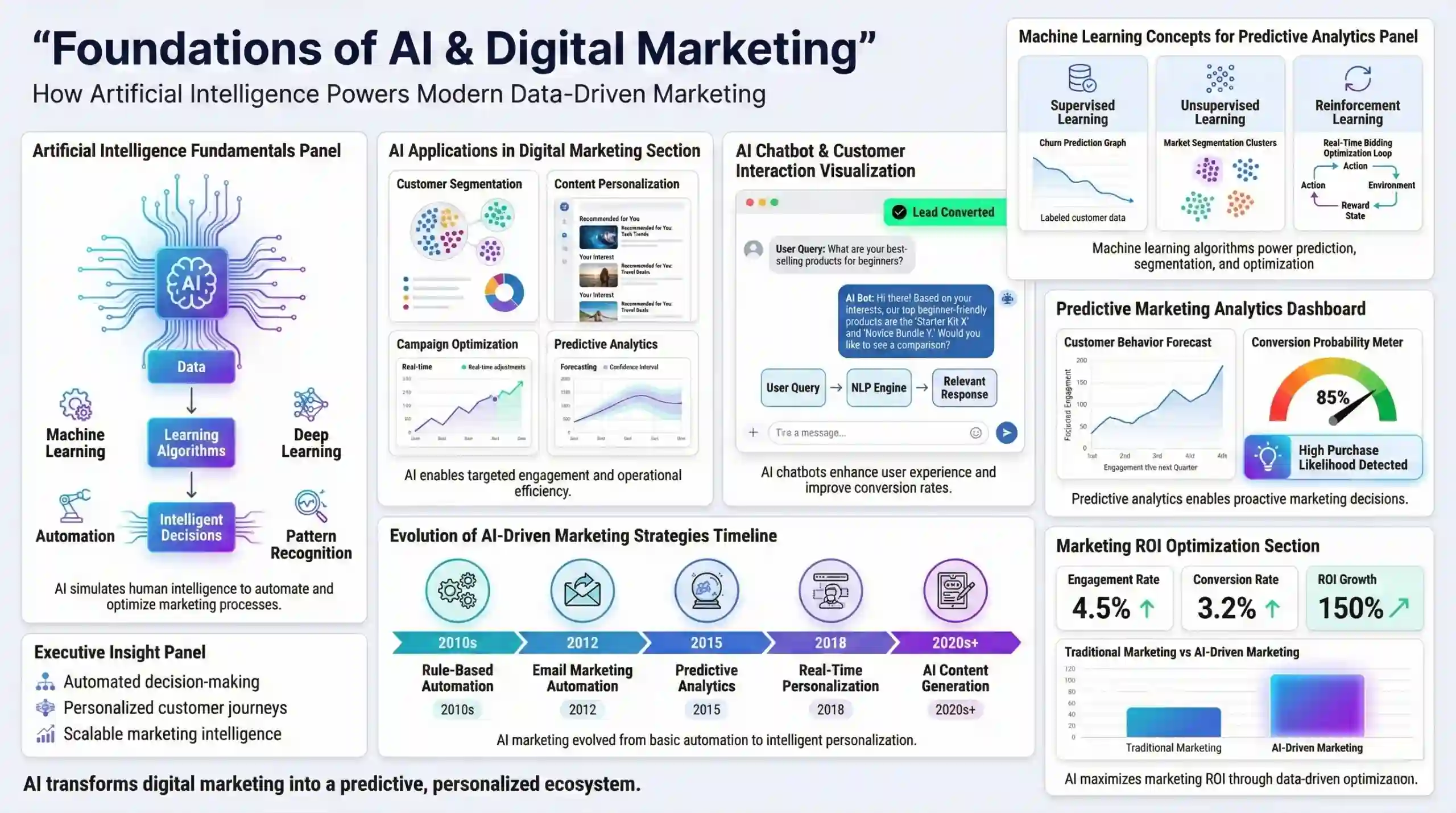
Artificial Intelligence (AI) refers to the simulation of human intelligence processes by machines, especially computer systems. It encompasses various subfields, including machine learning and deep learning, that enable systems to learn from data, identify patterns, and make decisions with minimal human intervention. In digital marketing, AI automates tasks such as customer segmentation, content personalization, and campaign optimization, ensuring higher efficiency and targeted engagement.
Example: An AI-powered chatbot can engage visitors in real-time, answer queries, and guide them toward purchase decisions, improving user experience and increasing conversion rates.
Evolution of AI-driven Marketing Strategies
The journey of AI in digital marketing began with rule-based automation tools, gradually evolving into sophisticated systems capable of predictive analytics, natural language processing, and computer vision. Early automation focused on email marketing and basic ad placements, while modern AI applications enable dynamic personalization, real-time bidding, and content generation. This progression has transformed traditional marketing into data-driven, automated, and highly personalized strategies.
Machine Learning Concepts for Predictive Analytics
Machine learning (ML) is a subset of AI involving algorithms that identify patterns in data to make predictions or decisions. Key ML techniques relevant for marketing include:
- Supervised Learning: Uses labeled data to train models for tasks like customer churn prediction.
- Unsupervised Learning: Finds hidden patterns, suitable for market segmentation.
- Reinforcement Learning: Learns optimal actions through trial and error, useful in real-time bidding.
Outcome: Mastering these algorithms enables marketers to forecast customer behavior, optimize campaigns, and maximize marketing ROI.
2. Data Collection & Management
Big Data and Customer Data Platforms (CDPs)
Effective digital marketing relies on collecting massive amounts of customer data from diverse sources such as websites, social media, transaction logs, and IoT devices. Customer Data Platforms (CDPs) unify this data into a coherent customer profile, enabling targeted marketing strategies. Integrating data from CRM systems ensures actionable insights into customer preferences and behaviors.
Example: A retail brand consolidates purchase history, browsing patterns, and social media activity into a CDP, allowing personalized email campaigns that lead to increased sales.
Data Preprocessing and Storage
For AI models to perform optimally, data must be preprocessed:
- Normalization: Scaling features to a uniform range.
- Outlier Detection: Removing abnormal data points that could skew models.
- Data Transformation: Formatting raw data into structured datasets suitable for analysis.
Use of data warehouses and data lakes enables efficient storage and retrieval, facilitating scalable AI-driven marketing analytics.
Data Privacy and Compliance
Legal frameworks such as GDPR (General Data Protection Regulation) and CCPA (California Consumer Privacy Act) impose strict rules on collecting, storing, and processing personal data. Ethical data management involves obtaining explicit user consent and ensuring transparency, which builds consumer trust and safeguards against legal penalties.
3. Key AI Technologies in Digital Marketing
Natural Language Processing (NLP)
NLP enables machines to understand, interpret, and generate human language. Applications include chatbots, content creation, sentiment analysis, and voice assistants. Advanced NLP models like transformers power chatbots that offer personalized, context-aware interactions.
• Example: An AI chatbot on a banking website automates FAQs, reducing wait times and improving customer satisfaction.Computer Vision
Computer vision allows analysis of visual content, facilitating applications like visual ad optimization, user-generated content analysis, and product recognition. AI algorithms analyze images and videos to enhance visual marketing strategies.
• Example: An apparel brand utilizes computer vision to identify clothing styles in user photos, enabling targeted ads based on visual similarity.Speech Recognition and Voice Search
Speech recognition converts spoken language into text, improving accessibility and optimizing content for voice search. As voice-activated assistants like Alexa and Google Assistant grow, businesses refine voice SEO to stay competitive.
• Example: An AI-powered voice search optimization enables a local restaurant to appear in voice queries for "best Italian restaurant nearby."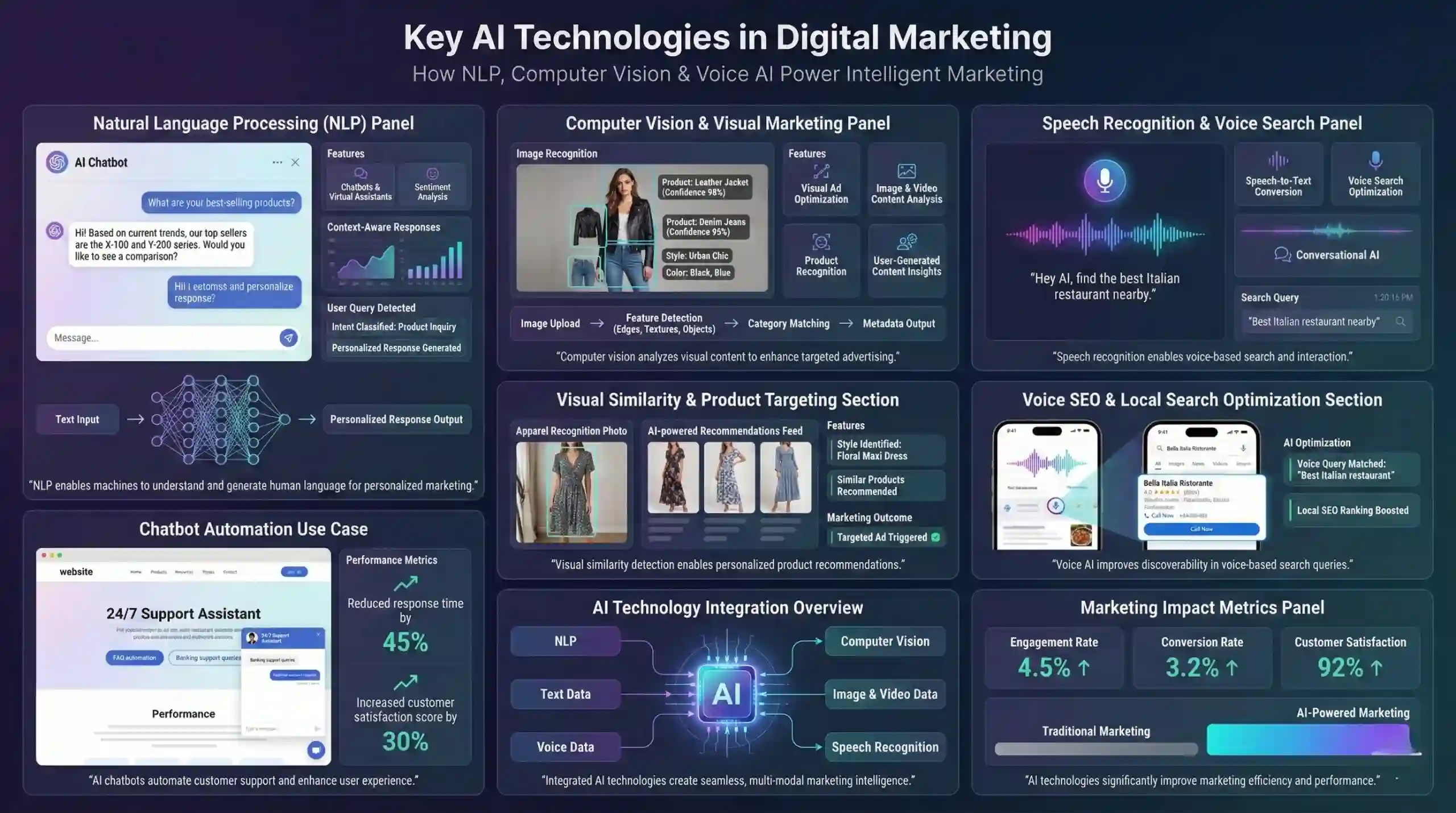
4. AI-Powered Marketing Tactics
Personalization Algorithms
AI integrates user data to tailor content, emails, and website experiences dynamically. Personalization algorithms analyze real-time user behavior to deliver relevant recommendations.
• Example: An e-commerce site suggests products based on browsing history and past purchases, increasing cross-selling opportunities.Predictive Analytics
Predictive models forecast future customer actions such as purchase likelihood or churn risk. Lead scoring prioritizes high-potential prospects, optimizing sales efforts.
Outcome: Businesses can proactively engage high-value customers with targeted offers, enhancing conversion rates.
Customer Segmentation
Clustering algorithms partition customers into distinct groups based on demographics, behaviors, or interests. Targeted advertising ensures marketing messages resonate with specific segments, improving ad relevance and return on ad spend (ROAS).
• Example: Segmenting customers by purchase frequency allows tailored loyalty offers, increasing retention.5. Content Optimization & Content Marketing
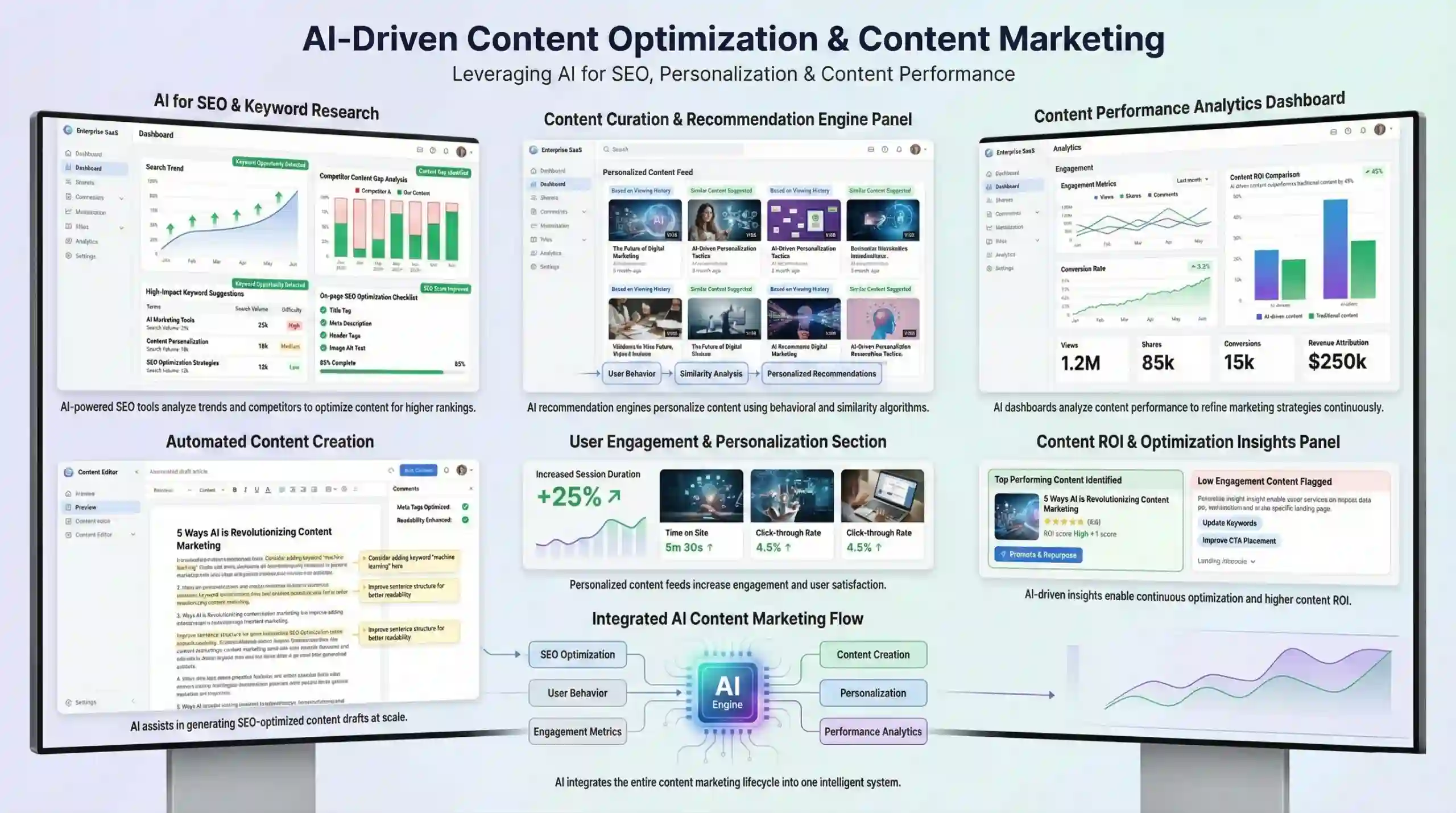
AI for SEO and Keyword Research
AI-powered SEO tools analyze search trends, competitors, and content gaps to recommend high-impact keywords and optimize on-page elements. Automated content creation tools generate draft articles, maintaining SEO best practices.
Outcome: Improved organic rankings and increased website traffic.
Content Curation and Recommendation Engines
AI leverages collaborative filtering and content similarity algorithms to personalize content feeds for users, increasing engagement and time spent on site.
• Example: Streaming platforms recommend shows based on viewing history, enhancing user satisfaction.Content Performance Analytics
AI dashboards analyze engagement metrics, conversions, and content ROI, enabling marketers to refine content strategies continuously.
6. AI in Advertising & Campaign Management
Programmatic Advertising
AI-driven programmatic platforms automate ad buying through real-time data analysis, ensuring optimal ad placements at the right time and audience.
• Outcome: Increased campaign efficiency and reduced wastage.Ad Placement and Bid Optimization
Using machine learning models, advertisers set dynamic bids based on user intent and contextual factors, maximizing ad effectiveness while controlling costs.
ROI Measurement with Attribution Modeling
AI-powered attribution models (multi-touch or data-driven) assign credit to various marketing touchpoints, providing accurate insights into channel effectiveness and guiding future investments.
7. AI Tools & Platforms for Digital Marketers
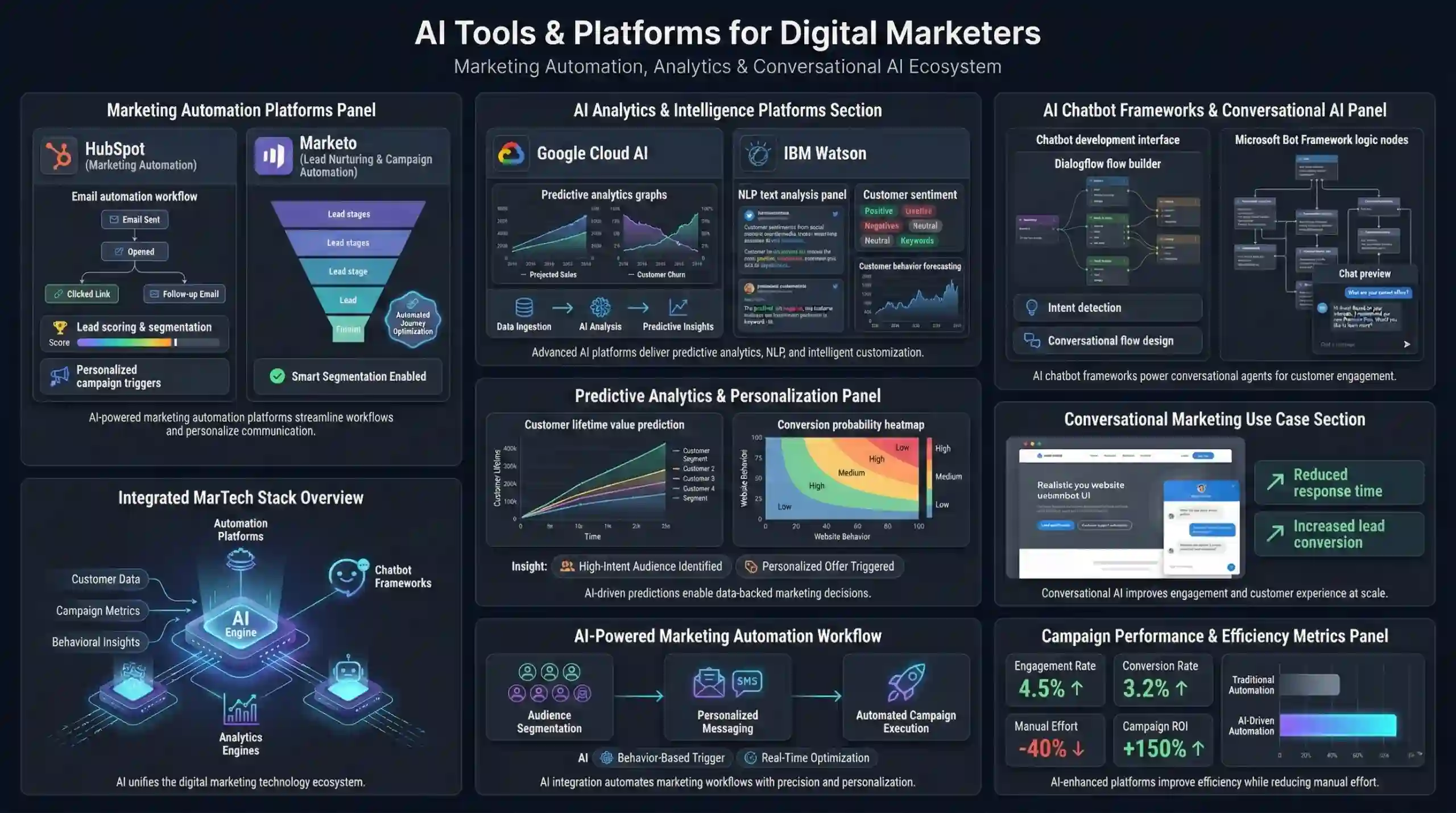
Leading Platforms Overview
- HubSpot & Marketo: All-in-one marketing automation with AI features.
- Google Cloud AI & IBM Watson: Advanced AI services for predictive analytics, NLP, and customization.
- AI Chatbot Frameworks: Dialogflow and Microsoft Bot Framework enable developers to create conversational agents.
Marketing Automation with AI
AI integration in automation tools streamlines workflows, personalizes communication, and improves segmentation efficiency, thereby reducing manual effort and enhancing campaign performance.
8. Ethical Considerations & Future Trends
AI Ethics in Digital Marketing
Responsible AI use involves bias detection, ensuring fairness, maintaining transparency, and safeguarding consumer privacy. Ethical standards foster trust and mitigate reputational risks.
Future Trends
Emerging trends include generative AI for content creation, personalized AI experiences tailored to individual preferences, and self-learning systems that adapt marketing strategies dynamically through continuous data feedback.
9. Practical Implementation & Projects
Hands-on Learning
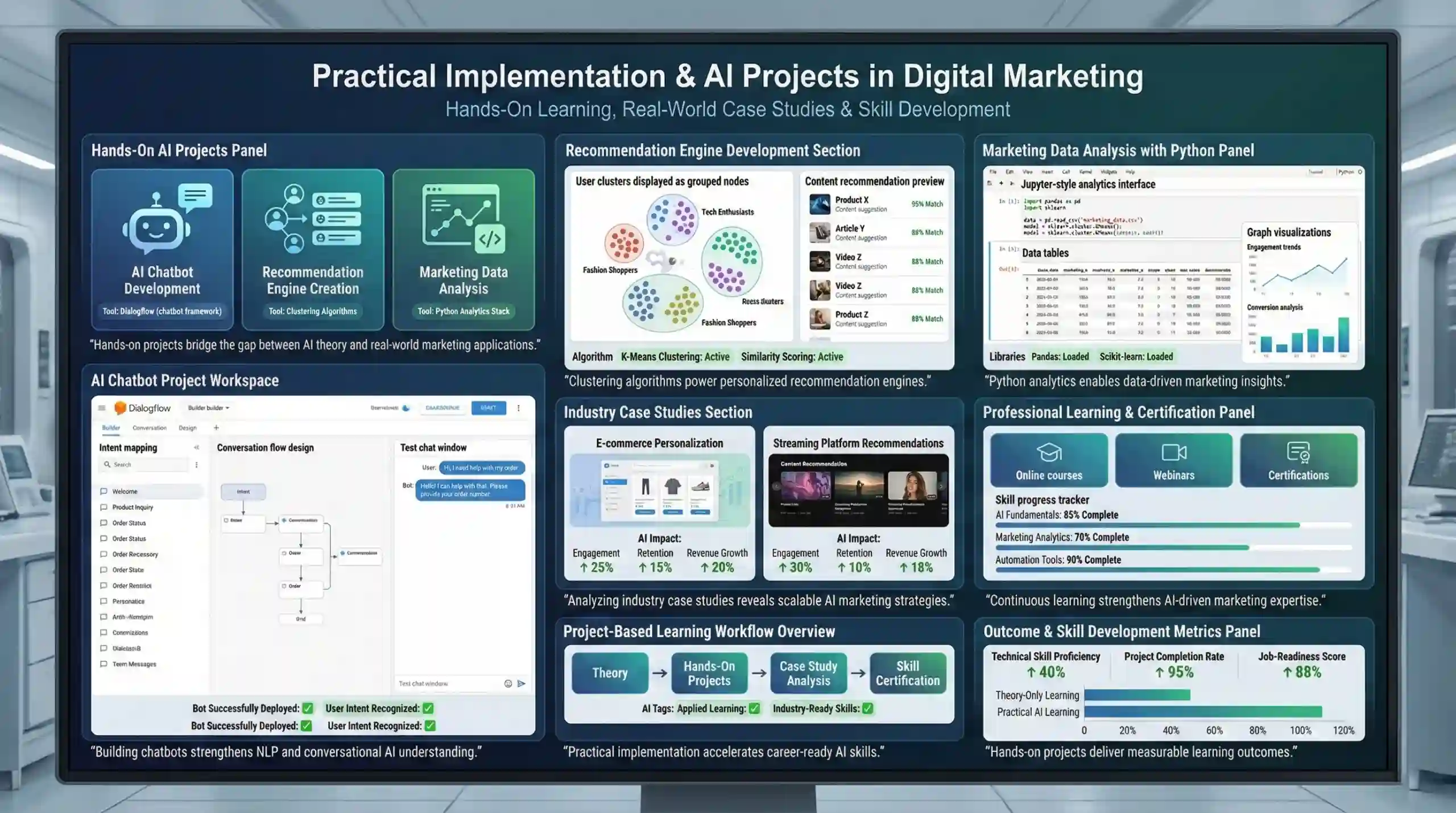
Implement projects such as building chatbots using frameworks like Dialogflow, creating recommendation engines with clustering algorithms, and analyzing marketing data with Python libraries including Pandas and Scikit-learn. These practical applications solidify theoretical concepts.
Industry Case Studies & Resources
Analyze successful AI marketing campaigns from companies like Amazon and Netflix to understand real-world applications. Engage in webinars and certification courses via platforms like Coursera, Udemy, and LinkedIn Learning for professional development.
Practice Questions
- What is the primary goal of using machine learning in digital marketing?
Answer: To forecast customer behavior, optimize campaigns, and improve ROI through predictive analytics. - Explain how NLP can enhance customer engagement in digital marketing.
Answer: NLP enables chatbots and content analysis that facilitate personalized and efficient communication with users, increasing satisfaction and conversions. - Describe the role of computer vision in visual content marketing.
Answer: It analyzes images and videos to identify objects, styles, or brand logos, enabling targeted advertising and user-generated content analysis. - What are the key legal frameworks impacting data collection in digital marketing?
Answer: GDPR and CCPA, which enforce data privacy, user consent, and transparency. - Write a simple Python code snippet to perform customer segmentation using KMeans clustering:
- What are the benefits of using AI-powered attribution modeling in marketing campaigns?
Answer: It provides accurate insights into the contribution of each channel or touchpoint, enabling better budget allocation and improved campaign effectiveness. - Name two NLP techniques used in content generation.
Answer: Transformer models (like GPT), and sequence-to-sequence models. - How does AI-driven personalization impact user experience?
Answer: It delivers relevant content and offers tailored to individual preferences, increasing engagement, loyalty, and conversion rates. - List three ethical considerations for implementing AI in digital marketing.
Answer: Bias detection, privacy protection, transparency, and fairness. - What future AI trend will most likely revolutionize content marketing?
Answer: Generative AI for creating realistic content at scale.
from sklearn.cluster import KMeans
import numpy as np

# Sample customer data: [annual_income, spending_score]
data = np.array([[60, 70], [50, 60], [80, 90], [30, 40], [90, 80]])

kmeans = KMeans(n_clusters=2)
kmeans.fit(data)

print("Cluster Centers:", kmeans.cluster_centers_)
print("Labels:", kmeans.labels_)
Expected Output:
Cluster Centers: [[58.33333333 63.33333333]
 [86.66666667 86.66666667]]
Labels: [1 0 1 0 1]
Study Resources
More Courses
- Social Media Marketing course with Gen AI
- Advance Digital Marketing & SEO course with Gen AI
- Advanced Certificate in Digital Design & Marketing course with Gen AI
- Meta & Google Ads course with Gen AI