Introduction to Search Engine Algorithms
Understanding Search Engine Optimization (SEO) Fundamentals
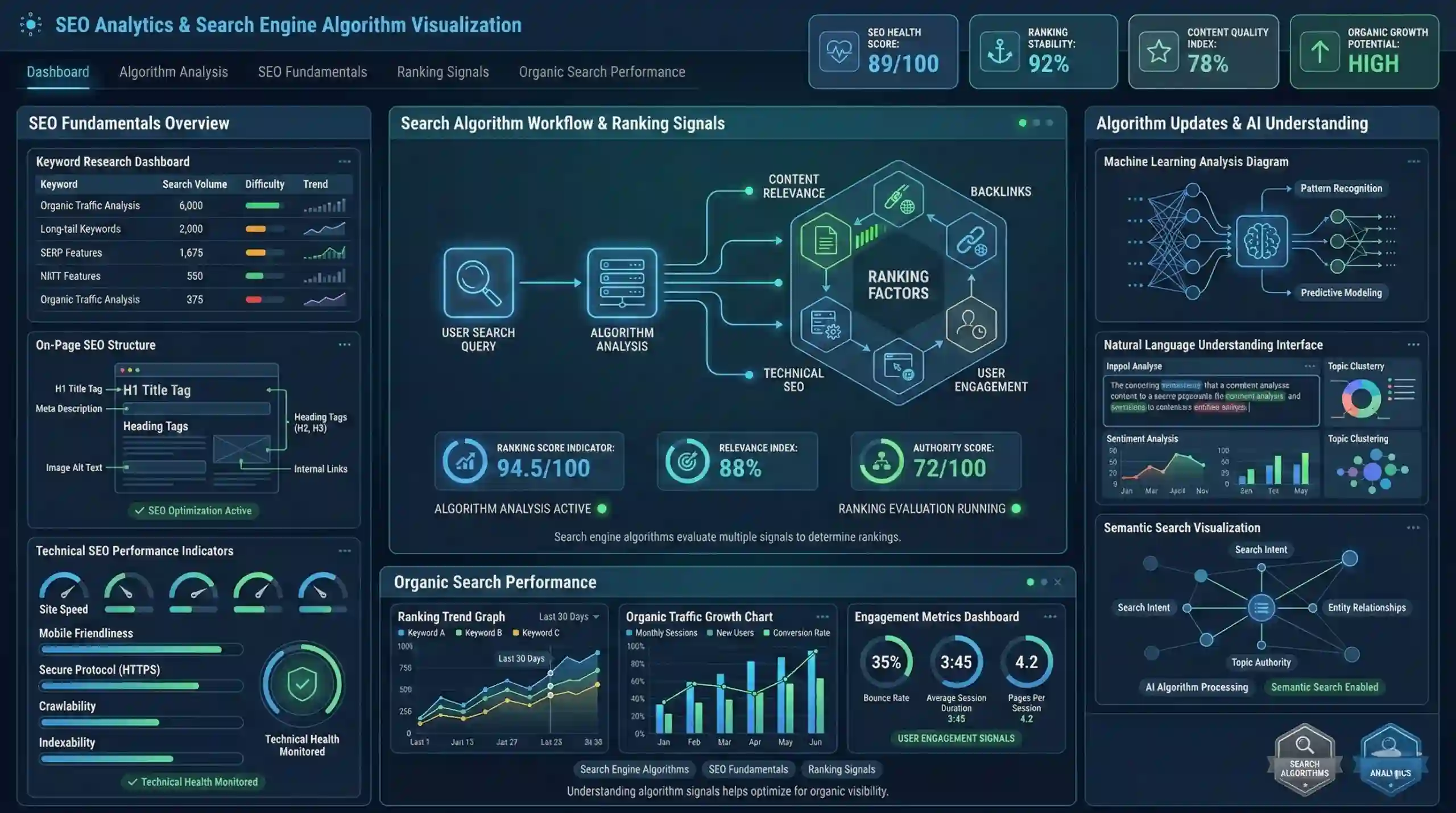
Search Engine Optimization (SEO) encompasses strategies aimed at improving a website’s visibility in organic search engine results. Core components include keyword research to identify relevant search terms, on-page SEO to optimize individual webpage content and structure, off-page SEO involving backlink building and domain authority enhancement, and technical SEO focusing on website architecture, speed, and crawlability. Effective SEO ensures that search engines understand and rank content appropriately, resulting in increased organic traffic.
Outcome: Improved organic visibility, higher rankings, and increased website traffic through effective SEO practices.
Example: Optimizing a blog post about “Best hiking boots” with targeted keywords, meta descriptions, and structured data improves its chances to rank higher when users search for related terms.
Role of Search Engine Algorithms in Organic Search Rankings
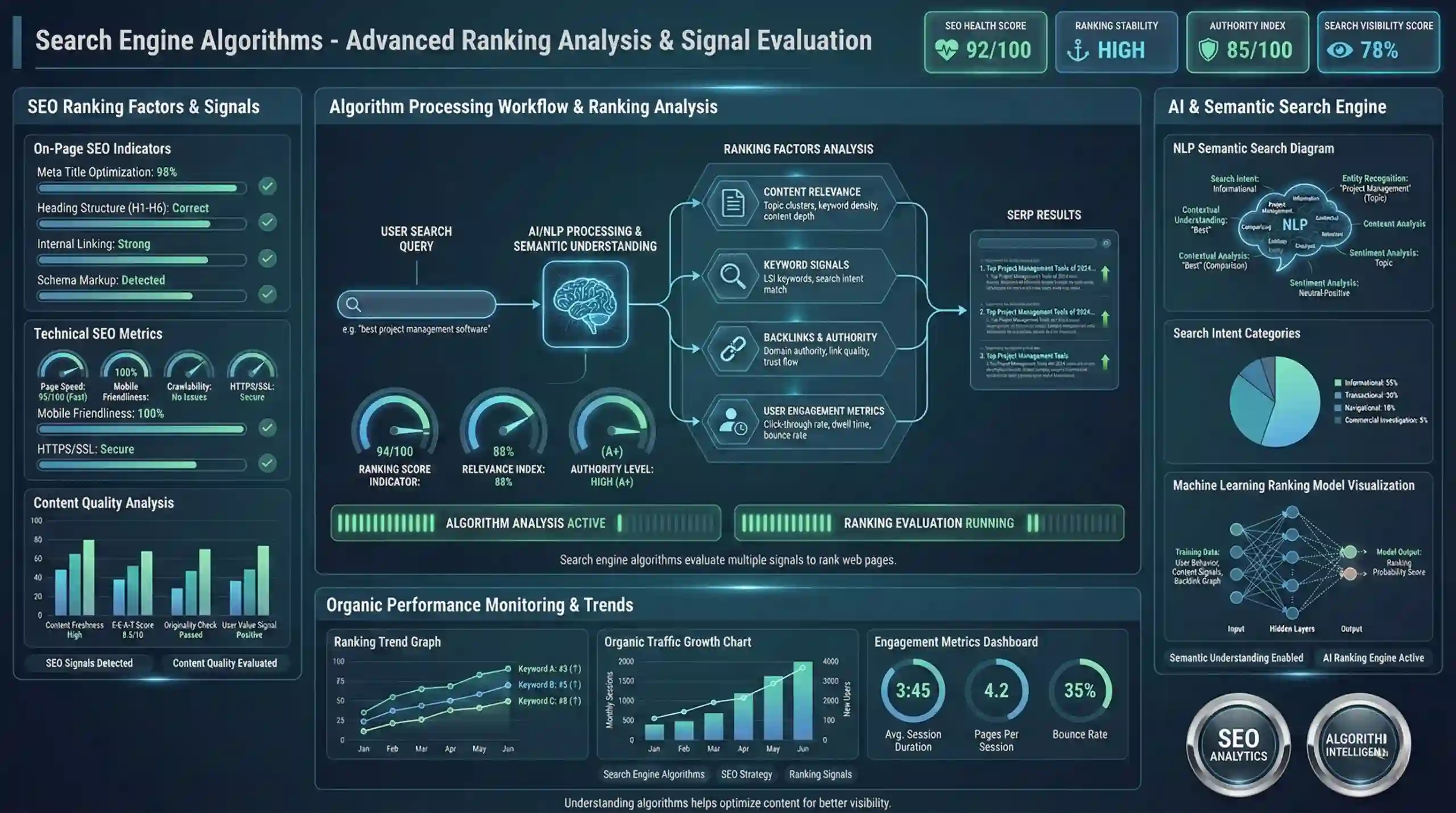
Search engine algorithms are complex computational systems used to evaluate and rank web pages based on relevance, authority, and user experience. They analyze various signals, including content relevance, backlinks, user engagement metrics, and technical factors, to filter and present the most pertinent results. These algorithms aim to deliver accurate, trustworthy, and user-friendly information.
Outcome: When a user searches for “healthy recipes,” algorithms prioritize pages with high-quality, relevant content, trustworthy backlinks, and good user engagement, offering an optimal search experience.
Overview of Popular Search Engine Algorithms (Google, Bing, Yahoo)
Major search engines employ different algorithms or update their existing ones periodically. Notable Google algorithms include:
- Google Panda: Focuses on content quality and duplicate content detection.
- Google Penguin: Detects manipulative backlink practices and spam.
- Google Hummingbird: Enhances understanding of natural language and semantic search.
- Google RankBrain: Incorporates machine learning to interpret complex queries.
- Google BERT: Deeply analyzes language context for improved comprehension.
Bing and Yahoo also implement similar algorithms to refine search results, emphasizing relevance and authority.
Basics of Search Engine Mechanics
Crawling: Web Crawler (Spider/BOT) Functions & Importance
Crawling is the process by which search engine bots systematically browse the web to discover and access web pages. These bots follow links from known pages to new content, fetching data for indexing. Efficient crawling ensures freshness of the search index and comprehensive coverage of the web.
Outcome: Proper crawling ensures new and updated pages are discovered promptly, maintaining the search engine’s relevance and comprehensiveness.
Example: Google’s crawler, Googlebot, might follow links from popular sites to discover new blog posts or updated pages, ensuring they are considered for ranking.
Indexing: Building the Search Index & Data Storage
Post-crawling, the retrieved web pages are analyzed and stored within a search index—a massive database optimized for quick retrieval. The index organizes data, capturing essential attributes like keywords, page structure, and contextual signals. Proper indexing is vital for rapid response times and accurate search results.
Outcome: When a user enters a query, the search engine scans its index rather than crawling the web, enhancing speed and efficiency.
Ranking Factors: How Search Engines Determine Search Results
Search engines evaluate numerous ranking signals. These include relevance of the content to the query, content quality, the number and quality of backlinks (link analysis), user engagement metrics (click-through rate, bounce rate), freshness of content, and technical factors like site speed and mobile usability.
Outcome: An authoritative, well-structured website with numerous high-quality backlinks will typically rank higher than a low-credibility site with thin content.
Core Components of Search Engine Algorithms
Query Processing & Semantic Search
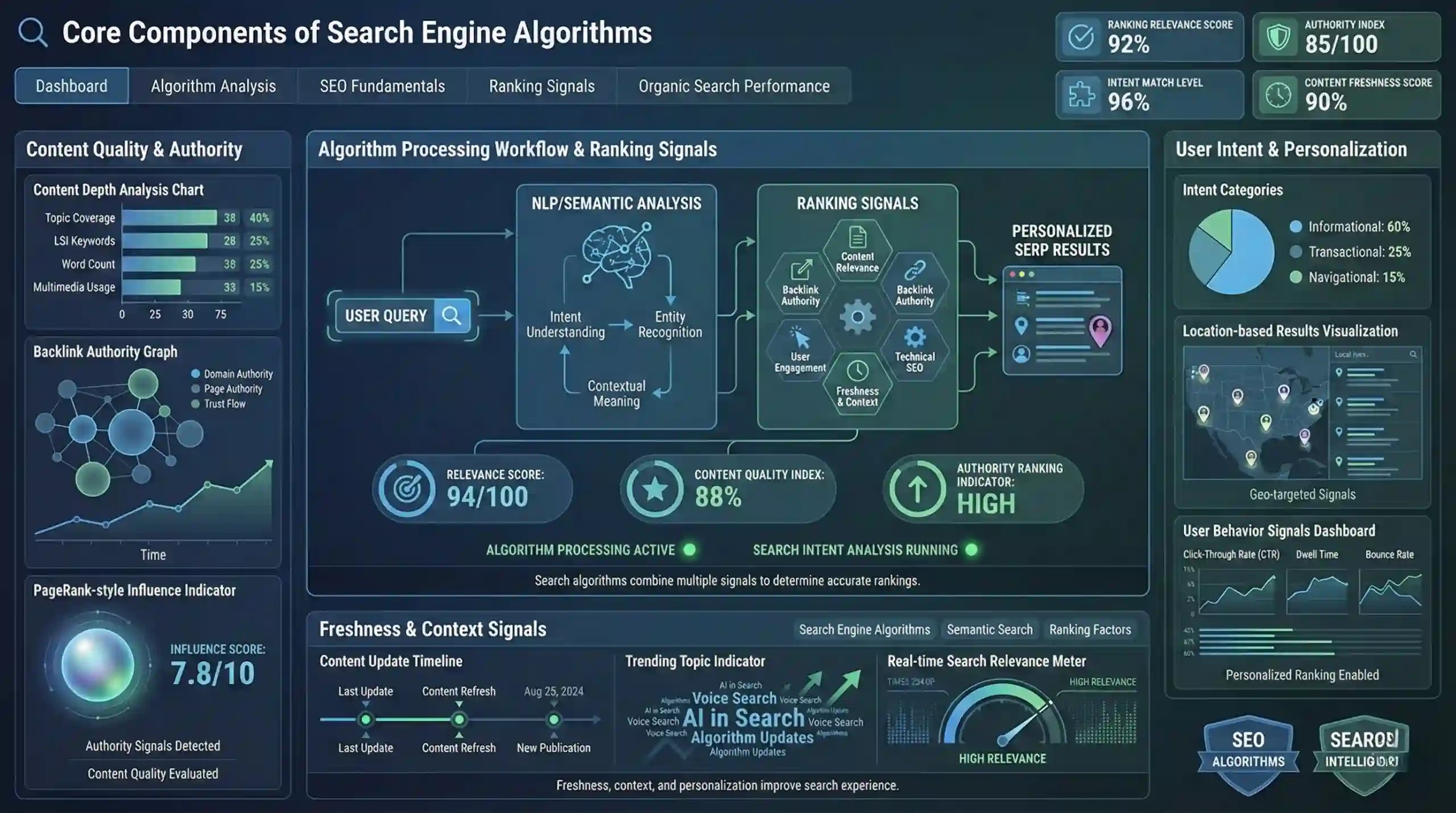
Query processing interprets user input, leveraging natural language processing (NLP) techniques to understand query intent and context. Semantic search aims to grasp the meaning behind words, enabling more accurate, conversational search results. This involves analyzing synonyms, user location, and previous interactions.
Outcome: Understanding user intent improves search relevance, leading to more satisfactory results.
Relevance & Content Quality Assessment
Algorithms evaluate whether page content aligns with the search intent, considering keyword relevance, content depth, accuracy, and readability. High-quality, comprehensive content that answers user questions effectively will be ranked higher.
Outcome: Search results favor in-depth and well-structured content over superficial articles.
User Intent & Search Context Analysis
Understanding the user’s purpose—whether informational, transactional, navigational, or local—is essential. Algorithms analyze user behavior signals, device type, location, and query history to personalize and prioritize search results.
Outcome: Personalized results improve user satisfaction and engagement.
Link Analysis & Authority Metrics (PageRank, Domain Authority)
Backlinks are a primary indicator of authority. Algorithms analyze the quantity, quality, and relevance of links pointing to a webpage. Metrics like Google’s PageRank quantify the influence of pages based on their backlink profile, affecting ranking.
Outcome: A webpage with numerous high-quality backlinks from reputable sites tends to rank higher.
Freshness & Update Signals
Timeliness can influence rankings, especially for trending or time-sensitive topics. Algorithms consider how recently content was published or updated.
Outcome: Recent content is prioritized for news, events, or trending topics.
Personalization & Location-Based Search
Search results are tailored based on user data, including geographic location, device type, browsing history, and preferences. Local SEO strategies optimize for such signals to attract local traffic.
Outcome: Local searches for “pizza delivery” show results relevant to the user’s location.
Key SEO Algorithms & Updates
Google Panda: Content Quality & Duplicate Content Check
Google Panda scans websites to penalize low-quality, thin, or duplicate content, promoting original, valuable information. Sites with duplicate or spammy content experience ranking drops.
Outcome: Emphasizes producing high-quality, original content to maintain or improve rankings.
Google Penguin: Backlink Quality & Spam Detection
Penguin targets manipulative link schemes like unnatural backlink profiles, penalizing sites practicing black-hat SEO tactics. It emphasizes the importance of natural link-building.
Outcome: Ethical backlink practices improve long-term ranking sustainability.
Hummingbird: Semantic Search & Conversational Queries
Hummingbird enhances natural language understanding, enabling the engine to interpret longer, conversational, or voice search queries with greater accuracy.
Outcome: Better comprehension of user intent in natural language queries.
RankBrain: Machine Learning in Search Ranking
RankBrain employs AI to interpret ambiguous or complex queries by analyzing patterns and user behavior, adjusting rankings accordingly.
Outcome: Improved relevance for complex or rare queries through machine learning insights.
BERT: Natural Language Processing (NLP) & Context Understanding
BERT models language nuances, pre-training on large text corpora to grasp context and relationships between words, refining understanding of complex, natural language queries.
Outcome: Enhanced understanding of nuances in search queries for greater accuracy.
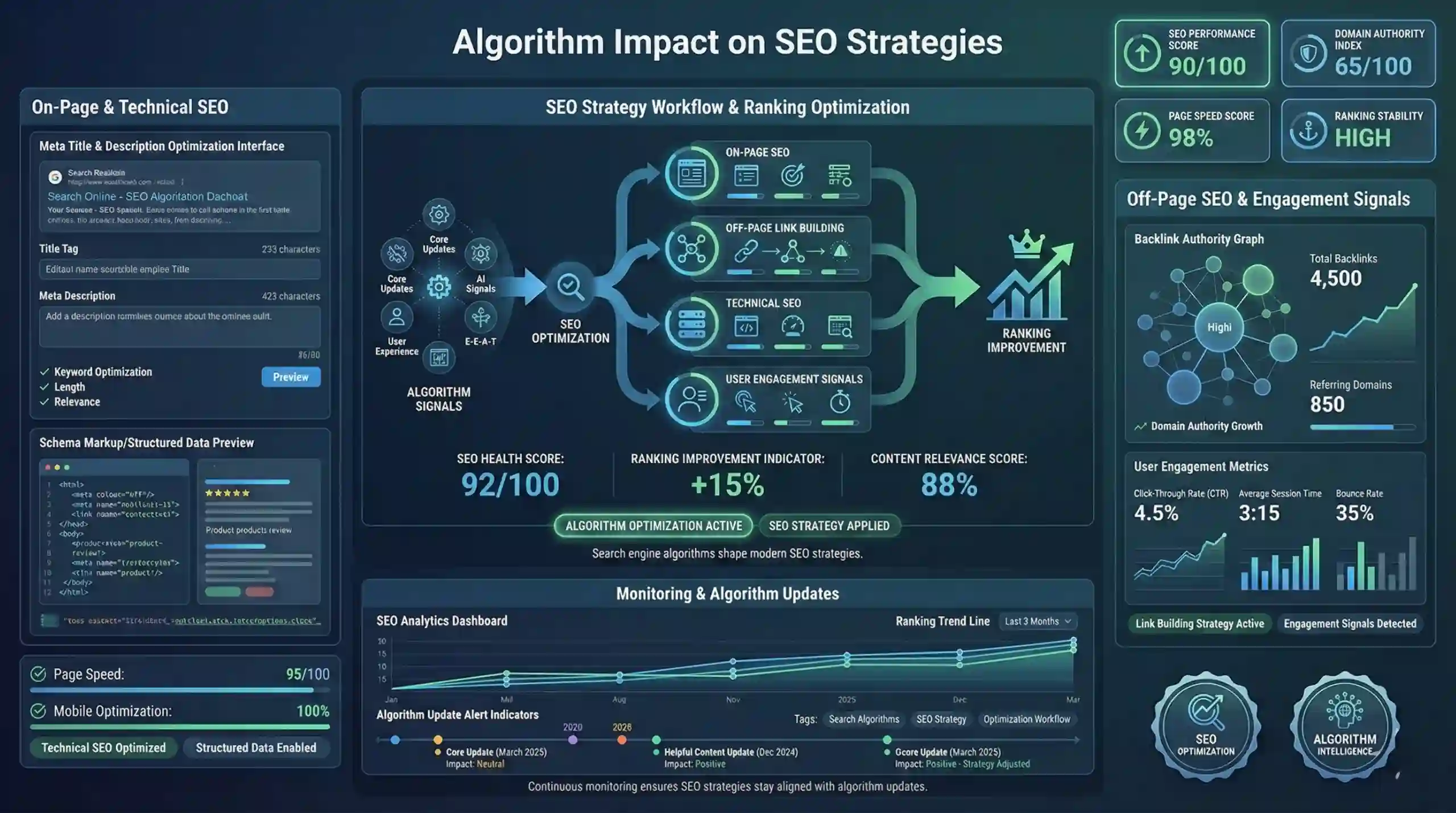
Algorithm Impact on SEO Strategies
On-Page SEO Techniques
Optimize page titles, meta descriptions, and headers with relevant keywords for search engine visibility. Implement schema markup to enhance rich snippets and ensure structured data aligns with the algorithmic focus on content clarity.
<head>
<title>Best SEO Strategies for Beginners</title>
<meta name="description" content="Learn fundamental SEO techniques including keyword optimization, schema markup, and improving search rankings.">
<script type="application/ld+json">
{
  "@context": "https://schema.org",
  "@type": "Article",
  "headline": "Best SEO Strategies for Beginners",
  "description": "Learn fundamental SEO techniques including keyword optimization, schema markup, and improving search rankings."
}
</script>
</head>
Off-Page SEO & Link Building Strategies
Building backlinks from authoritative websites enhances domain authority, positively influencing search rankings. Ethical and natural link-building through guest posting, partnerships, and content promotion is emphasized due to algorithms like Penguin penalizing manipulative tactics.
Technical SEO
Improving website speed, optimizing for mobile responsiveness, and ensuring clean crawlable code enable search engine algorithms to efficiently index and rank content.
Content Marketing & User Engagement Signals
Valuable content that encourages user interaction, sharing, and longer page visits signals authority and relevance, aligning with the ranking factors emphasized by Search Engine algorithms.
Monitoring & Updating SEO Practices
Using SEO Tools
Tools such as Google Analytics, Search Console, SEMrush, and Ahrefs provide insights into site health, performance metrics, keyword rankings, and indexing issues, vital for maintaining SEO effectiveness.
Analyzing Search Algorithm Changes & Penalties
Monitoring changes in organic traffic and rankings aids in detecting algorithm updates or penalties, guiding necessary adjustments.
Staying Updated with Search Engine Algorithm News & Best Practices
Regularly following SEO blogs (Moz, SEMrush, Ahrefs) and official sources like Google Search Central ensures awareness of latest updates and best practices.
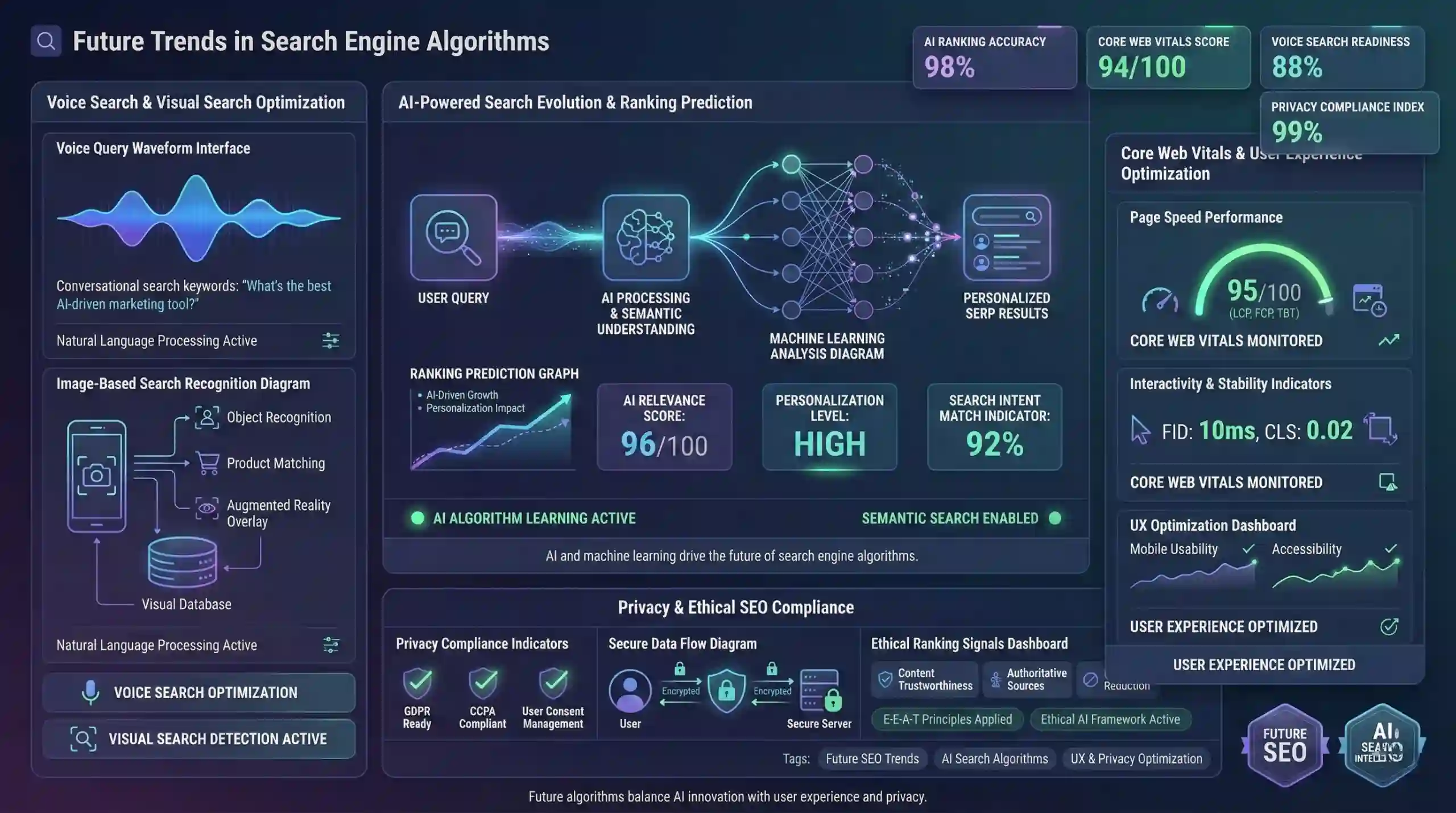
Future Trends in Search Engine Algorithms
AI & Machine Learning Advancements in Search
Increased integration of AI enhances search personalization, relevance, and understanding. Continuous evolution of RankBrain and BERT indicates ongoing sophistication.
Voice Search & Visual Search Optimization
With rising voice-activated devices and visual search technologies, optimizing content for voice queries and images is increasingly essential.
Incorporating User Experience & Core Web Vitals
Search engines prioritize user metrics like load speed, interactivity, and visual stability (Core Web Vitals), impacting rankings significantly.
Emphasis on Privacy & Ethical Search Practices
Growing privacy concerns demand transparent, ethical SEO practices respecting user data and adhering to laws like GDPR.
Resources & Learning Platforms
Practice Questions
- Explain the purpose of a web crawler and how it impacts search engine rankings.
- Describe how PageRank influences the authority of a webpage.
- What is the significance of content quality in the context of Google’s Panda algorithm?
- How does RankBrain enhance search result relevance?
- Write a simple schema markup for a blog post titled “Introduction to SEO.”
- Why is backlink quality more important than quantity?
- How do Google Hummingbird and BERT differ in understanding search queries?
- List three technical SEO factors that can improve a website’s trustworthiness.
- What are Core Web Vitals, and why are they significant for SEO?
- Provide a scenario where a core algorithm update might negatively impact a website’s ranking.
Sample Output:
Question 4: How does RankBrain enhance search result relevance?
Answer: RankBrain uses machine learning to interpret complex and ambiguous search queries by analyzing patterns, user behavior, and contextual signals. It helps the search engine understand user intent better, thereby delivering more relevant and accurate results, especially for queries with little prior data or novel phrasing.
Conclusion
Understanding how search engine algorithms operate is fundamental for effective SEO. It involves grasping both the technical aspects of crawling, indexing, and ranking, and the strategic components such as content quality, backlink building, and user experience. Staying informed about updates like Panda, Penguin, BERT, and RankBrain allows practitioners to adapt tactics proactively, ensuring sustained online visibility.
Additional Resources
By systematically studying these aspects, beginners can develop a solid foundation in search engine algorithms and optimize their websites for long-term success.