
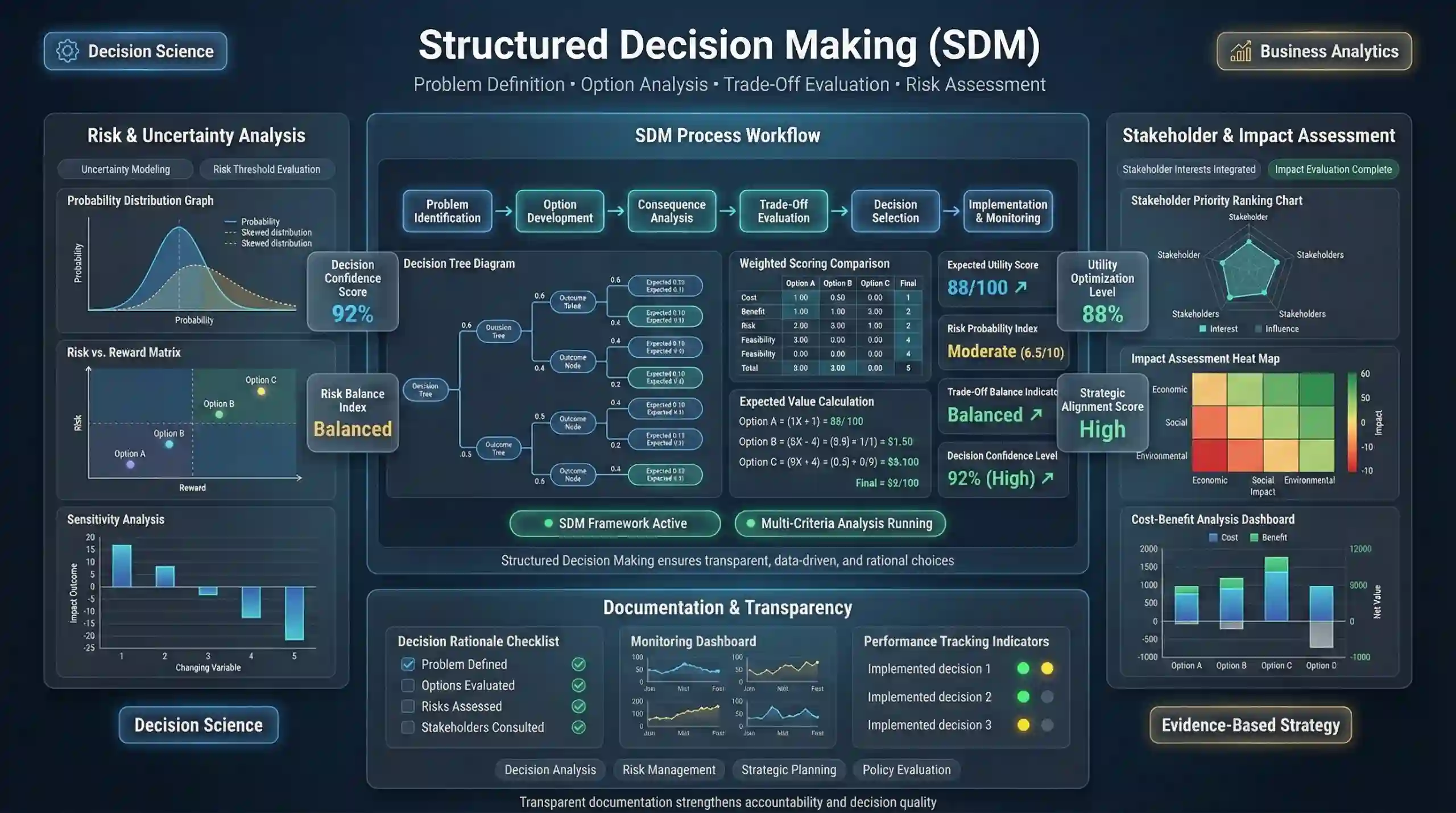
Introduction to Structured Decision Making (SDM)
Definition and Concept of SDM
Structured Decision Making (SDM) is a systematic, analytical approach to decision-making that emphasizes rationality, transparency, and consistency. Unlike ad-hoc or intuition-based decisions, SDM involves developing a clear understanding of the problem, generating alternatives, evaluating options based on multiple criteria, and choosing the most rational course of action. This method ensures decisions are justifiable, repeatable, and align with organizational or societal goals.
Core Components of SDM
The SDM process comprises key stages:
- Problem Definition: Clearly articulate the decision problem, context, and scope.
- Objective Setting: Establish what the decision aims to achieve, aligning with organizational or stakeholder goals.
- Development of Alternatives: Generate multiple feasible options through creative techniques.
- Evaluation & Analysis: Use analytical tools such as decision matrices, MCDA, or risk assessment to compare alternatives objectively.
- Implementation & Monitoring: Execute the chosen decision and establish mechanisms to monitor outcomes and adapt as necessary.
Importance of SDM in Various Fields
SDM’s structured approach enhances decision quality across diverse domains:
- Business Strategy: Facilitates data-driven decisions for product launches or mergers.
- Public Policy: Supports transparent policy formation for healthcare reforms or environmental regulations.
- Healthcare: Ensures evidence-based patient care and resource allocation.
- Project Management: Optimizes planning, scheduling, and risk management.
Foundations of Decision Theory
Fundamentals of Decision Analysis
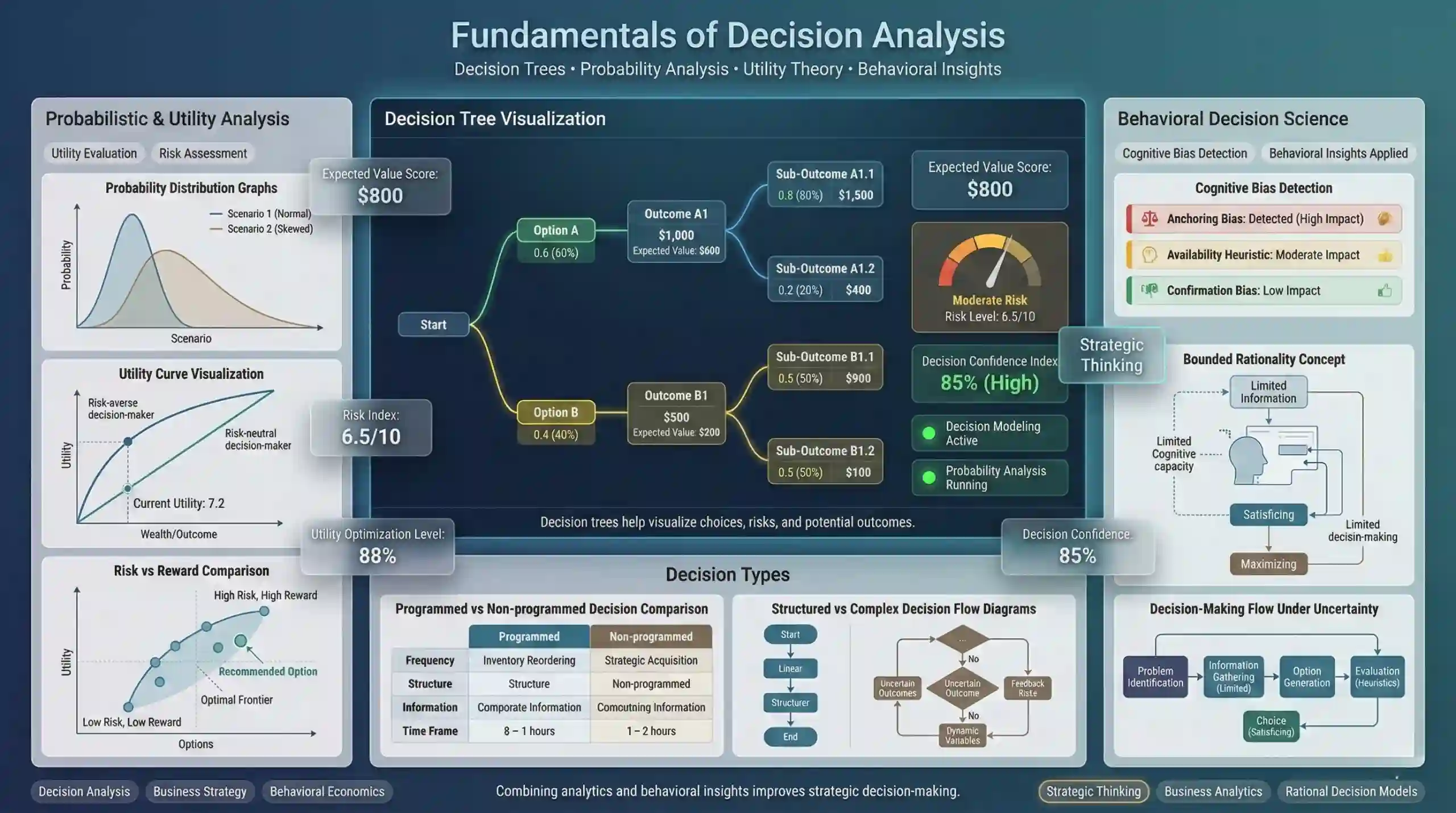
Decision analysis offers tools to evaluate choices under certainty and uncertainty. Key concepts include:
- Decision Trees: Visual branching diagrams representing options and outcomes.
- Probabilistic Assessment: Assigning likelihoods to uncertain events.
- Utility Theory: Quantifying preferences to evaluate trade-offs.
For example, when choosing an investment, decision trees can help visualize the possible returns and associated probabilities, aiding rational choice.
Decision Trees Example:
[Start]
   |
   |--> Invest in Asset A (Probability: 0.6, Return: $1000)
   |--> Invest in Asset B (Probability: 0.4, Return: $500)
Decision Types in Business and Public Sector
- Programmed Decisions: Routine, structured, such as restocking supplies.
- Non-Programmed Decisions: Complex, unique, such as entering a new market requiring detailed analysis.
Behavioral Decision Science
Insights from behavioral science highlight cognitive limitations:
- Bounded Rationality: Decision-makers often satisfice rather than optimize due to limited cognitive resources.
- Heuristics: Mental shortcuts like availability or anchoring bias influence quick judgments, sometimes leading to suboptimal decisions.
Stages of Structured Decision Making Process
1. Problem Identification & Clarification
Begin by explicitly defining the decision problem using SMART criteria—Specific, Measurable, Achievable, Relevant, Time-bound. Example: Deciding whether to launch a new product within six months based on market research and resource availability.
Practice question:
Why is precise problem definition critical in SDM?
Answer: It ensures clarity, aligns objectives, and provides focus, reducing ambiguity and avoiding misdirected efforts.
2. Option Development
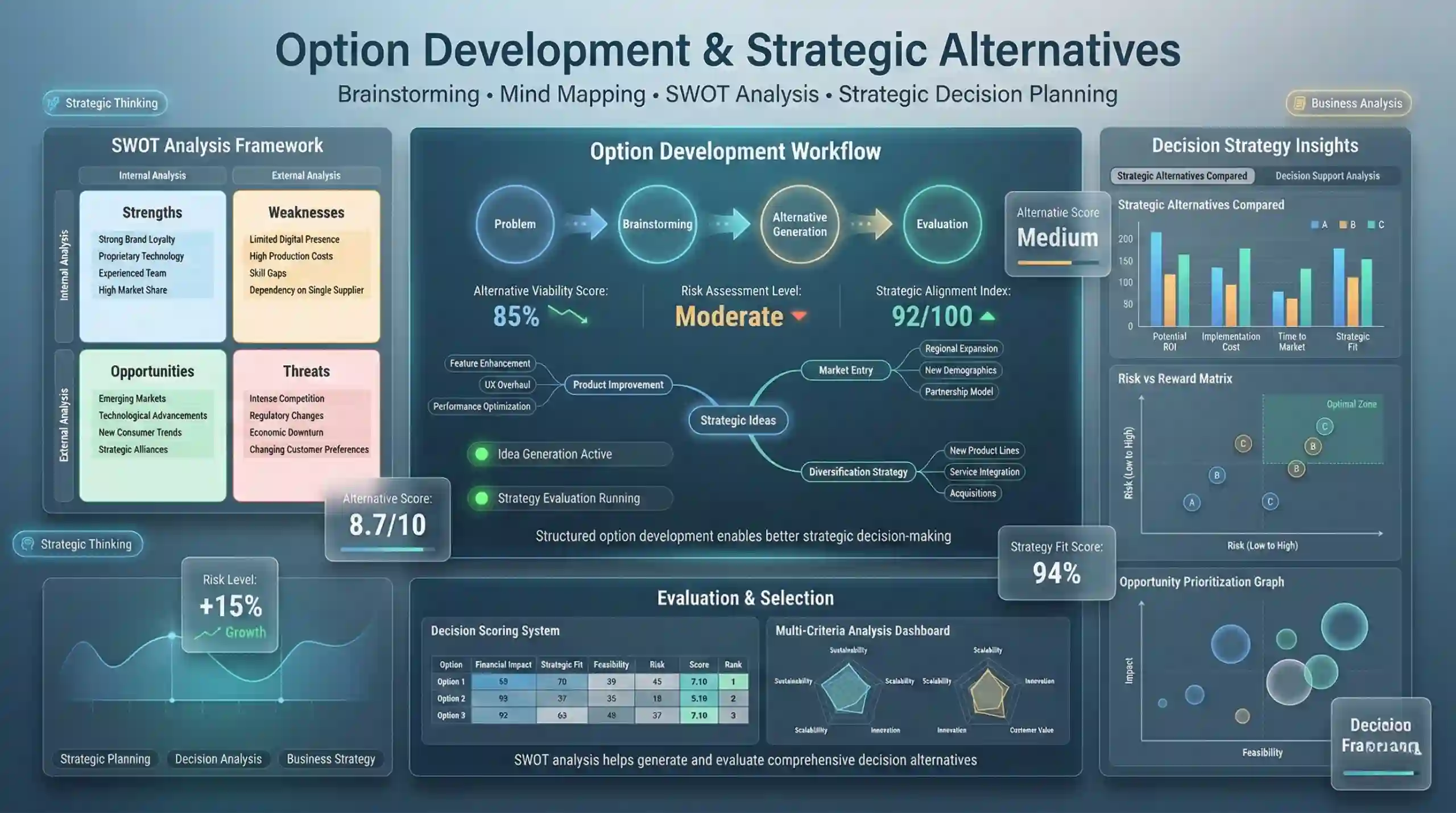
Generate multiple alternatives via brainstorming, mind mapping, or SWOT analysis—evaluating internal strengths & weaknesses and external opportunities & threats. For instance, a company might consider product improvement, diversification, or market entry as options.
Practice question:
How does SWOT analysis aid in developing alternatives?
Answer: It identifies internal and external factors influencing decision options, leading to comprehensive and informed alternatives.
3. Option Evaluation & Analysis
Use tools like Multi-Criteria Decision Analysis (MCDA) to prioritize options:
- Analytic Hierarchy Process (AHP): Breaks down decision criteria into a hierarchy, facilitating pairwise comparisons.
- TOPSIS: Ranks options based on their distance from an ideal solution.
Incorporate uncertainty evaluation:
- Probabilities: assess likelihoods.
- Monte Carlo simulations: model uncertainty impacts.
- Sensitivity analysis: test how changes in inputs affect outcomes.
Example: Choosing the best supplier based on cost, quality, and delivery time using AHP assigns weights to each criterion, then computes overall scores.
Practice question:
What is the role of sensitivity analysis in SDM?
Answer: It assesses how variations in data or assumptions influence decision outcomes, ensuring robustness.
4. Decision Selection
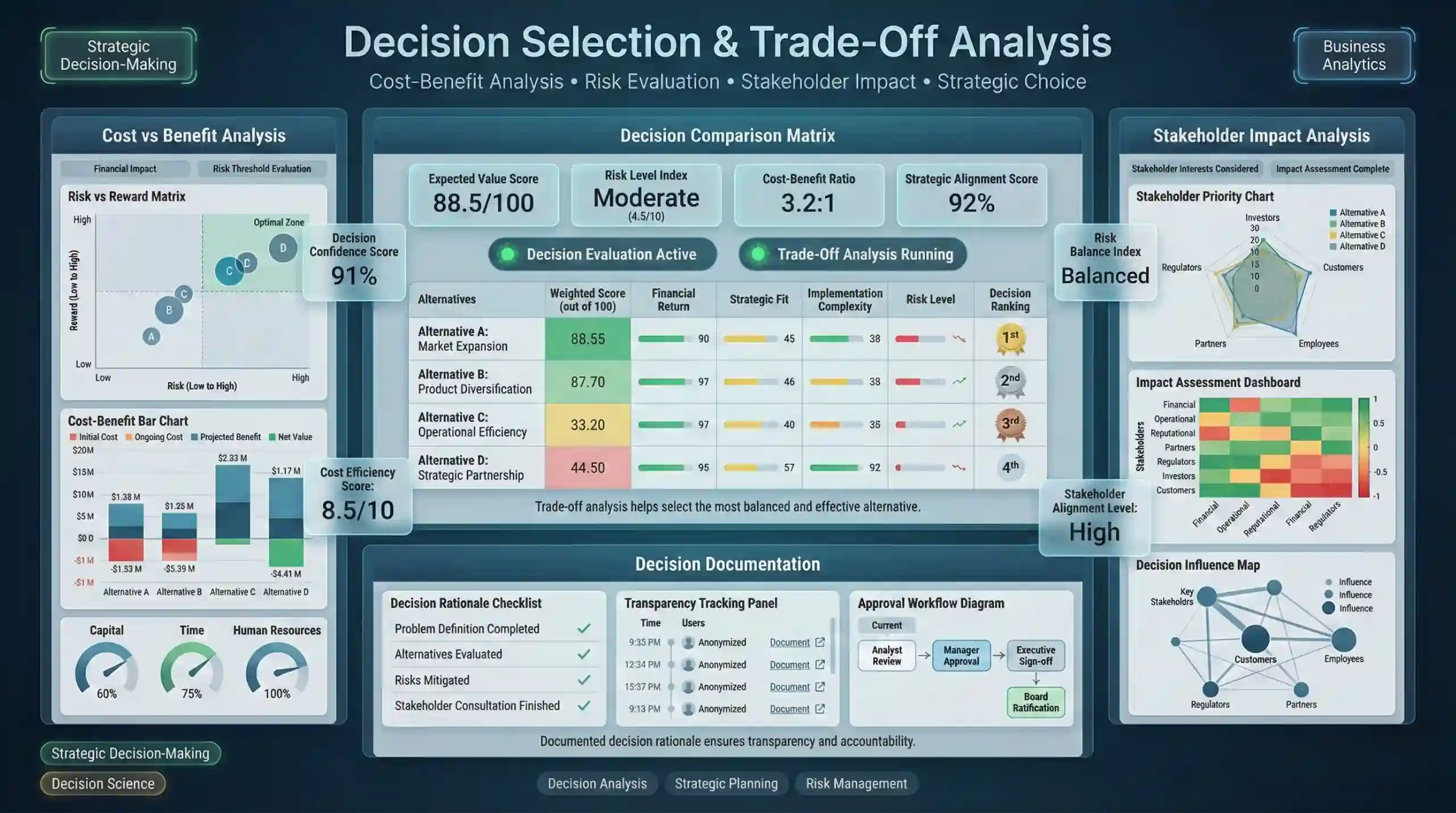
Select the preferred alternative based on analysis, considering trade-offs such as cost-benefit, stakeholder interests, and risk thresholds. Clear documentation of rationale enhances transparency.
Practice question:
Why are trade-offs important in the decision-making process?
Answer: They help balance conflicting criteria to make well-rounded, realistic decisions aligned with priorities.
5. Implementation & Monitoring
Create detailed action plans for execution. Establish Key Performance Indicators (KPIs) to monitor outcomes and facilitate adaptive management, revising decisions as new data emerge.
Practice question:
How does continuous monitoring improve SDM outcomes?
Answer: It provides feedback on decision effectiveness, allowing timely adjustments to optimize results.
Tools and Techniques in SDM
- Decision Trees & Flowcharts: Map decision pathways and visualize possible outcomes.
- SWOT Analysis: Evaluate internal strengths/weaknesses and external opportunities/threats.
- Cost-Benefit Analysis (CBA): Quantify financial and social impacts to inform economically sound choices.
- Sensitivity Analysis: Test decision robustness under uncertainty.
- Decision Support Systems (DSS): Software solutions aid in complex analysis.
- Expert System Software: AI-based tools simulate expert-level decision processes.
Best Practices & Guidelines for Effective SDM
- Stakeholder Engagement: Involve diverse stakeholders early for comprehensive perspectives.
- Transparency & Documentation: Record all steps, assumptions, and rationales for accountability.
- Decision Logs & Rationale Tracking: Maintain logs to facilitate future review and learning.
- Iterative Decision-Making: Regularly revisit decisions, updates, and new data to refine outcomes.
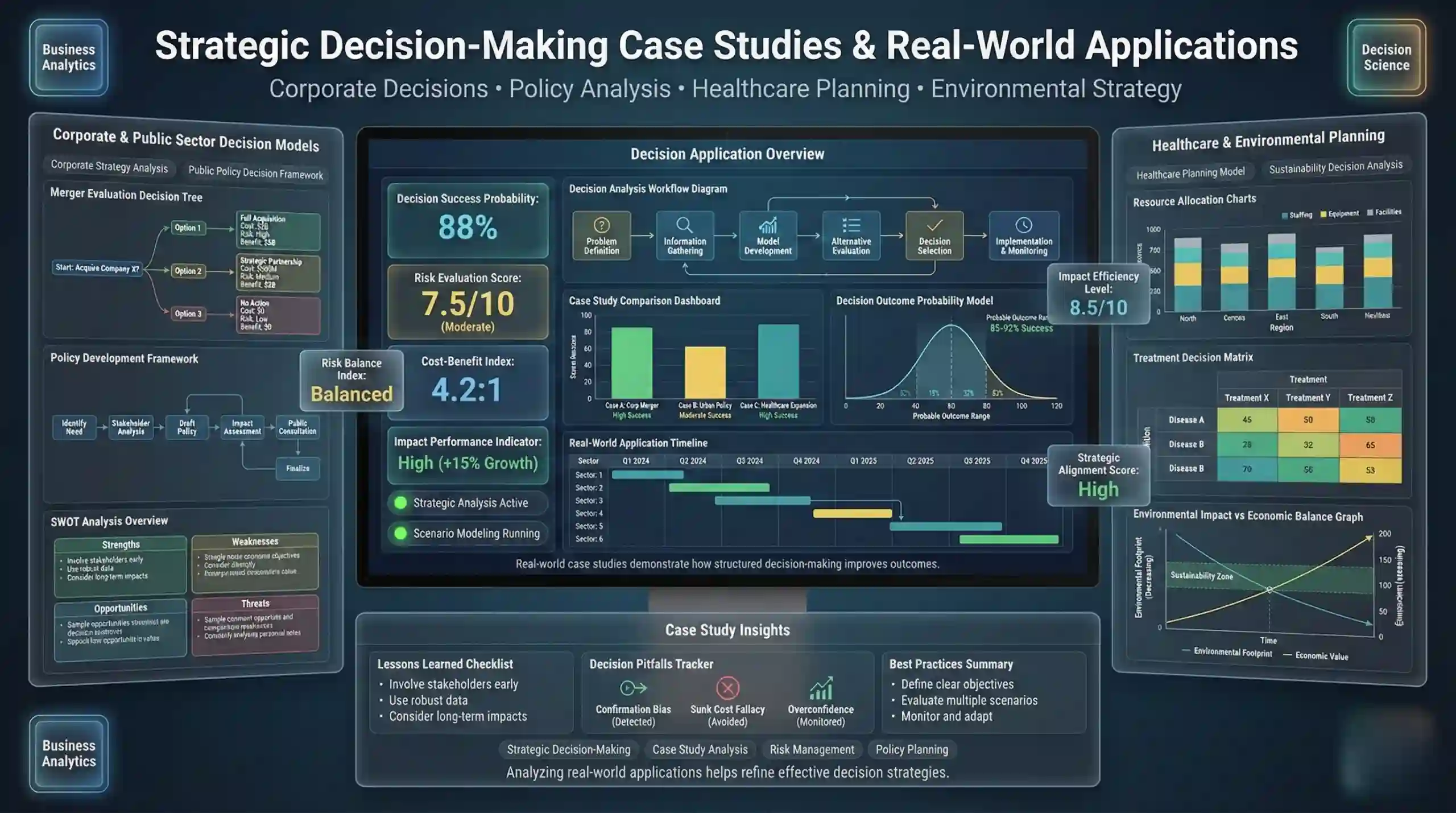
Case Studies & Real-World Applications
– Corporate Decision-Making: Such as evaluating merger opportunities using SDM tools.
– Public Sector Policies: Developing transparent healthcare or environmental policies.
– Healthcare Planning: Resource allocation decisions, patient treatment plans.
– Environmental Management: Decision-making in conservation projects balancing ecological and economic factors.
Analyzing successful case studies demonstrates practical application, guiding novices on effective SDM techniques and common pitfalls to avoid.
Learning Resources for SDM
- Coursera: Decision-Making and Scenarios
- Udemy: Practical SDM tutorials
- edX: Decision Analysis and Management Science
- Authoritative Books & Journals:
- Decision Analysis for Managers by Paul Goodman
- Journals: Decision Support Systems, Management Science
- Interactive Simulations:
- Practice with decision-making simulators on platforms like Harvard Business Review or SimVenture.
- Online Forums & Communities:
- LinkedIn decision analysis groups
- Reddit decision-making communities
Advanced Topics & Continuing Education
- Machine Learning & AI Integration: Leveraging predictive analytics enhances SDM by providing data-driven insights.
- Fuzzy Logic & Intelligent Decision Systems: Handle vagueness and ambiguity in data, enabling more flexible decision frameworks.
- Latest Research & Industry Reports: Stay informed through industry white papers, academic articles, and conference proceedings focusing on the latest developments in SDM.
Final Thoughts:
Mastering the structured decision-making roadmap is essential for developing rational, transparent, and effective choices across various sectors. Continuous practice, engagement with decision support tools, and active learning through case studies are instrumental in building expertise.
Study Resources for Beginners in SDM
These resources provide foundational and advanced insights suitable for beginners seeking to deepen their understanding of structured decision-making.
More Courses
- Social Media Marketing course with Gen AI
- Advance Digital Marketing & SEO course with Gen AI
- Advanced Certificate in Digital Design & Marketing course with Gen AI
- Meta & Google Ads course with Gen AI