1. Understanding Google Ads Quality Score
Definition & Importance of Google Ads Quality Score
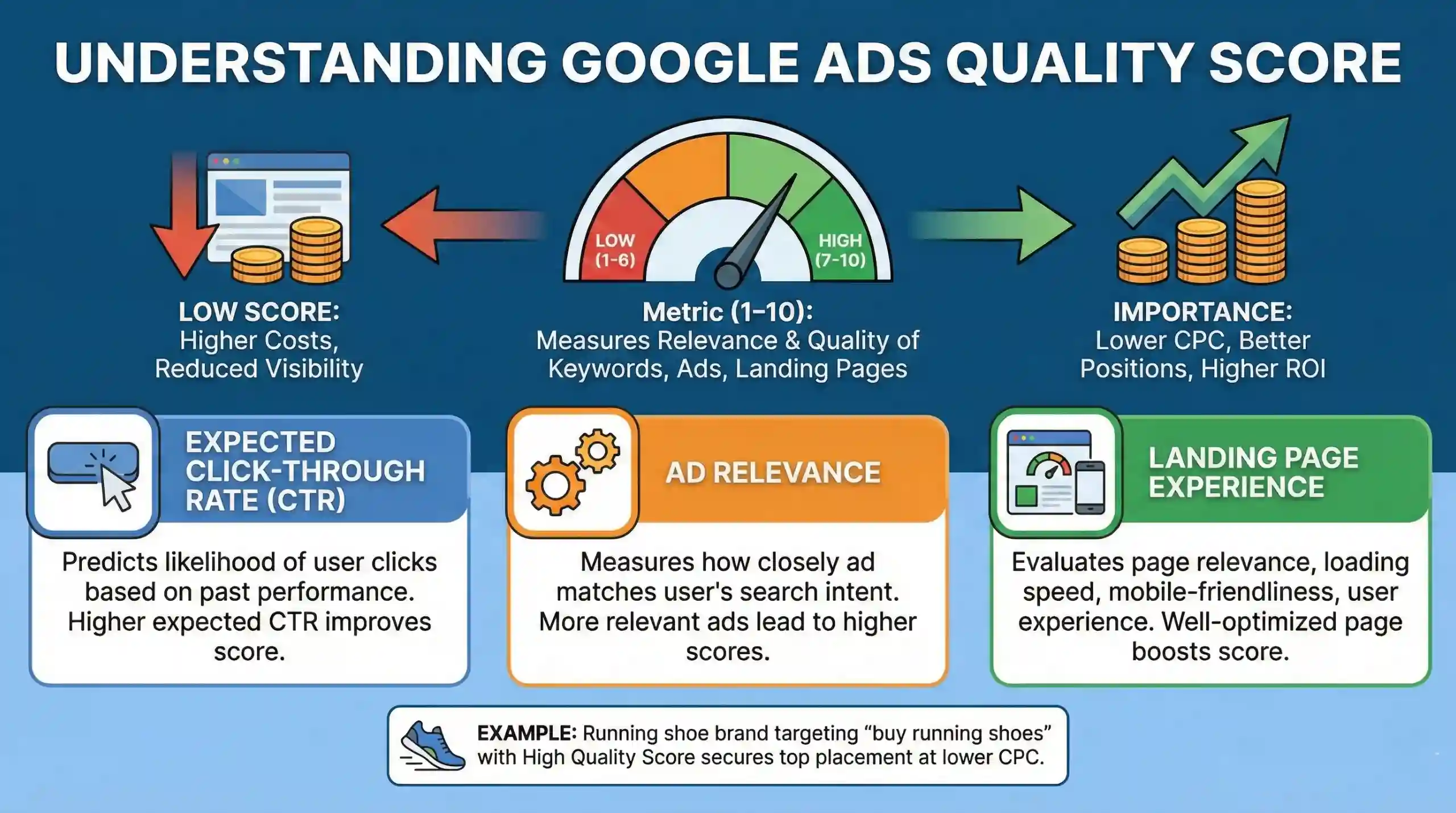
Google Ads Quality Score is a foundational metric in pay-per-click (PPC) advertising that quantifies the relevance and quality of your ads, keywords, and landing pages. It ranges from 1 to 10, with 10 representing optimal relevance and user experience. The primary significance of Quality Score is its influence on ad position and cost efficiency. Higher scores typically result in lower CPCs and better ad placements, enabling advertisers to maximize ROI. A low Quality Score, conversely, can lead to higher costs and poorer ad visibility, regardless of bid amount.
Practical Example:
A business promoting running shoes targets the keyword “buy running shoes”. If their ad appears in a prominent position with a low CPC due to a high Quality Score, they achieve better visibility at a lower cost, enhancing overall campaign effectiveness.
Components of Google Ads Quality Score
Expected Click-Through Rate (CTR):
This is an estimate based on historical data predicting the likelihood that your ad will be clicked when it appears for a given keyword. A high expected CTR signals relevance to users and directly boosts Quality Score.
Ad Relevance:
It measures how closely your ad copy matches the user’s search query. For instance, an ad for “women’s running shoes” that appears for “women’s sneakers” is considered highly relevant, increasing the chance of higher Quality Score.
Landing Page Experience:
This involves the relevance, transparency, and usability of the landing page. A fast-loading, mobile-optimized landing page with relevant content creates a positive experience, improving Quality Score and conversion rates.
2. Keyword Optimization for Google Ads Quality Score Enhancement
Keyword Research & Segmentation for PPC Campaigns
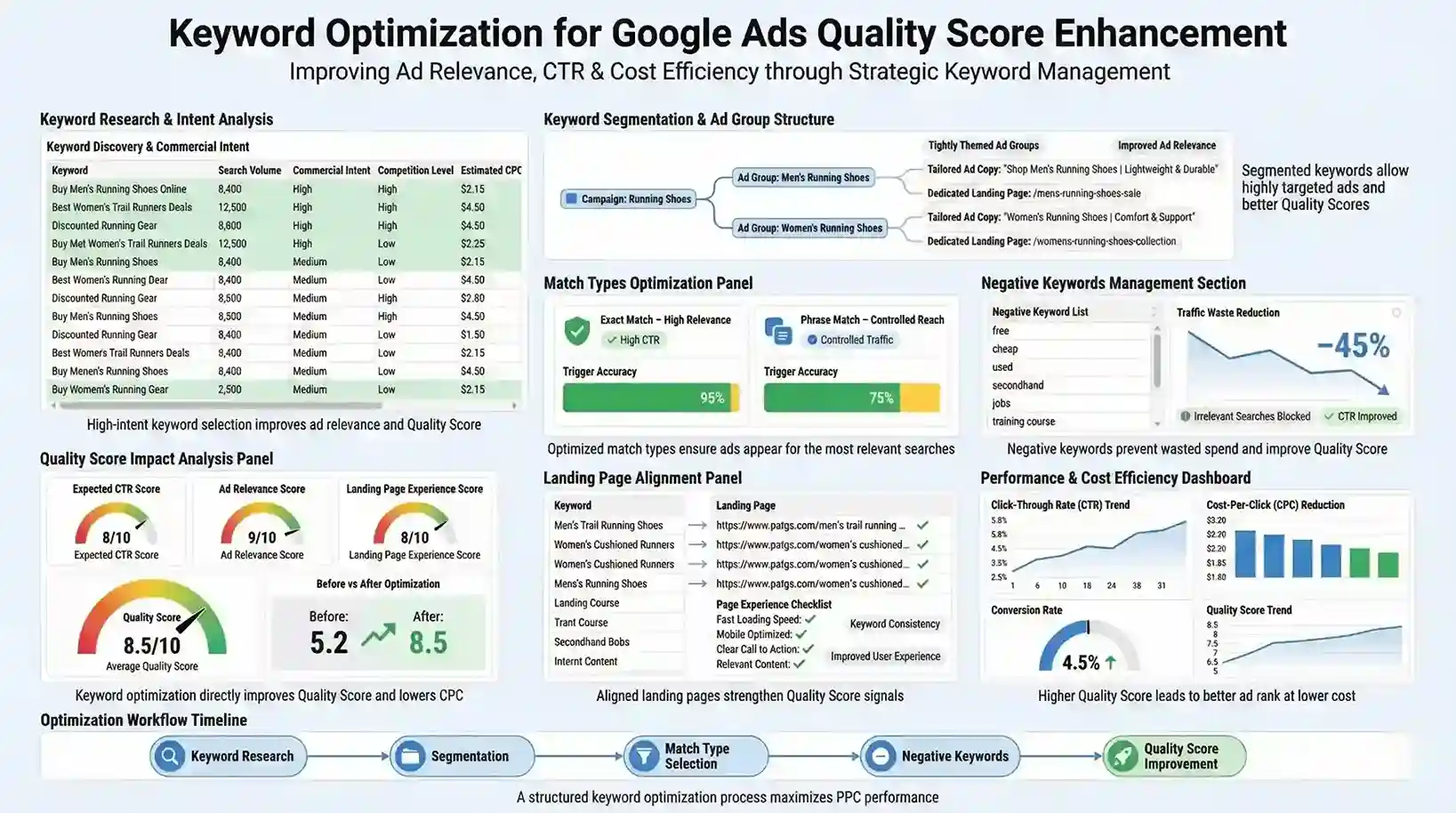
Robust keyword research is crucial for targeting high-intent search queries. Tools like Google Keyword Planner assist in identifying keywords with substantial search volume and commercial intent. Segmentation involves grouping tightly related keywords into ad groups; this improves ad relevance and Quality Score.
Example:
Separate ad groups for “men’s running shoes” and “women’s running shoes” allow tailored ad copies and landing pages, improving relevance.
Match Types & Negative Keywords Optimization
Utilizing different match types enables control over ad triggers:
- Exact Match: Delivers high relevance by matching search queries precisely.
- Phrase Match: Triggers when search contains the phrase within the query.
Implementing negative keywords filters out irrelevant traffic, preventing wasted spend and enhancing CTR and Quality Score.
Example:
Adding “free” as a negative keyword for a paid shoe campaign prevents showing ads for free shoes, thereby increasing relevance.
Keyword Grouping for Better Relevance
Organizing keywords into small, focused ad groups ensures that ad copy and landing pages are laser-focused for each group’s intent. This structure leads to higher ad relevance and improved Quality Score.
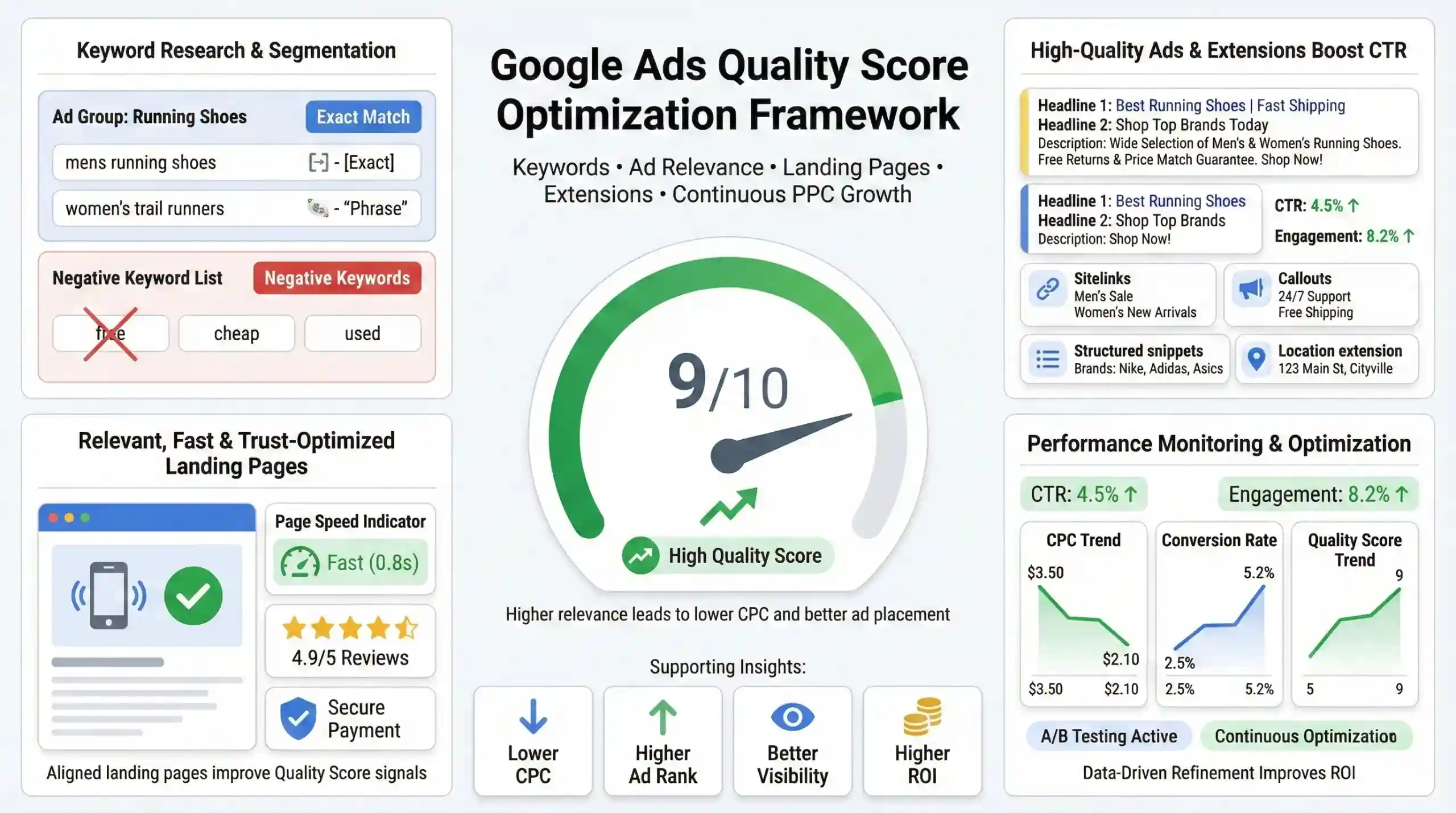
3. Crafting High-Quality Google Ads for Better Performance
Developing Compelling, Keyword-Rich Ad Copy
Effective ad copy should incorporate primary keywords naturally into headlines and descriptions, immediately conveying value propositions. Clear CTAs like “Buy Now,” “Get Started,” or “Learn More” guide user actions. Persuasive language tailored to user intent increases CTR, positively impacting Quality Score.
Maximizing Google’s Ad Extensions for Increased CTR
Extensions expand your ad footprint, offering additional clickable links and information. Using Sitelink Extensions, Callout Extensions, Structured Snippets, and Call Extensions makes your ads more informative and trustworthy, which enhances relevance, CTR, and consequently, Quality Score.
A/B Testing Paid Search Ad Variations
Regular testing of different ad variations helps identify high-performing ads. Analyzing CTR, conversions, and bounce rates allows continuous optimization, refining language, offers, and CTAs—ultimately improving relevance and Quality Score.
4. Landing Page Optimization for Enhanced Quality Score
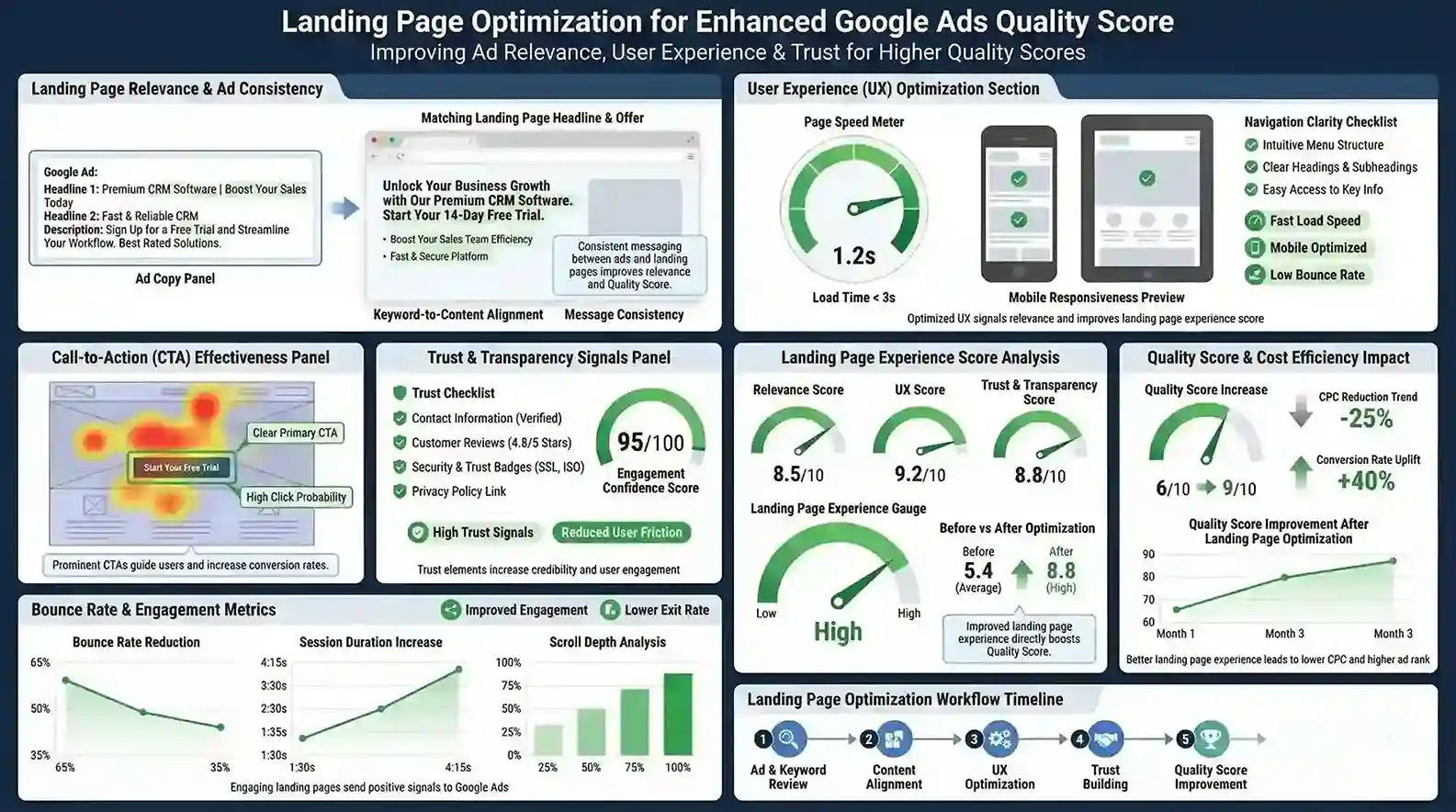
Ensuring Landing Page Relevance & Consistency
Align your landing page content with ad copy and keywords. For example, an ad promising “Free Shipping on Running Shoes” should direct users to a landing page highlighting that offer. Consistency between ad and landing page maintains user trust and improves perceived relevance, which enhances Quality Score.
Improving User Experience (UX)
Optimize page load times to under three seconds, ensure mobile responsiveness, and streamline navigation. Clear, prominent CTA buttons reduce bounce rates, signal relevance to Google, and boost Quality Score.
Building Trust & Transparency
Incorporate contact details, customer reviews, and trust badges. These elements foster credibility, reduce hesitation, and increase user engagement, positively influencing the landing page experience and Quality Score.
5. Utilizing Google Ads Extensions Effectively
Sitelink Extensions
Add links directing users to specific site pages like product categories, promotions, or contact pages. Increased ad real estate enhances visibility and CTR.
Call & Message Extensions
Enable direct communication channels—phones or messaging apps—facilitating quick user engagement and higher interaction rates.
Structured Snippets
Highlight key features, such as “Free Shipping,” “Available in S-XXL,” and “24/7 Support,” to enrich ad information and relevance.
Location Extensions
Show your business’s physical store locations or service areas, crucial for local campaigns, increasing local relevance and ad visibility.
6. Monitoring & Continuous Improvement of Google Ads Quality Score & Extensions Performance
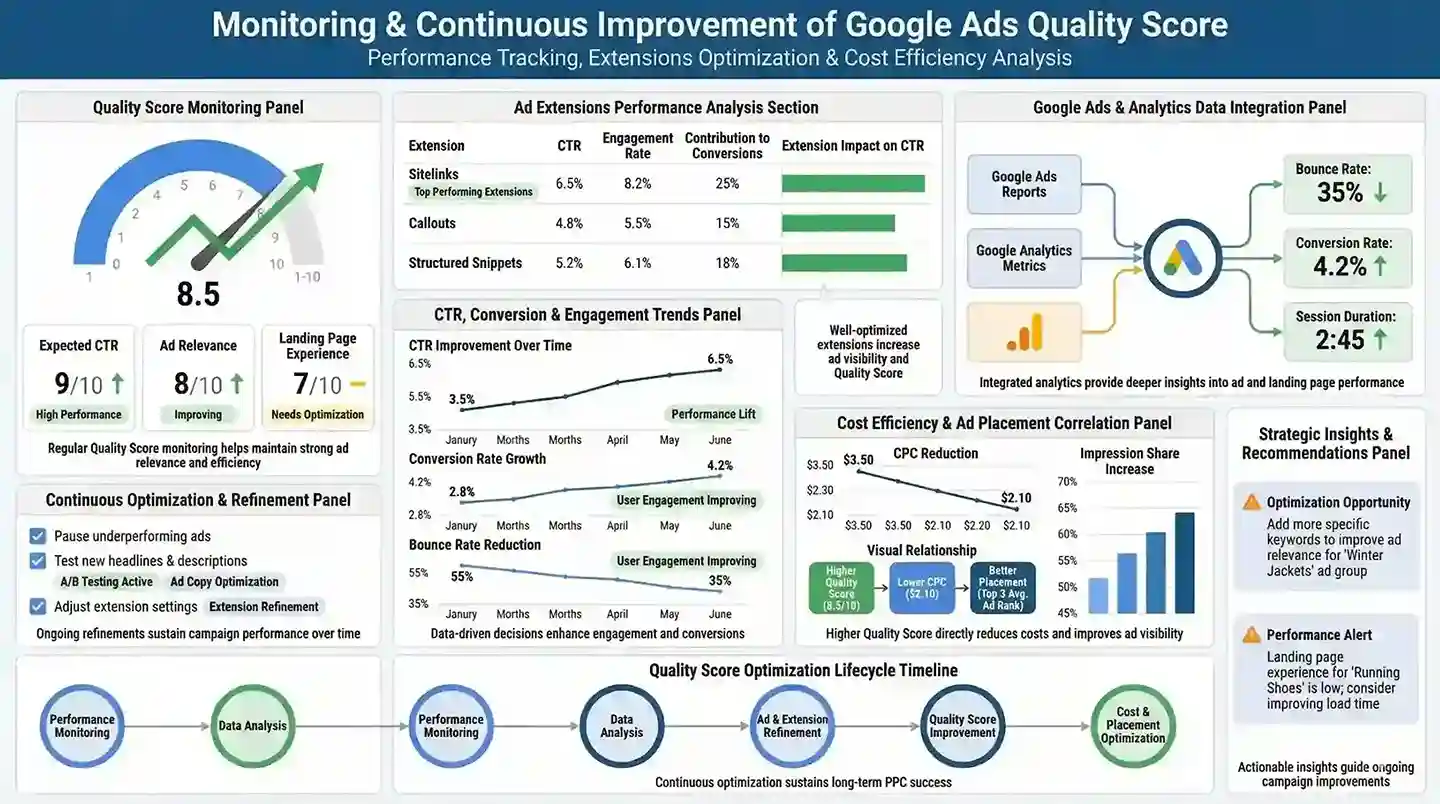
Regular Data Analysis & Performance Tracking
Use Google Ads and Google Analytics reports to assess Quality Score components and extension performance. Focus on CTR, bounce rates, and conversions to identify improvement opportunities.
Refinement Strategies
Eliminate underperforming ads, test new headlines and descriptions, and optimize extension settings. Continuous refinement ensures sustained campaign performance.
Correlating Quality Score with Cost & Placement
Recognize that a higher Quality Score correlates with lower CPCs and better ad placement. Ongoing optimization maintains these advantages and aligns with marketing goals.
7. Advanced Strategies for Continuous Google Ads PPC Growth
Ad Customizers & Dynamic Keyword Insertion
Personalize ads dynamically using customizers or insertion code to tailor messaging based on user behavior or search terms, resulting in increased CTR and improved Quality Score.
Audience Targeting & Remarketing
Target specific segments, such as remarketing lists, to reach users already interested in your offerings. Engaged audiences are more responsive, leading to higher relevance and better ad rankings.
Landing Page Testing & Conversion Rate Optimization
Implement A/B testing on landing pages, varying headlines, layouts, and CTA placements. Higher conversion rates reinforce relevance signals to Google, further influencing your Quality Score positively.
Summary
Achieving an optimal Google Ads Quality Score involves a harmonious balance of keyword relevance, compelling ad copy, strategic use of extensions, and optimized landing pages. Regular monitoring and data-driven refinements are essential for sustained PPC success. Leveraging advanced tactics like ad customizers and remarketing enables long-term growth in ad performance and cost-efficiency.
Prioritize relevance throughout your campaign—from keywords to landing pages—and utilize extensions effectively. Continuous optimization and testing are key to maximizing visibility, lowering CPCs, and enhancing your overall Google Ads ROI.
Practice Questions
- What are the three main components affecting Google Ads Quality Score?
Answer: Expected CTR, Ad Relevance, Landing Page Experience. - How does implementing negative keywords improve your Quality Score?
Answer: It filters out irrelevant search queries, increasing ad relevance and CTR. - Why is aligning landing page content with ad copy important?
Answer: It maintains relevance, builds user trust, and positively influences the Landing Page Experience component of Quality Score. - Name two types of Google Ads extensions and their purpose.
Answer: Sitelink Extensions (direct users to specific pages), Call Extensions (enable direct calls). - What is the benefit of A/B testing in Google Ads campaigns?
Answer: It helps identify high-performing ads, improving CTR and Quality Score through continuous optimization. - Explain how ad customizers can enhance ad relevance.
Answer: They dynamically personalize ad content based on user behavior or search context, increasing relevance and CTR. - What impact does a high Quality Score have on CPC and ad placement?
Answer: It lowers CPCs and results in better ad placement and higher visibility. - Suggest a method to improve the landing page experience for mobile users.
Answer: Ensure mobile responsiveness and fast load times to improve usability and engagement. - How can structured snippets improve your ad performance?
Answer: They offer detailed information about your products/services, making your ad more relevant and enticing. - Why is continuous monitoring essential in Google Ads optimization?
Answer: It enables identification of underperforming areas and supports data-driven refinements for sustained success.
Additional Resources
This educational material offers a comprehensive understanding of Google Ads Quality Score and extensions optimization, empowering learners to develop effective PPC strategies through both theoretical knowledge and practical insights.
Disclaimer: The images and videos used in this blog are for educational and illustrative purposes only. Some visuals may be generated using AI tools, while others are sourced from publicly available platforms. We do not claim ownership of any third-party images or videos. All rights and credits belong to their respective owners.
MORE COURSES
Advance Digital Marketing & SEO course with Gen AI
Advanced Certificate in Digital Design & Marketing course with Gen AI