
Meta pours $10B into Google Cloud

Source: Manuel Orbegozo | Reuters
Meta signs a six year $10B+ deal with Google Cloud for AI infrastructure.
Key Highlights:
- Meta has committed more than $10 billion to Google Cloud services through 2031.
- The investment focuses on AI infrastructure to train and scale Llama models and power new AI-driven features.
- The deal strengthens Google’s challenge to Amazon Web Services and Microsoft Azure in the cloud market.
What’s Happening:
Meta has reportedly agreed to spend over $10 billion on Google Cloud over the next six years, primarily to support its growing AI ambitions. The partnership centers on large-scale compute for training and deploying Llama models, as well as expanding AI capabilities across Meta’s apps and services.
While Meta already uses Amazon and Microsoft for cloud infrastructure, the scale of its AI workloads has made a multi-cloud strategy necessary. For Google, landing Meta as a major customer is a significant win as it works to gain ground against the dominant cloud providers.
Why This Matters:
Just a couple of years ago, Google was widely criticized after Bard’s uneven debut. Now, it’s not only back in the AI race—it’s providing foundational infrastructure to companies that also compete with it at the AI model level.
Securing Meta’s $10B+ commitment highlights the maturity of Google’s TPU-based AI stack and shows it can compete with NVIDIA at scale, while simultaneously pulling cloud revenue from rivals like Meta and OpenAI. It’s a clear signal that Google Cloud is no longer playing defense—it’s actively reshaping the balance of power in AI infrastructure.
AI Psychosis Concerns
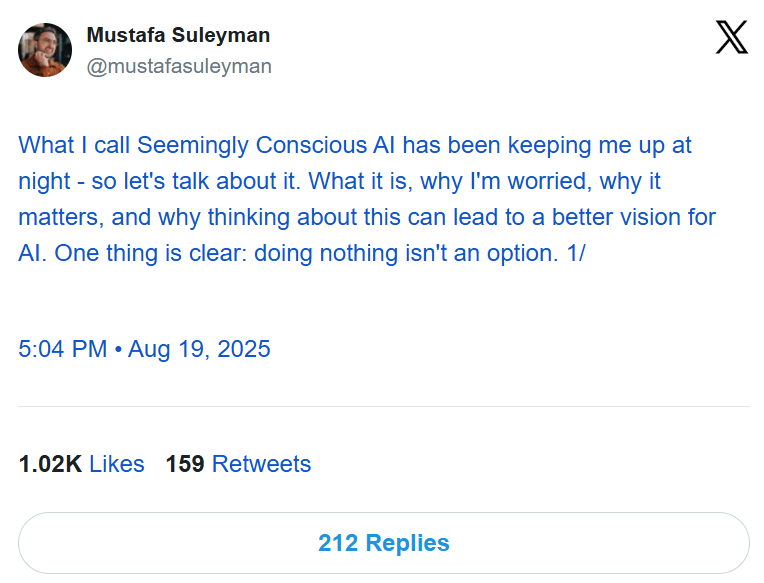
Microsoft’s Mustafa Suleyman warns of a rise in people experiencing “AI psychosis.”
Key Highlights:
- A growing number of people are beginning to believe AI chatbots are sentient or possess special powers.
- Some users develop delusions—ranging from thinking an AI is romantically attached to them to expecting life-changing financial rewards.
- Experts caution that AI may affect mental health in ways similar to social media.
What’s Happening:
According to Microsoft’s AI chief Mustafa Suleyman, reports of what he calls “AI psychosis” are becoming increasingly concerning. In these cases, users begin to treat tools like ChatGPT and Claude as conscious entities rather than software systems.
Documented examples include users believing an AI is in love with them, seeing it as a divine or all-knowing presence, or expecting massive financial outcomes based on chatbot interactions. Mental health professionals warn that these beliefs can detach users from reality. Some doctors suggest that AI usage may eventually be included in routine health screenings—similar to questions about alcohol, smoking, or social media use. Researchers compare the trend to the early psychological impacts of social platforms before safeguards were widely understood.
Why This Matters:
AI isn’t conscious—but it can feel that way. And that illusion can be powerful enough to distort thinking, especially for vulnerable users. Suleyman warns that presenting chatbots with human-like personalities or implied awareness increases the risk of obsession, delusion, and emotional harm.
As AI becomes more conversational and embedded in daily life, how these systems are framed matters. Clear boundaries, honest design, and better user education may be just as important as technical advances in preventing unintended mental health consequences.
AI on the Sidelines
Microsoft is putting Copilot on NFL sidelines to shape playcalling and game analysis.
Key Points:
- Microsoft has extended its partnership with the NFL, adding AI-driven capabilities.
- Copilot now helps filter plays, analyze situations, and organize team data in real time.
- More than 2,500 Surface Copilot+ PCs are being deployed league-wide.
What’s Happening:
Microsoft and the NFL are renewing their long-running collaboration, this time putting AI at the center of game-day decision-making. Coaches and analysts will use GitHub Copilot to surface relevant play options based on live game conditions, while Microsoft 365 Copilot helps booth staff process and organize large volumes of game data.
Over 2,500 Surface Copilot+ PCs will roll out across all teams, integrating directly with the league’s Sideline Viewing System. Beyond gameplay, the tools will also support scouting, finance, HR, and other front-office functions, extending AI use well past the field.
Why This Matters:
On the sideline, coaches gain a fast, searchable playbook—able to surface play families by down, distance, and coverage in seconds. In the booth, analysts reduce manual spreadsheet work with Copilot-powered dashboards. Front offices bring the same AI stack into scouting, draft prep, and daily operations.
With Copilot+ PCs embedded across all 32 teams, this moves from experimental tech to a league-wide workflow shift. It also raises new expectations: better prompt design, clearer tracking of AI-assisted decisions, and potentially more data-driven scrutiny during postgame analysis and officiating debates. AI isn’t just supporting football anymore—it’s becoming part of how the league operates.
All logos, trademarks, and brand images used in this blog are the property of their respective owners. They are used here for informational and educational purposes only. We do not claim any ownership or affiliation with these brands.