OpenAI announces jobs platform
OpenAI is building an AI-driven hiring service to rival LinkedIn.
Key Highlights:
- OpenAI plans to launch an AI-driven hiring platform in 2026, positioning it as a direct competitor to LinkedIn..
- The platform will connect employers with candidates and offer AI fluency certifications as proof of skills..
- Walmart is an early partner, with a goal to help certify 10 million Americans by 2030.
What’s Happening:
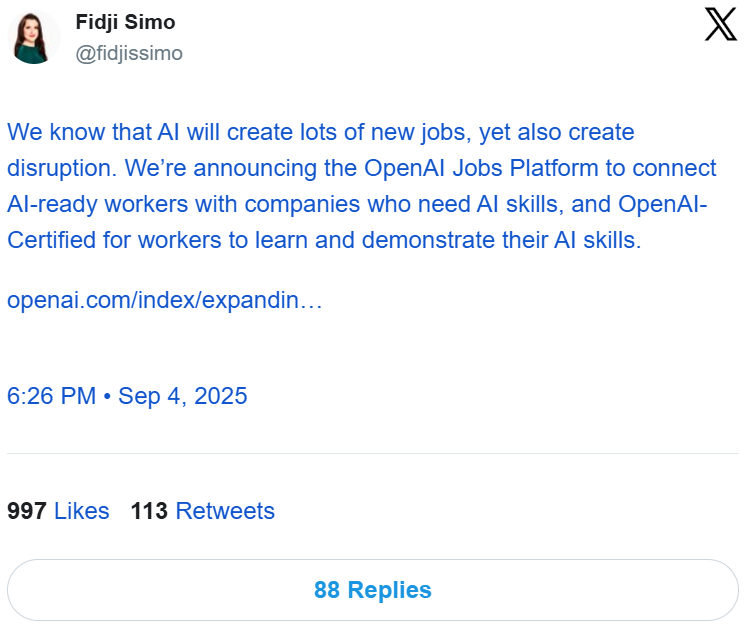
OpenAI is developing the OpenAI Jobs Platform, expected to debut in mid-2026. The service will use AI to match companies with workers more effectively than traditional résumé-based systems. Led by Fidji Simo, the initiative will also support small businesses and local governments, expanding hiring access beyond big tech hubs.
A key component is OpenAI Academy, which will issue certifications focused on AI literacy and applied skills. These credentials are designed to live inside ChatGPT, giving employers clearer signals of real capability rather than keyword-optimized CVs. The move puts OpenAI in direct competition with Microsoft-owned LinkedIn, which has been adding AI features to its own hiring tools.
Why This Matters:
For hiring teams, this introduces a new recruiting channel centered on verified, skills-based credentials instead of résumé screening. Employers get faster, more reliable filters, while candidates gain portable certifications that signal readiness for AI-powered work.
With partners like Walmart aiming to certify millions of workers, these badges could become a common hiring standard. HR leaders, startups, and even city governments can begin planning job roles, upskilling programs, and workflows around AI fluency well ahead of the 2026 launch. The shift suggests hiring is moving away from networks and keywords—and toward measurable, AI-validated skills.
Warner Bros sues Midjourney

Source: Warner Bros. Discovery
Warner Bros is taking Midjourney to court over alleged mass copyright infringement.
Key Highlights:
- Warner Bros. Discovery claims Midjourney creates unlimited, unlicensed images of its characters.
- The lawsuit cites examples involving Superman, Batman, Bugs Bunny, and others.
- Disney and Universal have filed similar suits, increasing pressure on AI image platforms.
What’s Happening:
Warner Bros. Discovery has sued Midjourney, accusing the AI image generator of exploiting its intellectual property by producing unauthorized images—and even videos—of well-known characters such as Superman, Scooby-Doo, Wonder Woman, and Rick and Morty.
According to the complaint, Midjourney can generate infringing content even from broad or indirect prompts like “classic comic book superhero battle,” without users explicitly naming copyrighted characters. Warner Bros. is seeking damages and an injunction that would prevent Midjourney from offering its tools without stronger copyright safeguards.
Why This Matters:
For marketers, designers, and creators using AI-generated images in pitch decks, ads, or merchandise, the legal risk is rising fast. Expect stricter prompt restrictions, heavier content filters, watermarking, and audit trails such as C2PA-style metadata—along with higher costs as platforms move toward paid licenses or tighter controls.
Agencies and brands will need clean asset logs, written IP clearances, and clearer internal rules around AI use. If your workflow touches well-known franchises or characters, the safer path is licensed libraries or fully original designs—or budgeting for takedowns, rework, and delays. The bigger question ahead: does this push the industry toward safer-by-default tools, or toward pay-per-character AI generation?
Google bets on creatives for Flow AI video
Google brings filmmaker Henry Daubrez in-house to shape Flow’s future.
Key Highlights:
- Google has hired filmmaker Henry Daubrez as the first filmmaker in residence for its generative video tool Flow.
- Daubrez will produce original projects, help shape the product, and mentor creatives.
- Flow Sessions will offer filmmakers free access to Flow along with hands-on guidance.
What’s Happening:
Google is deepening its investment in generative AI video by bringing Henry Daubrez on board as Flow’s inaugural filmmaker in residence. Daubrez, best known for the Flow-created short Electric Pink, will work closely with the team to develop new content, influence Flow’s creative direction, and lead mentorship programs called Flow Sessions.
These sessions are designed to give filmmakers real-world experience with the tool, pairing free access to Flow with direct guidance from a creator who has already shipped finished work using it. The move comes as competition in AI video heats up, with rivals like Meta and OpenAI also courting professional creators.
Why This Matters:
Flow Sessions give filmmakers more than demos—they offer real production time with a mentor who understands both storytelling and the tool’s limits. That helps turn experiments into usable outputs like pitch trailers, animatics, branded shorts, and fast previsualization, especially for teams working with tight budgets.
Google is backing this access with visible proof points, including a growing library of Flow-made shorts and collaborations such as Primordial Soup, linked to Darren Aronofsky. With interactive projects like The Enchanted Door in the pipeline, Flow is positioning itself as a faster, cheaper way to test story ideas, iterate, and share concepts with stakeholders—exactly the kind of workflow indie filmmakers and agencies are looking for right now.