Introduction to Google Ads & Pay-Per-Click (PPC) Advertising
Google Ads is an online advertising platform that allows businesses to create and display ads on Google’s search engine results pages (SERPs), YouTube, and partner sites. Pay-Per-Click (PPC) advertising is a model where advertisers pay only when users click on their ads, making it a cost-effective method for targeted marketing. Within the broader scope of Search Engine Marketing (SEM), Google Ads facilitates the promotion of websites, products, or services through precisely targeted paid advertisements, thereby increasing online visibility.
Real-World Example:
A local bakery employs Google Ads to appear at the top of search results when users search for “best bakery near me.” This targeted paid strategy enhances local brand awareness and foot traffic, directly translating into increased sales.
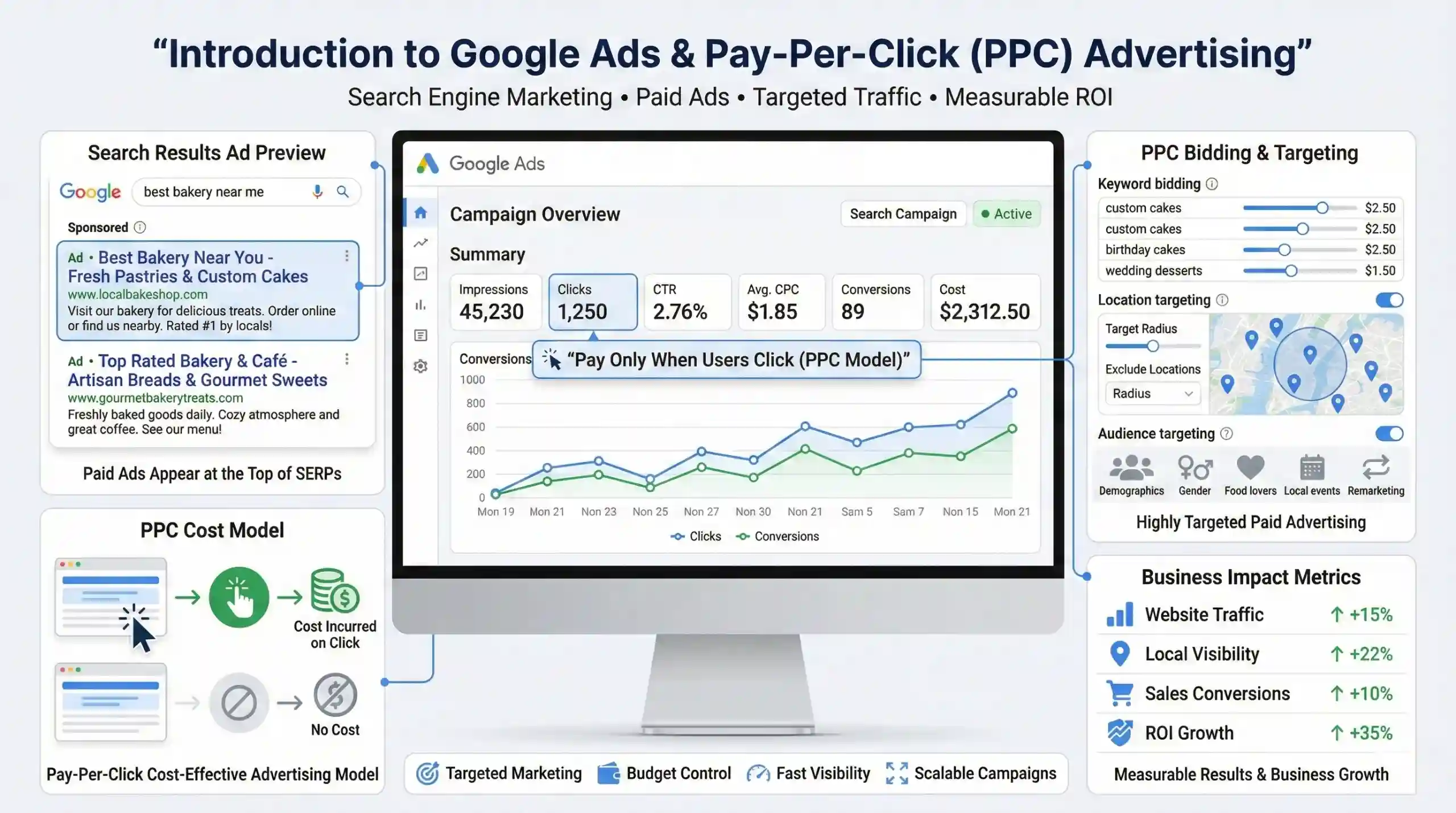
- What is the fundamental principle behind PPC advertising? Answer: Advertisers pay only when users click on their ads, making it a pay-per-user engagement model.
- How does Google Ads contribute to SEM strategies? Answer: It allows precise targeting of potential customers through paid ads on Google search results and partner sites, boosting search engine visibility.
Keyword Research & SEO Keyword Strategy Development
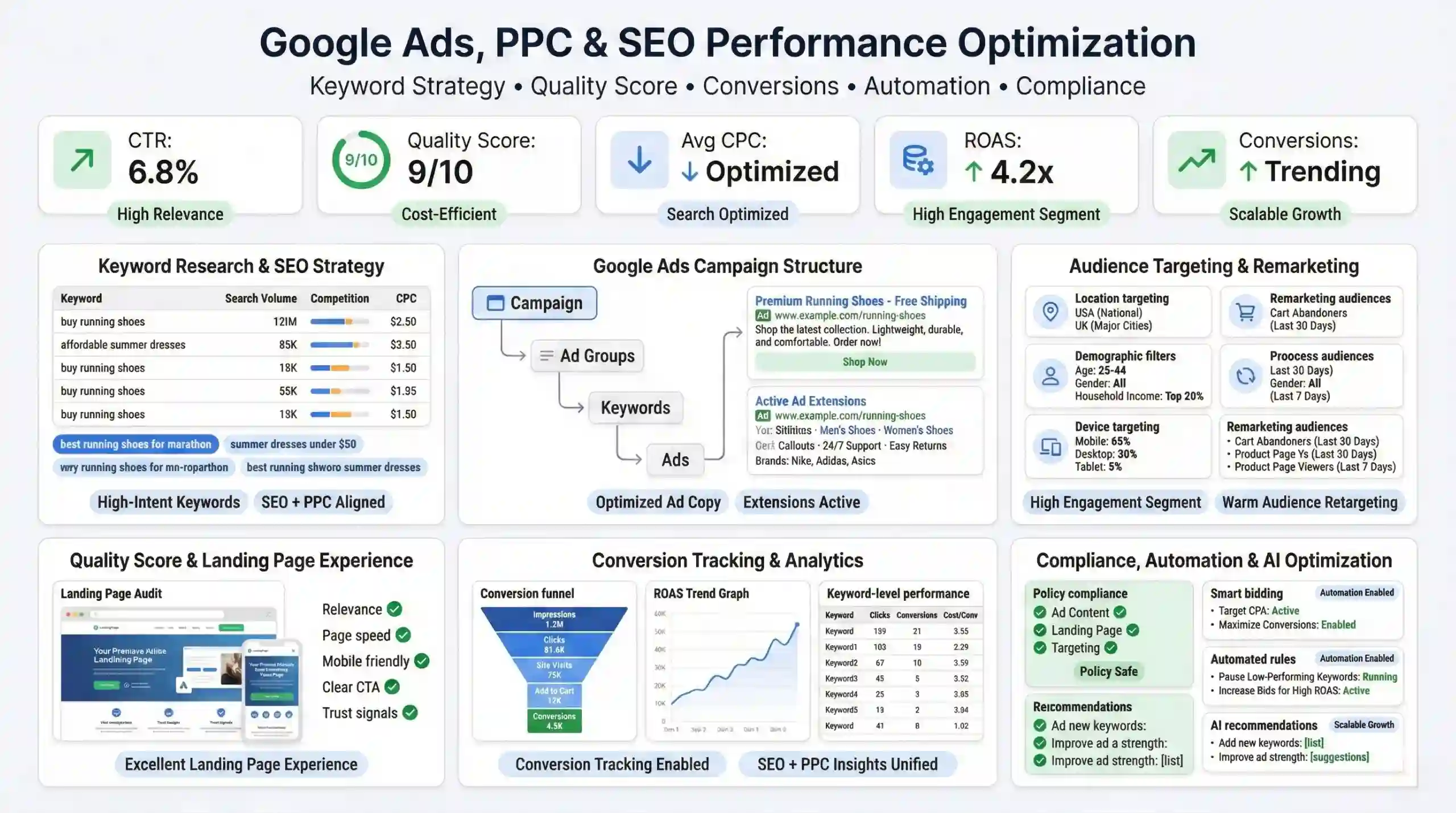
Successful PPC campaigns hinge on meticulous keyword research. Google Keyword Planner and similar tools help identify high-search-volume, relevant keywords aligned with SEO strategies. Essential focus areas include long-tail keywords, which are more specific and less competitive, and analyzing search volume to prioritize keywords that attract traffic efficiently. Competitor keyword analysis provides insights into what terms competitors are bidding on, enabling strategic adjustments.
Real-World Example:
An online clothing retailer conducts keyword research and uncovers that “affordable summer dresses” has high search volume with low competition. Incorporating this long-tail keyword into PPC campaigns improves ad relevance and reduces CPC.
- Why are long-tail keywords advantageous in PPC advertising? Answer: They are more specific, tend to have lower competition, and attract highly targeted traffic, leading to higher conversion rates.
- Which tools can assist in SEO keyword strategy development? Answer: Google Keyword Planner, SEMrush, Ahrefs, and Moz.
- How does competitor keyword analysis enhance PPC campaigns? Answer: It reveals keywords competitors are bidding for, allowing you to identify gaps and opportunities to optimize your own keyword targeting.
Account Structure & Campaign Setup for SEO & PPC
An organized Google Ads account structure enhances campaign efficiency and manageability. It typically comprises campaigns aligned with specific marketing goals or target markets, with each campaign containing multiple ad groups centered on thematic keyword themes. Keywords within ad groups should directly correlate with associated landing pages and SEO strategies.
Effective segmentation—by target audience, geographical location, or product category—ensures relevant ad delivery, improves Quality Score, and boosts landing page performance, reinforcing SEO benefits.
Real-World Example:
A software company creates separate campaigns for “B2B software solutions” and “consumer software,” with ad groups targeting specific products or industry sectors, ensuring precise advertising and audience relevance.
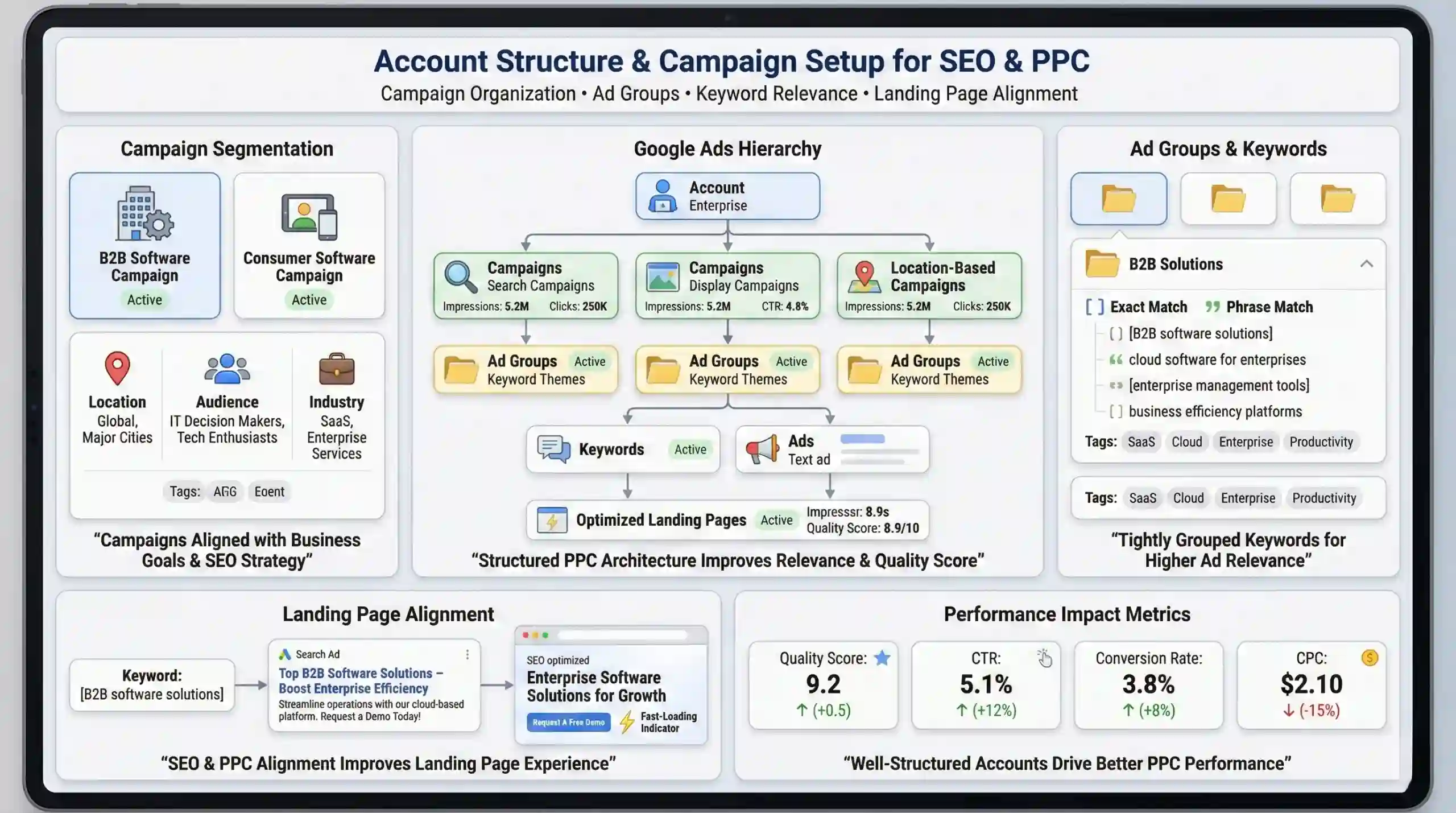
- Describe a good practice for structuring Google Ads campaigns for SEO synergy. Answer: Segment campaigns by target audience, location, or product, with tightly themed ad groups tied to specific keywords and SEO landing pages.
- Why is account organization important in PPC advertising? Answer: It simplifies management, improves relevance, enhances Quality Score, and allows for targeted performance analysis.
Ad Copywriting & SEO-Friendly Google Ads Content
Compelling ad copy is central to increasing click-through rates (CTR). Incorporating targeted SEO keywords naturally into the ad headlines and description lines improves ad relevancy for both users and Google’s algorithms. Strong calls-to-action (CTAs), such as “Shop Now,” “Learn More,” or “Get a Free Quote,” motivate user engagement.
Ad extensions—sitelines, callouts, structured snippets—further improve ad visibility and relevance. Well-optimized ad extensions contribute to higher Quality Scores and better ad placements, reinforcing SEO efforts.
Real-World Example:
An online course platform creates an ad with the headline “Learn SEO Strategies” and includes sitelinks to free resources, blog content, and sign-up pages, increasing CTR and conversions.
- Why is integrating SEO keywords into ad copy beneficial? Answer: It increases ad relevancy, improves Quality Score, and attracts highly targeted traffic.
- Name two types of ad extensions useful in PPC campaigns. Answer: Sitelinks and callouts.
- What role does a call-to-action (CTA) play in ad copy? Answer: It encourages users to take immediate action, increasing CTR and conversions.
Targeting Options & Audience Segmentation Strategies
Google Ads offers diverse targeting options, including location targeting (geographical areas), demographic targeting (age, gender, income), device targeting, and remarketing. These options enable advertisers to deliver highly relevant ads aligned with SEO and user intent.
Audience segmentation involves categorizing users based on behavior, interests, or engagement level, enabling personalized ad experiences. Such strategies enhance ad relevance, improve Quality Score, and foster better alignment with SEO search intent.
Real-World Example:
A travel agency targets users in specific regions planning to vacation, with banner ads tailored for mobile users showing booking incentives, leading to increased engagement and conversions.
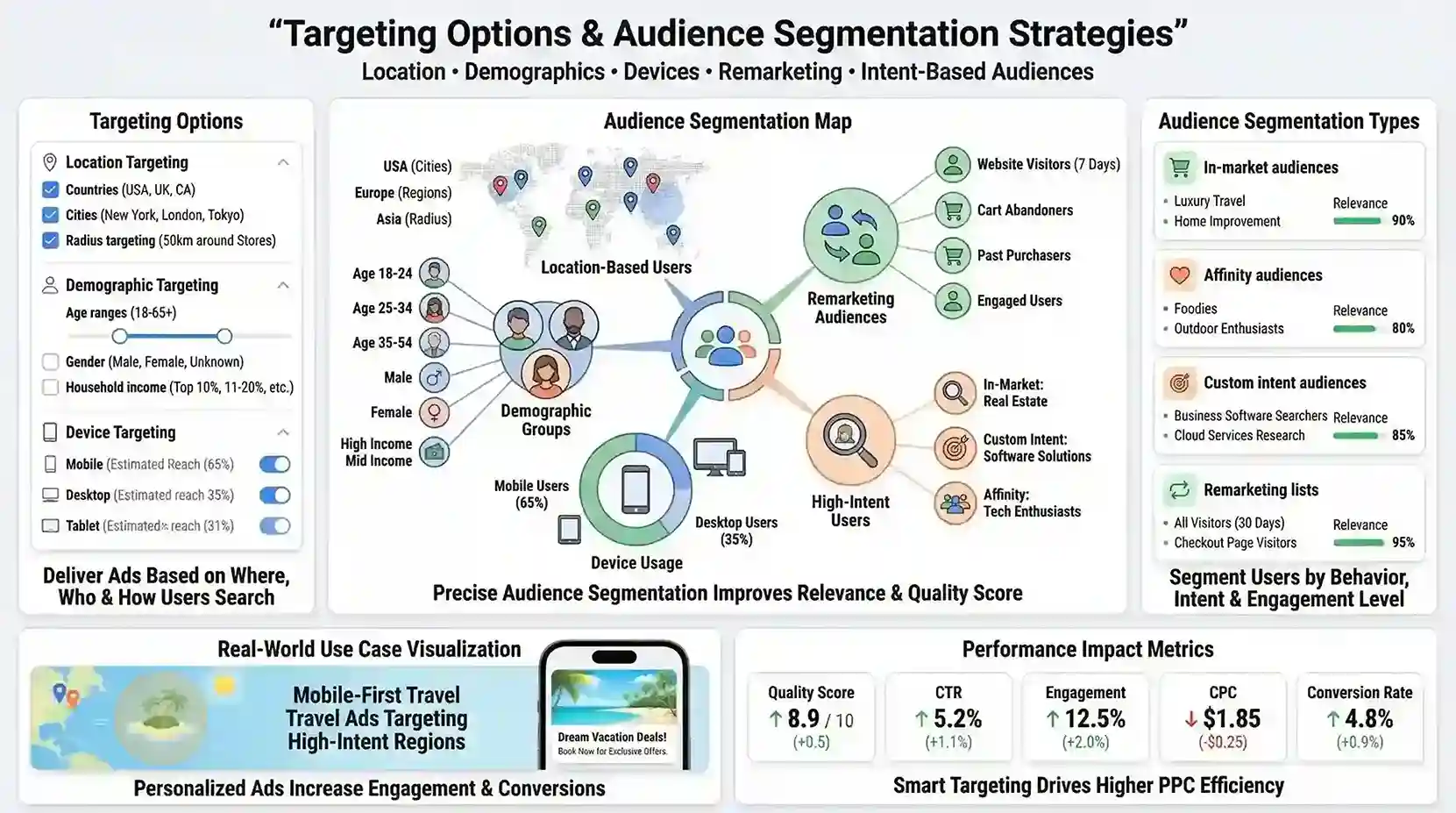
- What is the benefit of remarketing in Google Ads campaigns? Answer: It re-engages users who previously visited your site, increasing likelihood of conversions.
- How does audience segmentation improve PPC campaigns? Answer: It allows tailored messaging, improving relevance, user engagement, and ad performance.
- Which targeting options help local businesses optimize visibility? Answer: Location targeting and local audience targeting.
Bidding Strategies & Budget Optimization for SEO Campaigns
Choosing the right bidding strategy is crucial for campaign efficiency. Cost-per-click (CPC) bidding is manual or automated, allowing control over individual keyword bids. Cost-per-acquisition (CPA) bidding focuses on conversions, optimizing for individual user actions, while ROAS (Return on Ad Spend) bidding seeks to maximize revenue relative to ad spend.
Adjusting bids based on keyword performance, ad rank, and SEO competition ensures effective allocation of budget, optimally balancing cost and visibility.
Real-World Example:
An e-commerce store shifts to ROAS bidding to focus on revenue generation, increasing profitability while maintaining ad exposure for high-converting keywords.
- What is ROAS bidding and why is it useful? Answer: It focuses on maximizing return on ad spend, aligning bids with revenue-generating keywords.
- How can bid adjustments improve campaign efficiency? Answer: By allocating higher bids to high-performing keywords and reducing bids on underperformers, optimizing ROI.
Quality Score & Ad Relevancy Optimization for SEO Impact
Google’s Quality Score evaluates ad relevance, expected CTR, and landing page experience, directly influencing ad rank and CPC. An optimized landing page with SEO keywords enhances user experience and signals relevance to Google, improving Quality Score.
Ensuring ad copy mirrors landing page content, aligns with user search intent, and offers fast load times are critical for elevating Quality Score, which benefits both PPC and SEO visibility.
Real-World Example:
A health supplements site optimizes landing pages with SEO keywords like “natural vitamin supplements,” leading to higher ad rankings and lower CPC.
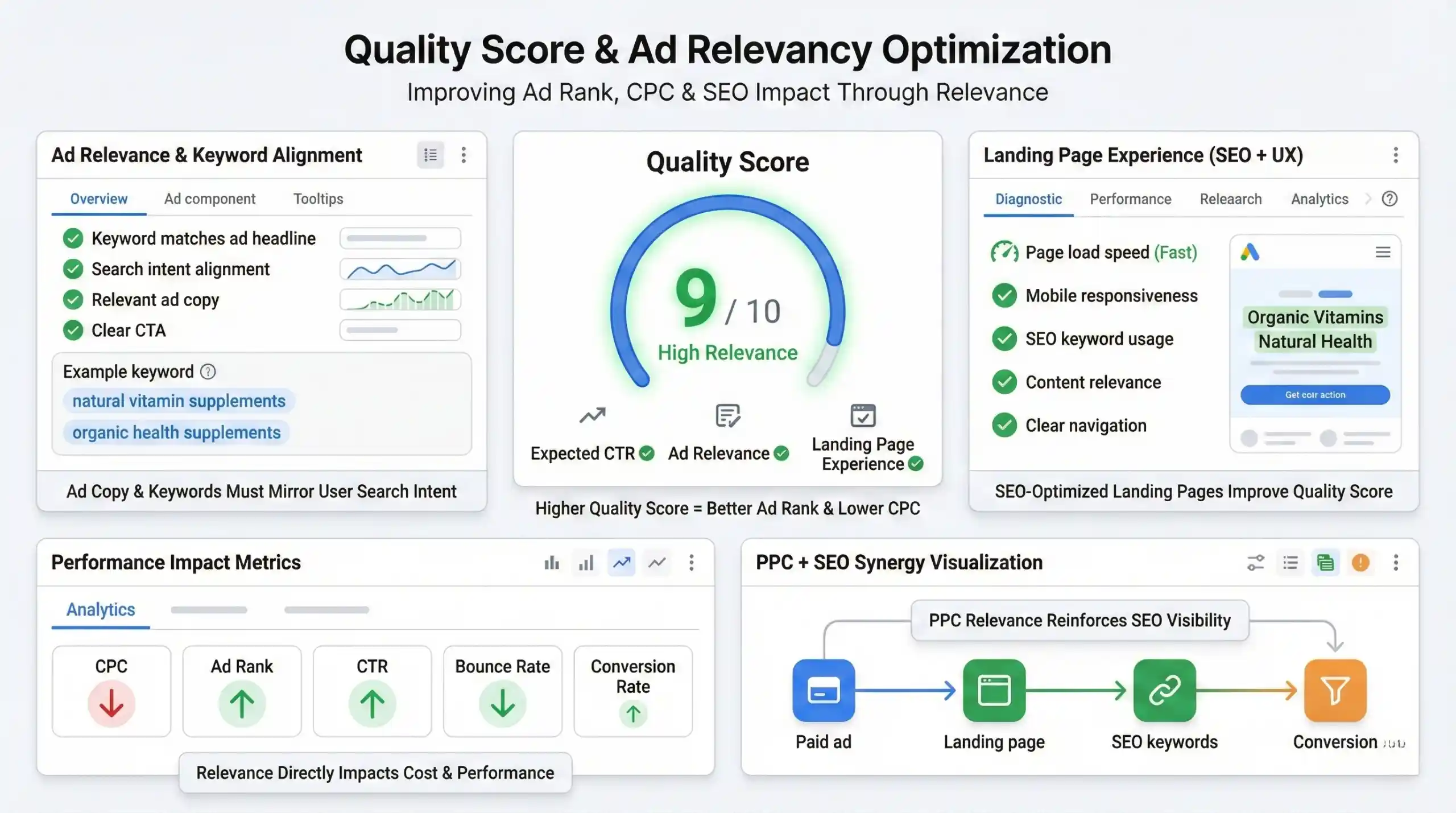
- What three components influence Google’s Quality Score? Answer: Ad relevance, expected CTR, and landing page experience.
- How does SEO-friendly landing page design impact Quality Score? Answer: It improves relevance and user experience, leading to higher Quality Scores and better ad placement.
Conversion Tracking & Analytics for PPC & SEO Metrics
Setting up Google Ads conversion tracking and linking with Google Analytics allows measurement of key actions—purchases, sign-ups, or downloads—stemming from ad campaigns. Analyzing user behavior and conversion funnels provides insight into the effectiveness of specific keywords and ad copy.
Data-driven optimization involves refining keyword targeting, ad content, and landing pages to increase ROAS and improve SEO keyword performance.
- Why is conversion tracking essential in PPC advertising? Answer: It measures the effectiveness of campaigns, informing optimization and ROI calculations.
- How can data insights improve SEO and PPC integration? Answer: By identifying high-converting keywords and optimizing both paid and organic strategies accordingly.
Remarketing & Audience Campaigns for Increased Conversions
Remarketing tactics involve serving ads to users who have previously visited a website, increasing brand recall and conversion chances. Custom audiences can be built based on user interactions, search intent, or SEO-related behavior, creating personalized advertising experiences that align with user needs.
Real-World Example:
A fashion ecommerce site uses remarketing ads showing personalized product recommendations to visitors who viewed specific categories, resulting in higher conversion rates.
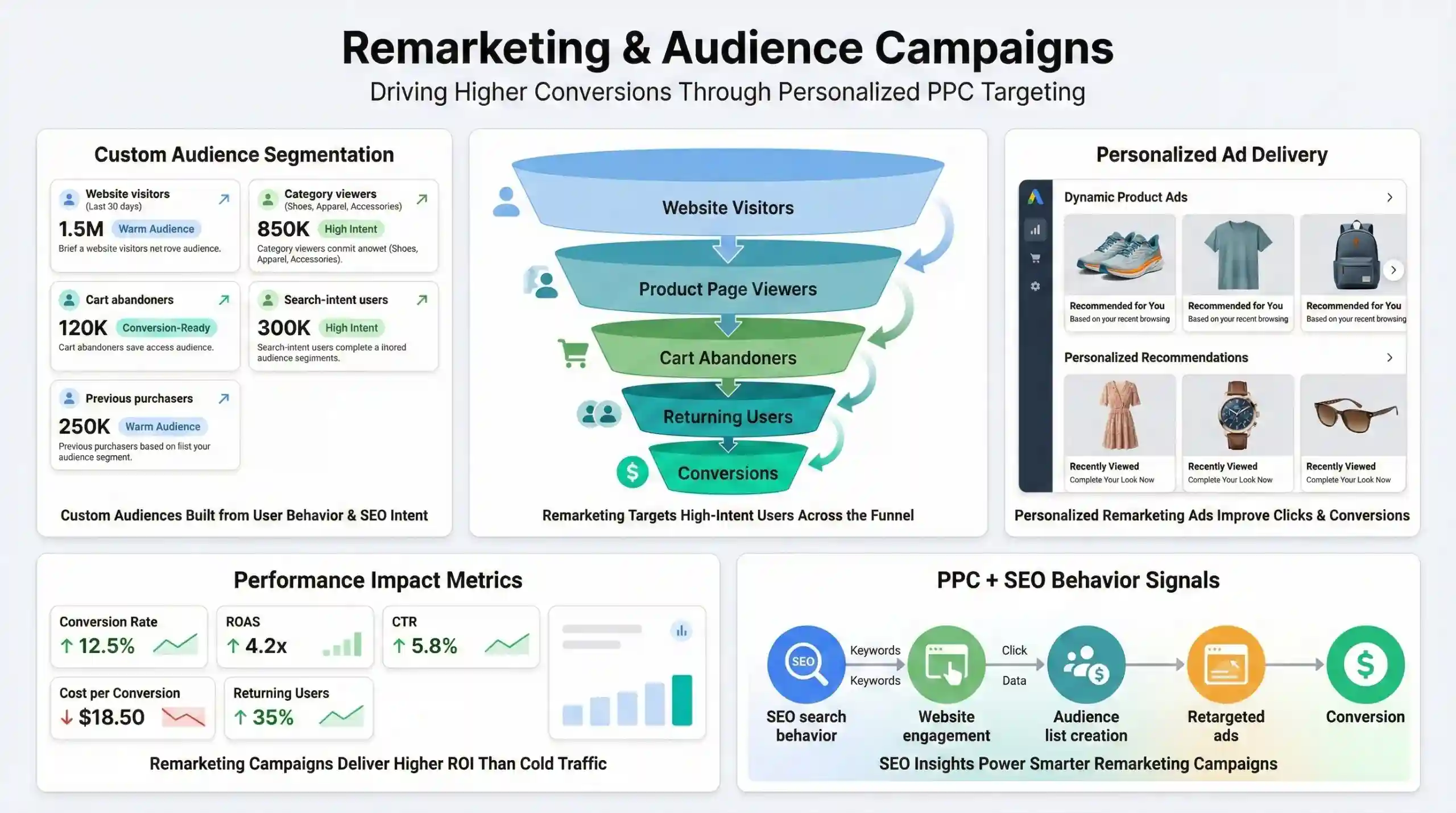
- What is the primary benefit of remarketing campaigns? Answer: They re-engage warm audiences, increasing the likelihood of conversions.
- How does audience personalization influence PPC success? Answer: It enhances ad relevance and aligns messaging with user intent, improving engagement.
Campaign Optimization & A/B Testing for Continuous Improvement
A/B testing involves comparing two or more ad copies, landing pages, or bidding strategies to identify the most effective variant. Regularly reviewing performance metrics—such as CTR, conversion rate, and Quality Score—guides iterative improvements, optimizing the overall campaign success.
Data analysis uncovers insights into which SEO keyword strategies resonate best with audiences, enabling continuous refinement.
- Why is A/B testing important in PPC campaigns? Answer: It helps identify the most effective ad elements, leading to higher performance.
- List key metrics to monitor for campaign optimization. Answer: CTR, conversion rate, Quality Score, bounce rate, and CPC.
Compliance & Best Practices in Google Ads & SEO
Adhering to Google Ads policies and SEO best practices ensures long-term campaign sustainability. Avoiding prohibited content, misleading claims, and ensuring landing pages meet quality standards prevent disapproval and account suspension. Staying updated on industry trends and Google algorithm changes is vital for maintaining compliance.
Real-World Example:
A legal services firm regularly reviews Google’s advertising policies to ensure their ads and landing pages remain compliant, avoiding disapproval and maintaining ad visibility.
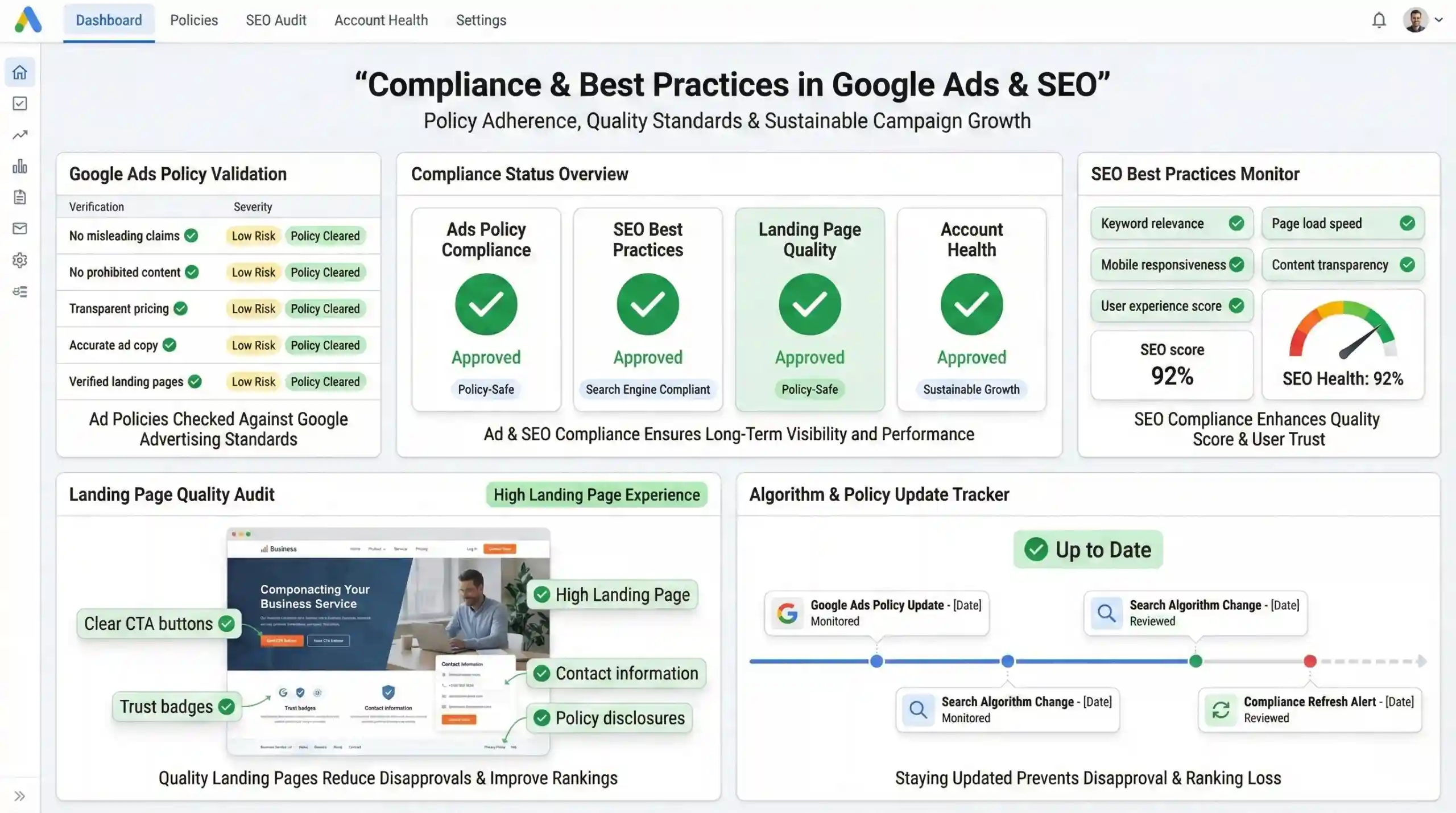
- Why is policy compliance essential in Google Ads management? Answer: It ensures ads are approved, avoids suspension, and maintains campaign continuity.
- How does SEO best practice relate to Google Ads? Answer: Ensuring landing pages are relevant, fast, and informative improves Quality Score and organic rankings.
Advanced Strategies & Automation Tools for PPC & SEO Growth
Automating routine tasks—through Google Ads scripts, smart bidding, and automation tools—enables scalable management of campaigns. Integrating SEO strategies with PPC, such as using SEO insights for keyword selection, enhances overall online visibility.
Emerging AI-powered tools can optimize bids, generate ad variations, and predict user behavior, ensuring a competitive edge in digital marketing.
Real-World Example:
A digital marketing agency deploys Google Ads scripts to automatically pause low-performing keywords and adjust bids based on time of day, maximizing ROI.
- What are the benefits of automation in PPC campaign management? Answer: Increased efficiency, scalability, and real-time optimization.
- How can integrating SEO and PPC strategies benefit overall digital marketing? Answer: It creates cohesive messaging, improves organic and paid visibility, and maximizes ROI.
Resources for Further Study
Conclusion
Mastering Google Ads involves understanding the interconnected aspects of keyword research, campaign structuring, ad copy optimization, audience targeting, bidding strategies, and analytics. When combined with SEO principles—such as keyword relevance, landing page optimization, and compliance—it creates a powerful synergy that boosts search engine visibility and ensures high return on investment. Continuous learning, testing, and adaptation are essential to stay ahead in the dynamic landscape of PPC advertising and SEM success.
Disclaimer: The images and videos used in this blog are for educational and illustrative purposes only. Some visuals may be generated using AI tools, while others are sourced from publicly available platforms. We do not claim ownership of any third-party images or videos. All rights and credits belong to their respective owners.
MORE COURSES
Advanced Certificate in Digital Design & Marketing course with Gen AI
How to Analyze Your Competitors’ Backlink Strategies to Improve Your SEO
Understanding Inbound Links and Why They Matter in Off-Page SEO