

If you want your website to rank higher, load faster, and give users a smooth experience, then understanding Core Web Vitals and page speed is extremely important. Whether you are learning through a Technical SEO training course, gaining skills in an advanced digital marketing course, studying at digital marketing training courses, preparing through a digital marketing full course, or learning practically at a Performance SEO institute, mastering Core Web Vitals and speed optimization is a must for strong SEO performance.
⭐ What Are Core Web Vitals?
Core Web Vitals are a set of performance metrics introduced by Google to measure user experience quality.
They focus on how fast your website loads, how stable it is, and how smooth user interaction feels.
Core Web Vitals are not just technical values.
They show how comfortable your users feel on your website.
If your website performs well in Core Web Vitals, Google rewards it with better rankings.
Why Core Web Vitals Matter for SEO?
Good Core Web Vitals help in:
➡️Better Google rankings
➡️Better user experience
➡️Lower bounce rate
➡️Higher engagement
➡️More conversions
That is why trainers emphasize them strongly in every Technical SEO training course.
The Three Core Web Vitals
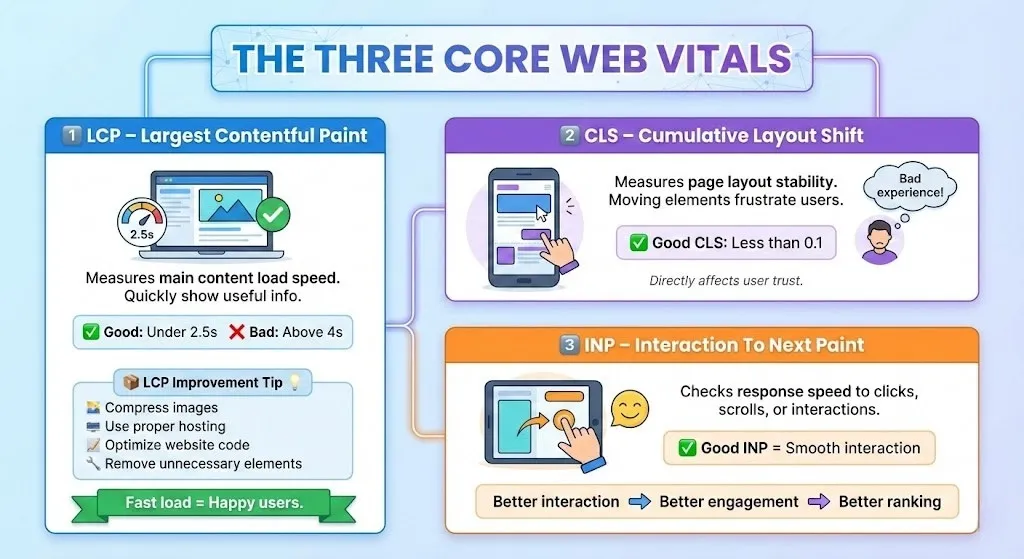
1️⃣ LCP – Largest Contentful Paint
This measures how fast the main content of your page loads.
Simply, it checks how quickly users can see useful information.
✔ Good: Under 2.5 seconds
❌ Bad: Above 4 seconds
If the page loads slow, users leave early.
LCP Improvement Tip
To improve LCP:
- Compress images
- Optimize website code
- Use proper hosting
- Remove unnecessary elements
Fast load = Happy users.
2️⃣ CLS – Cumulative Layout Shift
CLS measures how stable your page layout is.
If elements keep moving while loading, users get frustrated.
Example:
You try to click a button
Page shifts
You click something wrong
Bad experience!
✔ Good CLS: Less than 0.1
This is deeply explained in every advanced digital marketing course because it directly affects user trust.
3️⃣ INP – Interaction To Next Paint
INP checks how quickly your website responds when users click, scroll, or interact.
If your site feels slow and unresponsive, users leave.
✔ Good INP = Smooth interaction
Better interaction = Better engagement = Better ranking.
💡 Real Life Example 1
A business website had great content and design, but the website was slow and unstable.
Problems:
- Slow loading
- Layout shifting
- Delayed clicks
Users left quickly.
Rankings dropped.
After guidance from digital marketing training courses, they:
- Optimized speed
- Fixed layout
- Improved performance
Results?
- Better ranking
- More traffic
- Higher engagement
Core Web Vitals made a big difference.
🧠 Page Speed – The Heart of Web Performance
Page speed means how quickly your website loads.
Google clearly prefers fast websites.
Slow website = Lost users
Fast website = More trust + Better ranking
This is why speed optimization is taught deeply in every digital marketing full course.
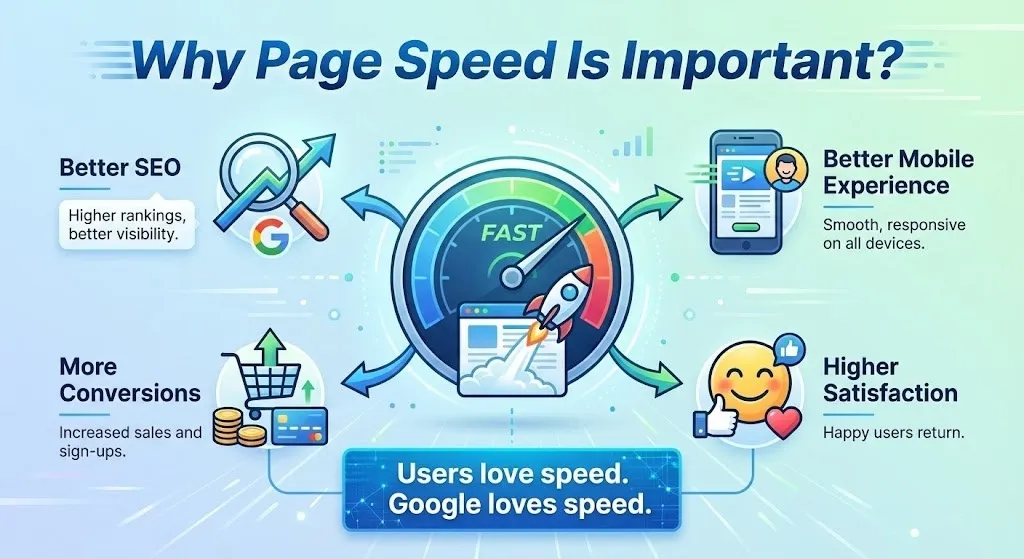
🚀 Why Page Speed Is Important?
A fast website helps in:
- Better SEO
- Better mobile experience
- More conversions
- Higher satisfaction
Users love speed. Google loves speed.
📊 Core Web Vitals & Speed Summary Table
| Metric | Meaning | Good Value |
| LCP | Main content loading | < 2.5 sec |
| CLS | Layout stability | < 0.1 |
| INP | Interaction smoothness | Responsive |
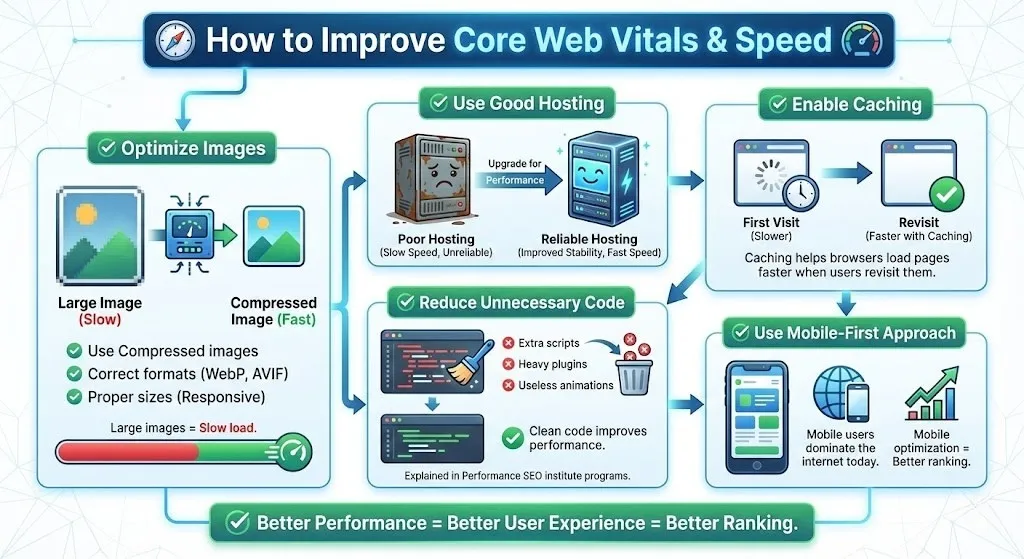
🧭 How to Improve Core Web Vitals & Speed
✔ Optimize Images
Use:
- Compressed images
- Correct formats
- Proper sizes
Large images = Slow load.
✔ Use Good Hosting
Poor hosting leads to slow speed.
Reliable hosting improves stability.
✔ Reduce Unnecessary Code
Remove:
- Extra scripts
- Heavy plugins
- Useless animations
Clean code improves performance.
This is explained in every Performance SEO institute program.
✔ Enable Caching
Caching helps browsers load pages faster when users revisit them.
✔ Use Mobile-First Approach
Mobile users dominate the internet today.
Mobile optimization = Better ranking.
💡 Real Life Example 2
A digital marketing website was full of heavy images, animations, and scripts.
Looks great.
But…
It took 9 seconds to load.
Users left before seeing anything.
After learning speed techniques from an advanced digital marketing course, they:
- Reduced image size
- Removed heavy scripts
- Simplified design
Result?
Website speed improved
Ranking improved
Leads increased
Speed helped business growth.
Performance Improvement
To improve performance
- Focus on speed
- Improve stability
- Ensure smooth interaction
Good performance = Powerful SEO.
💬 Real Life Example 3
A blogging website had amazing articles.
But traffic was still low.
Reason?
The site was slow and unstable.
They joined a Technical SEO training course, understood Core Web Vitals, and optimized everything.
Soon:
- Google rankings improved
- Traffic increased
- Reader engagement became strong
Sometimes performance matters more than content alone.
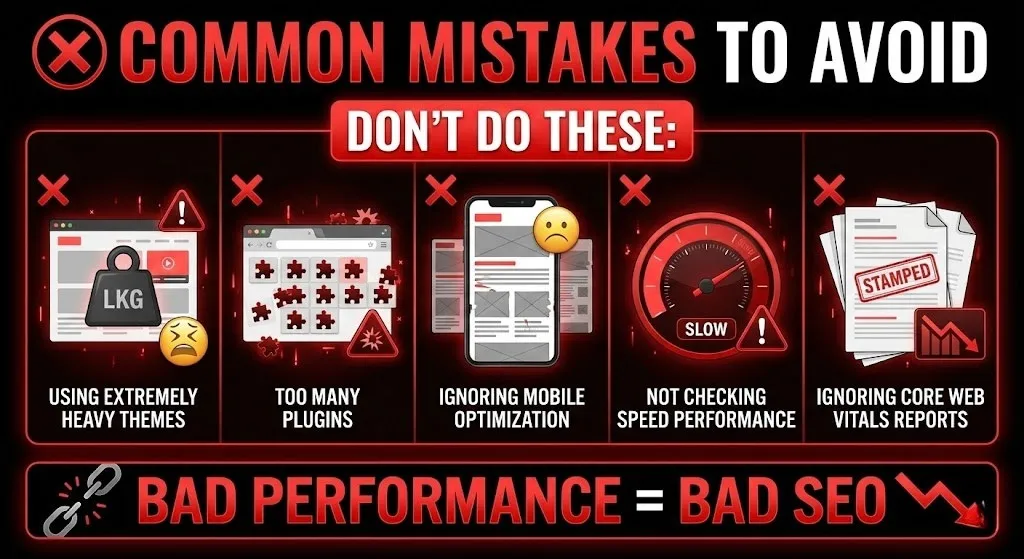
❌ Common Mistakes to Avoid
Don’t do these:
- Using extremely heavy themes
- Too many plugins
- Ignoring mobile optimization
- Not checking speed performance
- Ignoring Core Web Vitals reports
Bad performance = Bad SEO.
🧾 Best Practice Checklist
Use this checklist every time:
✔ Fast loading pages
✔ Stable layout
✔ Smooth interaction
✔ Compressed images
✔ Clean code
✔ Good hosting
✔ Mobile-friendly
✔ Regular performance testing
Follow this and your website will stay powerful in SEO.
🎯 Final Thoughts
Core Web Vitals and page speed are not just technical topics — they directly impact rankings, user experience, and business results.
Whether you learn through a Technical SEO training course, grow with an advanced digital marketing course, study in digital marketing training courses, complete a digital marketing full course, or train through a Performance SEO institute, mastering website performance will always give you a strong advantage.
If your website is fast, stable, mobile-friendly, and user-focused…
Google will reward it.
Users will trust it.
Your business will grow.
Disclaimer: The images and videos used in this blog are for educational and illustrative purposes only. Some visuals may be generated using AI tools, while others are sourced from publicly available platforms. We do not claim ownership of any third-party images or videos. All rights and credits belong to their respective owners.